The Diagnosis of Mineral Deficiencies in Plants by Visual Symptoms
Published by His Majesty's Stationary Office — 1943
— Crown Copyright Reserved —
TOMATOES IN SAND CULTURE — from the 1951 edition
by Thomas Wallace, M.C., D.Sc., A.I.C.
 250. TOMATO PLANT
Nitrogen deficiency
Growth dwarfed, thin and upright habit; stem and petioles rigid;
leaves pale green, occasional purplish tints, older leaves yellowing.
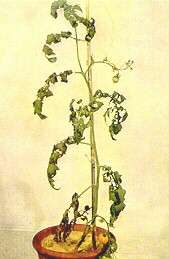 251. TOMATO PLANT
Phosphorus deficiency
Growth dwarfed and thin; leaflets droop, curl backward and develop strong,
dull purple tints.
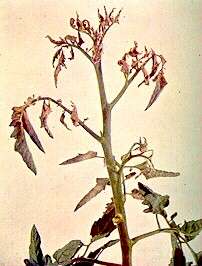 252. TOMATO STEM
Calcium deficiency
Death of growing point and die-back of main stem from tip; die-back of
leaves, progressing from terminal leaflets and of flower and fruiting
trusses.
 253. TOMATO TRUSS
Calcium deficiency
Dying off of terminal leaflets and flowers; leaves purplish brown tinting.
 254. TOMATO TRUSSES — "Blossom End Rot"
Calcium deficiency
Dying back of trusses and "Blossom End Wilt" of distal fruitlets.
(cf. Plate No. 265, boron deficiency)
 255. TOMATO LEAF
Magnesium deficiency
Central intervenal chlorosis and green marginal bands.
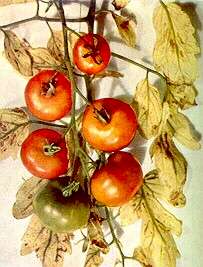 256. TOMATO TRUSS
Magnesium deficiency
Leaves intervenal chlorosis and necrosis; fruits show "Green Back".
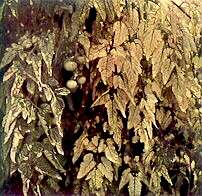 257. TOMATO PLANTS
Magnesium deficiency
Greenhouse view. Leaves intervenal chlorosis and necrosis.
 258. TOMATO LEAF
Potassium deficiency
Leaflets slight marginal and intervenal chlorosis followed by brown marginal
scorching; scorched margins curled foward.
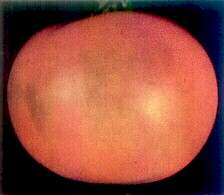 259. TOMATO FRUIT
Potassium deficiency
"Blotchy Ripening"; green and yellow areas merging into red color of surface.
(cf. Plate 260, mosaic fruits)
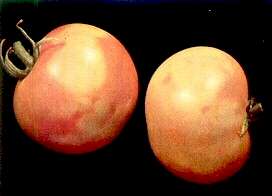 260. TOMATO FRUITS - Tomato "mosaic"
Virus Disease
Virus Disease. Blotchy uneven ripening, similar to "Blotchy Ripening" due
to potassium deficiency but blotchy areas more sharply defined.
(cf. Plate 259, potassium deficiency)
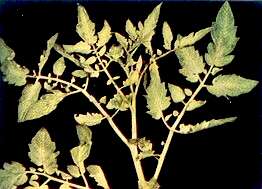 261. TOMATO FOLIAGE
Iron deficiency
Tip leaves, especially basal areas of leaflets, intense chlorotic mottling;
stem near tip also yellow. (cf. Plate 262, manganese deficiency)
 262. TOMATO LEAF
Manganese deficiency
Intervenal chlorotic mottling distributed over entire surfaces of leaflets;
mottled areas become necrotic. (cf. Plate 261, iron deficiency)
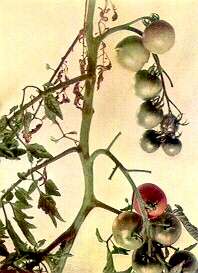 263. TOMATO SHOOT
Manganese toxicity (soil acidity complex)
Stem and petioles, especially nodal areas, necrotic lesions; leaves wither
and hang down.
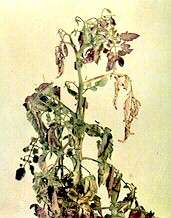 264. TOMATO SHOOT
Boron deficiency
Stems stiff; terminal buds die and growths die back; lateral shoots
developed, giving plant flat top; leaves highly tinted purple, brown and
yellow.
 265. TOMATO FRUITS
Boron deficiency
Fruits pitted and corky areas in skin; ripening uneven.
(cf. Plate 254, calcium deficiency)
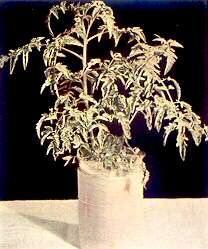 266. TOMATO PLANTS
Molybdenum deficiency
Leaflets somewhat chlorotic, strongly incurled and die back from tips.
 267. TOMATO LEAVES
Molybdenum deficiency
Left: healthy leaf receiving molybdenum. Right: Molybdenum
deficient leaf; leaflets, incurled margins, intervenal chlorotic motting
and death of tips.
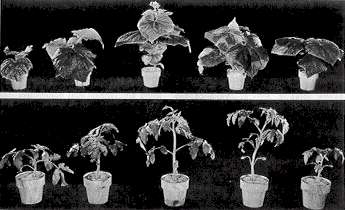 Cucumber plants top, and tomato plants bottom, were grown for 20 days under
controlled environmental conditions. Five different day / night temperatures,
starting from 75° / 65° F. and increasing at 5° intervals to
95° / 85° F. were used in this experiment.
Cucumber plants top, and tomato plants bottom, were grown for 20 days under
controlled environmental conditions. Five different day / night temperatures,
starting from 75° / 65° F. and increasing at 5° intervals to
95° / 85° F. were used in this experiment.
(Note: Both tomatoes and cucumbers like warmer temperatures. Many Plants need lower temperatures for optimum growth.)
| Index | ||
|---|---|---|
|
|
|
|
| Top of Page | ||
Color Pictures of Mineral Defeciencies in Plants – 1943
Using Hydroponics to Understand the Earth's Life Processes
Understanding Colloidal Suspensions
" The Art of Healing Ourselves "
The Diagnosis of Mineral Deficiencies in Plants by Visual Symptoms
by Thomas Wallace, M.C., D.Sc., A.I.C.
on the Atomic Level
The Tortoise Shell Hydroponic Reference Center
Plants need to absorb what you feed them.
Only You can bring Good Health and Healing into Your Body.