The Diagnosis of Mineral Deficiencies in Plants by Visual Symptoms
Published by His Majesty's Stationary Office — 1943
— Crown Copyright Reserved —
POTATO IN SAND CULTURE — from the 1951 edition
by Thomas Wallace, M.C., D.Sc., A.I.C.
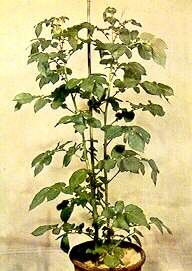 01. Potato Plant in Sand Culture
Complete mineral nutrient
Growth normal; foliage healthy green color.
 02. Potato Plant in Sand Culture
Nitrogen deficiency
Growth severely restricted, few stems; yellowing of older foliage.
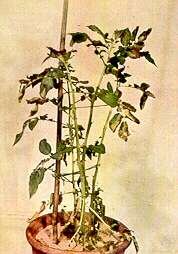 03. Potato Plant in Sand Culture
Phosphorus deficiency
Growth thin, few stems; leaflets marginal scorch, older leaves shed.
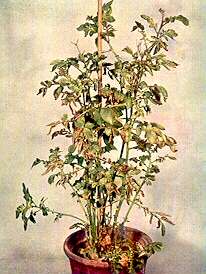 04. Potato Plant in Sand Culture
Calcium deficiency
Growth fairly good; bushy appearance; young leaflets small, slightly
chlorotic, forward roll and marginal scorch. This plant failed to form
tubers of appreciable size. (see
Plate No. 160)
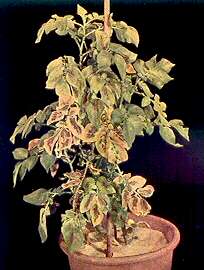 05. Potato Plant in Sand Culture
Magnesium deficiency
Growth fairly normal; foliage slightly pale; older leaflets develop central
necrosis, turn yellow or brown and wither prematurely.
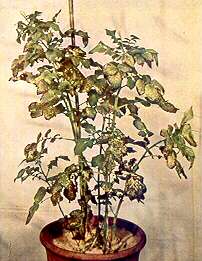 06. Potato Plant in Sand Culture
Potassium deficiency
Growth tends to be squat and bushy; leaflets bluish green and slight
intervenal chlorosis, marginal scorch and brown spots on under surface.
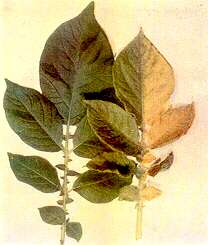 155. Potato Leaves
Nitrogen deficiency
Right: nitrogen deficient leaf, pale green and yellow tinted,
contrasted with left, normal green leaf with ample nitrogen supply.
 156. Potato Leaf
Phosphorus deficiency
Leaflets, lustreless green, marginal scorch and forward curling of
margins. (cf.
Plate No. 164, potassium deficiency)
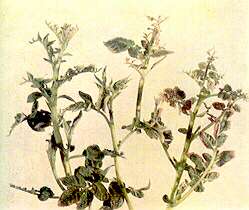 157. Potato Shoots
Calcium deficiency
Acute deficiency condition. Shoots become thin; leaflets of terminal leaves
small, margins chlorotic, incurled and may develop faint pink tints or
necrotic brown spots or scorch; tips of leaflets die.
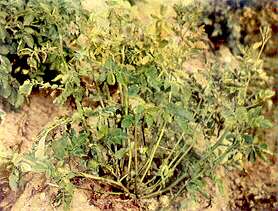 158. Potato Plant
Calcium deficiency
Field plant. Bushy growth habit, thin shoots, small terminal leaves
and scorched leaflets.
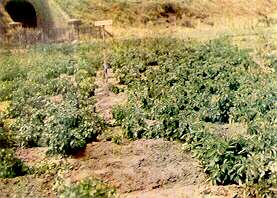 159. Potato Plants
Calcium deficiency
Field view showing calcium deficiency induced by heavy potassic manuring on
acid soil. Left foreground: no potash; plants bushy and squat, due to
potash deficiency; Right foreground: heavy potassic manuring; plants
tall, leaves rolled due to calcium deficiency.
 160. Potato Tubers
Calcium deficiency
Top: calcium omitted, tubers dwarfed and useless; bottom:
complete mineral nutrient, tubers normal.
 161. Potato Leaf
Magnesium deficiency
Central intervenal necrosis pattern.
 162. Potato Plants
Magnesium deficiency
Field view. Leaves pale green, central intervenal chlorosis followed by
necrosis and withering.
 163. Potato Foliage
Potassium deficiency
"Bronzing" due to brown spotting, and scorching of leaves.
 164. Potato Leaf
Potassium deficiency
Leaflets bluish green, slight intervenal chlorosis and backward curling
of margins; intervenal spotting, marginal scorching. (cf.
Plate No. 156, phosphorus deficiency)
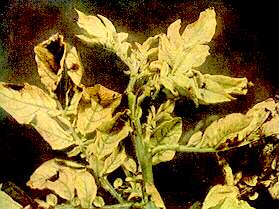 165. Potato Foliage
Iron deficiency
Young leaver strongly chlorotic; veins may remain green; margins and
tips brown patches.
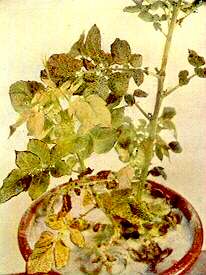 166. Potato Plant
Iron and Potassium deficiencies
Young leaves chlorotic due to iron deficiency; older leaves brown spotting
and scorch due to potassium deficiency.
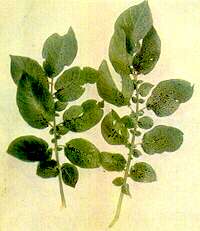 167. Potato Leaves
Manganese deficiency
Leaves from near tips of shoots still green, but showing characteristic brown
spotting, mainly along veins.
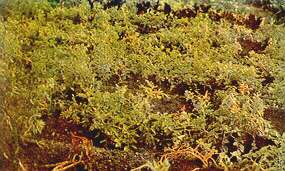 168. Potato Plants
Manganese deficiency
Field view. Stunted growth and dying of haulm at tips; leaflets of young
leaves small, slightly chlorotic and strong forward curling of margins.
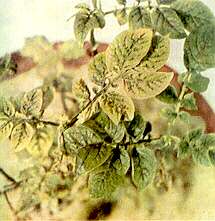 169. Potato Plant
Manganese toxicity (soil acidity complex)
Severe toxicity. Necrotic lesions on leaves, mainly along veins and on
petioles and stems.
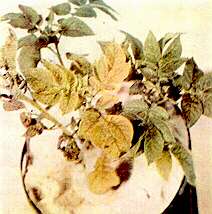 170. Potato Plant
Boron deficiency
Growth stunted; growing point killed; leaves dull grayish green,
changing to yellow before dying off.
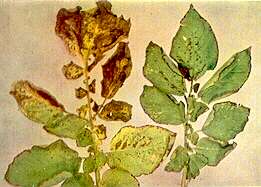 171. Potato Leaves
Boron toxicity and magnesium deficiency
Boron toxicity shown by narrow brown rims on leaflets;
magnesium deficiency by intervenal necrosis and withering.
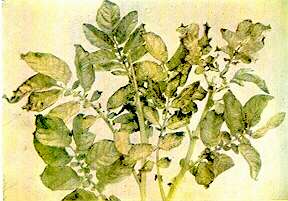 172. Potato Foliage
Chloride injury
Leaflets of terminal leaves slightly chlorotic, margins scorched and
turned forward.
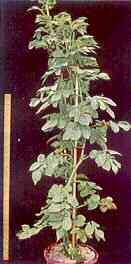 1. Complete Nutrient Solution — Healthy growth.
Potato Plant in Sand Culture
Growth Normal; foliage healthy green color.
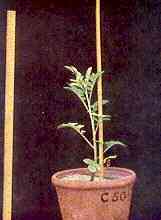 2. Nitrogen Deficiency — Severely restricted growth, upright habit.
Potato Plant in Sand Culture
Growth small and single thin shoots; upright habit; leaves pale green color.
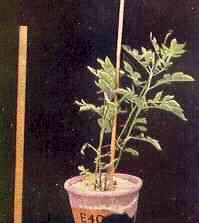 3. Phosphorus Deficiency — Restricted growth, leaves rolled forward.
Potato Plant in Sand Culture
Growth small and shoots thin; upright habit; leaves slightly pale, with
forward roll and scorched margins; defoliation of oldest leaves.
 4. Calcium Deficiency — Tip leaves small, rolled and scorched.
Potato Plant in Sand Culture
Growth fairly good; young leaves chlorotic, forward roll and marginal
scorch. This plant failed to form tubers of appreciable size.
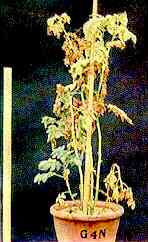 5. Magnesium Deficiency — Chlorosis and necrosis of leaves,
defoliation.
5. Magnesium Deficiency — Chlorosis and necrosis of leaves,
defoliation.
Potato Plant in Sand Culture
Growth fairly good; foliage chlorotic and with intervenal necrosis; death
of older foliage and severe defoliation.
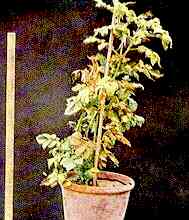 6. Potassium Deficiency — Marginal leaf scorch.
Potato Plant in Sand Culture
Growth fairly good; leaves bluish-green and intervenal chlorosis, spotting
and marginal scorch present.
| Index | ||
|---|---|---|
|
|
|
|
| Top of Page | ||
Color Pictures of Mineral Defeciencies in Plants – 1943
Using Hydroponics to Understand the Earth's Life Processes
Understanding Colloidal Suspensions
" The Art of Healing Ourselves "
The Diagnosis of Mineral Deficiencies in Plants by Visual Symptoms
by Thomas Wallace, M.C., D.Sc., A.I.C.
on the Atomic Level
The Tortoise Shell Hydroponic Reference Center
Plants need to absorb what you feed them.
Only You can bring Good Health and Healing into Your Body.