|
Using Hydroponics
— Follow the Tortoise —
|

|
|---|
to
Understand the Earth's Life Processes
on the Atomic Level.
Make this window Top Frame, and resize my windows for Your viewing Pleasure, and ...
Listen to "Tommy Talk Radio" on Hydroponics in either
Windows Media {wma}
or
Quick Time & Real Player {mp3}
Trace Elements are Critical
for ...
the surface life, on planet earth. Life that is powered by sunlight. Some
of the most important players in this dance of life, are the Chlorophyll Proteins. These groupings of atoms have an arrangement in their structure, which resonates to a specific frequency of sunlight. This resonating structure has the power to energize the electron orbitals of the
carbon dioxide and water molecules. The result is that, the carbon and oxygen atoms change dance partners. These new joinings are at a higher energy levels and thus, contain stored energy.
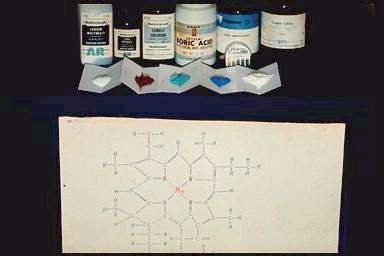
The Chlorophyll proteins, have only
one atom of magnesium, surrounded by four
amino acid units, and have a long carbon chain tail. The tail has a special
radical that performs the protein's function. ( It is like a single size,
socket wrench that turns in only one direction. )
The Chlorophylls
The amount of chlorophyll
(A) {C55H72O5N4Mg}, in plants,
is roughly three times that of chlorophyll
(B) {C55H70O6N4Mg}.
" Just The Facts "
Hemoglobin
( The oxygen carrying protein in red blood cells. )
(C738 H1166 Fe N203 O208 S2)4
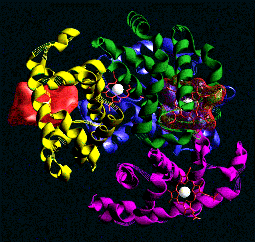
Molecular Weight — 68,000
One Hemoglobin Molecule is comprised of 9,268 atoms.
Four of these atoms are Iron.
Iron accounts for ...
0.043% of the total atomic count.
0.32% of the total molecular weight.
3285.294 ppm of Hemoglobin.
Very Small Quantities, of Some Atoms, are Required by Life Processes.
One Enzyme can perform 2,000,000 reactions per minute
All Enzymes are Proteins
The Magnesium Protein Collects Solar Energy.
An Iron Protein Carries Oxygen in our bodies.
The Chrome Protein Manufactures Insulin.
The Selenium Protein Manufactures A.T.P.
Please Find more and E-mail me.

There are many different proteins busy doing their work inside the cell
nucleus.
Each protein does only one job. Each is unique. If one protein fails to
perform its function, then the whole chain of growth is broken.
The Cell's inner workings are an assembly line; a chain of step processes.
When Everything is Adjusted "Just Right" ...
You get Quite Remarkable Results ! ! !
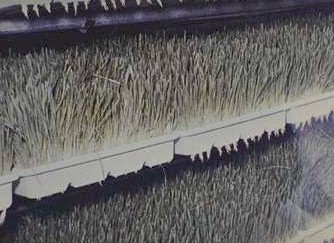
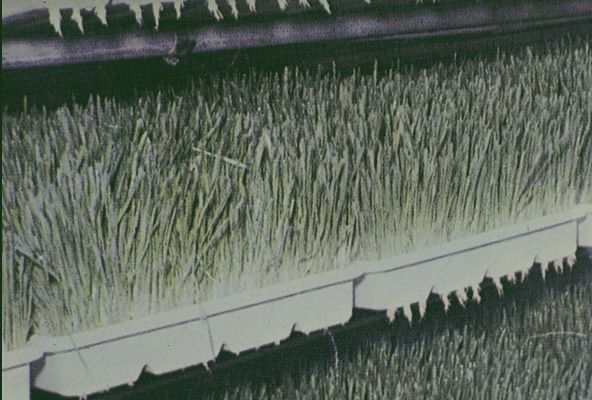
Seven Pounds of rye grass from a pound of seed in Seven Days !!!
Constant light,
24 hr. a day, and a sprayed hydro-solution. No soil or root medium is used.
Both the shoots and roots are used as a feed supplement, for live–stock
and poultry, yielding remarkable health and production results.
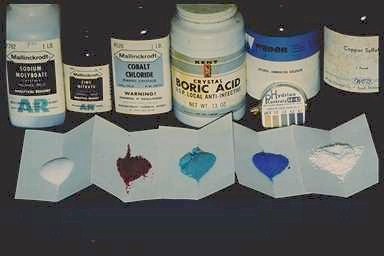
The salts need to be very pure and very soluble in water, and stable
in solution when all the 22+ salts are dissolved and mixed together.
Each salt is weighed and mixed separately in a "unit" of "high resistance
water".
(Very Very Pure Water!).
Some salts may require a day or more to completely dissolve. Dilutions will
need to be made to increase the accuracy of your scale.
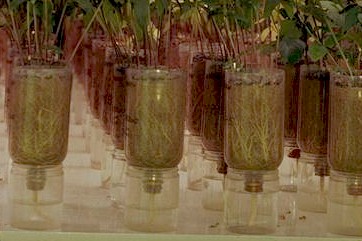
It is critical, that the plant roots get enough oxygen and carbon dioxide.
Here, the plants are watered using a lamp wick, extending up through the sand
medium. "Top watering" is done only once at the time of transplanting.
The plant root will penetrate the growth medium, only to the extent that
it can still assimilate oxygen. Oxygen then, is the limiting factor
determining how deep the plant root will penetrate the soil in search of
nutrients and water.
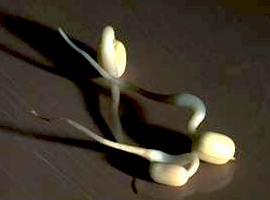
Real Research
Seeds are germinated and selected for uniformity.
Sprouts about this size are selected for the experiment. They are then
inoculated with nitrogen fixing bacteria.
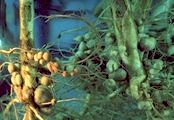
The bacteria then attach themselves to the roots of the legumes, forming
tumors called nodules. If there is a happy symbiotic relationship, the
nodules, when broken open will be pink. If the inside is gray, rather than
pink, then the bacteria is more of a parasite than a symbiont.
The medium must have the correct amount of Molybdenum in order for the
bacteria to create their nodule homes.
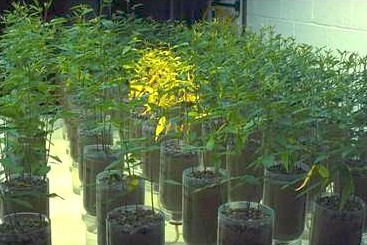
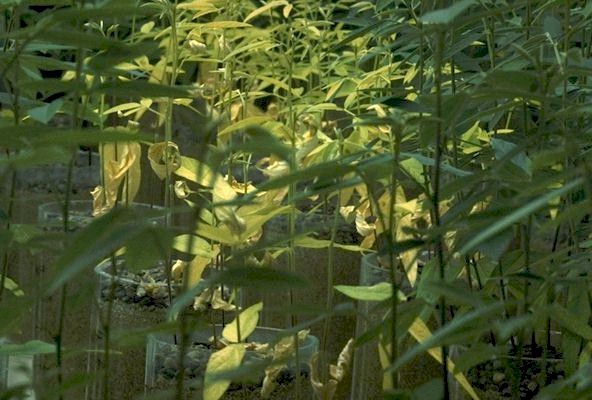
Seven Days growth from sprouts.
The yellow plants in the center are the controls.
This solution
has the basic elements for growth with the exception
of nitrogen. All nitrogen these plants receive, comes from the
nitrogen-fixing bacteria.

Each new hybrid that is created is tested to determine the best bacteria
species for the nitrogen fixing process.
Take a
Slide Show Tour
of the Factory.
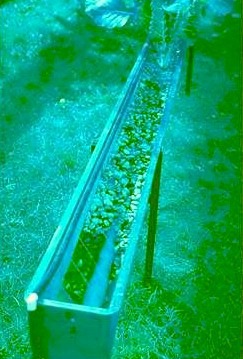
Close to being a Good System
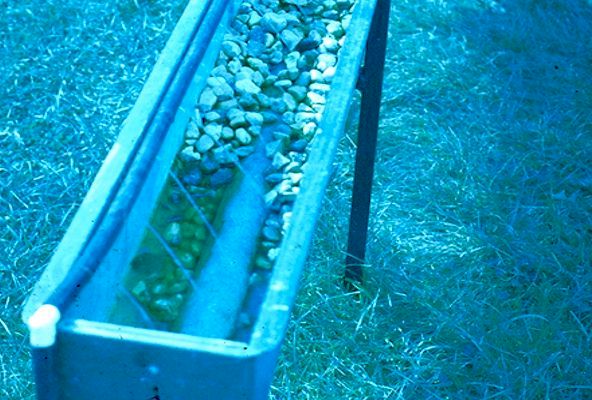
These 20-foot trays were raised above the lawn high enough for a lawn mower
to pass under. This also made the system wheel chair accessible. The plumbing
was underground and the system for the most part was very productive.
The bad news was, the trays needed to be a reflective color. The roots
over–heated and production was impaired. The roots unlike the shoots, do not
like large swings in temperature and they do better when the roots are warmer
than the shoots.
Having an insulating layer on the trays, and a method for controlling
temperature, will greatly increase production.
I did some things setting up this system, that I recommend you not!
- Rocks are out ! —— Use a
"Compost able" Growth Medium, or none at all.
- Sterilizing the Medium is out ! —— The
most destructive parasites will come to dominate, because their competitors
have been removed. If you feel the need to sterilize, add
friendly organisms before planting.
- Working Without Tray Covers is out ! ——
It does rain outside, (Your solution tank will flood!) and covers help control excess humidity inside.
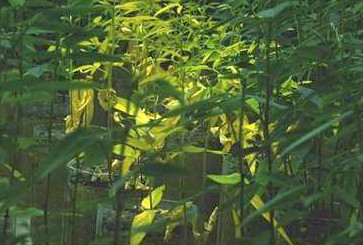
Hungry Plants
Some plants will demonstrate dramatic and specific growth changes, in
response to various Atomic deficiencies in their diet.

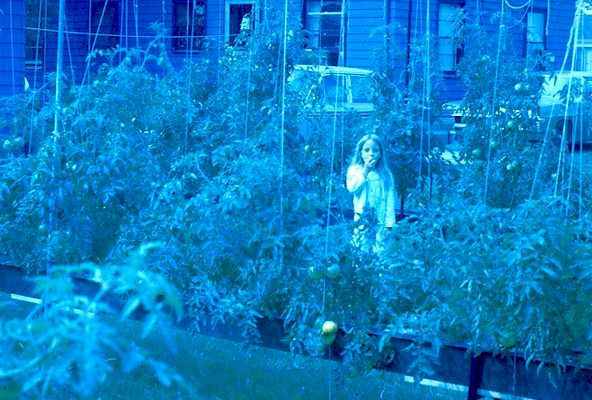
— 1972 —
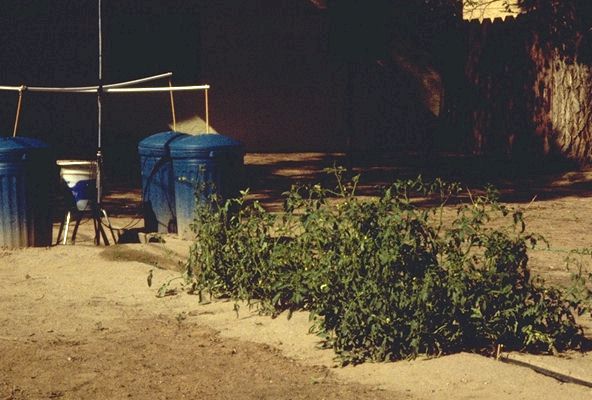
Three 20-foot trays in our back yard, are growing tomato plants suspended by
strings.
We canned 100 quarts of tomato sauce, and fed all the neighbors with
tomato treats, the year of this photo.
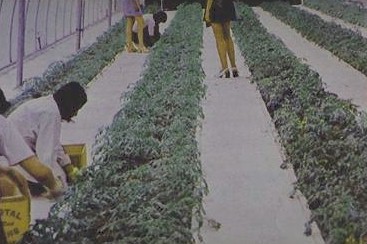
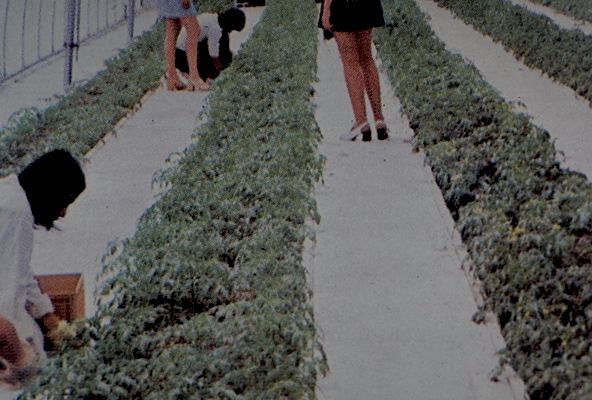
Rooted cuttings are brought out from the nursery.
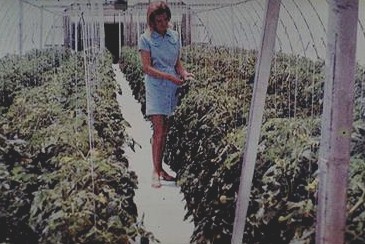
30 days later, the young plants are doing quite fine.
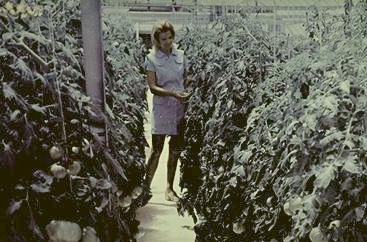
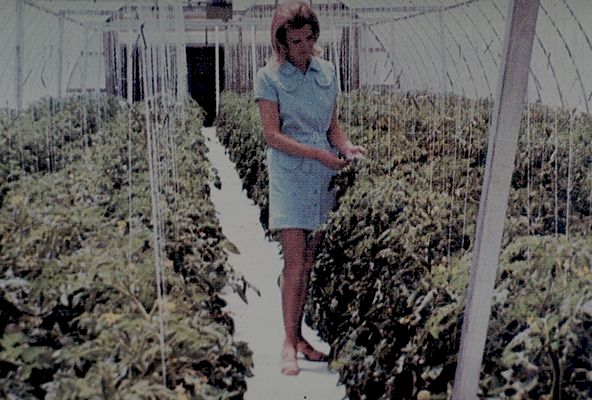
At 60 days, it is getting a little crowded.
1,100 plants, all needing bi-weekly pruning and support adjustments.
Also, tomatoes are usually pollinated by the wind. Some method to ensure
pollination indoors is required.
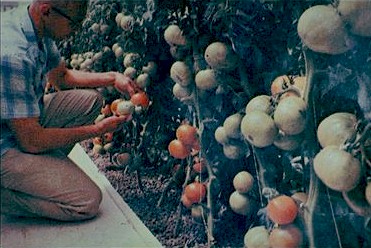
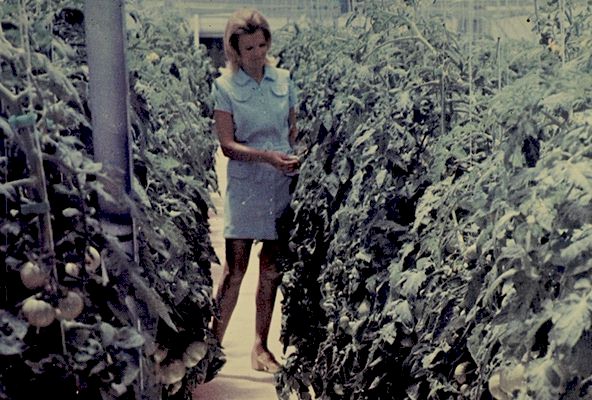
Only 90 days after Transplant, the First Red Tomatoes are ready for picking.
A Space 26 ft. by 126 ft., will house 1,100 plants and yield 20 to 30 lb.
of fruit per plant. In some sunny regions, you can grow three crops a year.
It takes a full 2,000 man-hours a year to manage a grow room this size.

A Low Cost System
This system is exploring the concept of using a constant flow of solution
through the root zone.
The system doesn't use a holding tank or reservoir.
The solution is filtered, aerated, and refreshed at the pumping station.
The 22+ salts are grouped, and then blended, into four stock solution tanks.
The grouping, helps keep the salts in solution, at concentrations higher
than the working solution.
The basic system is just a trench lined with plastic.
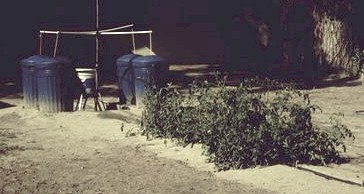
This part of the system, had a 4-inch plastic, schedule 40 PVC drainpipe
inserted in the plastic lined trench. Unrooted tomato cuttings were inserted
into the holes in the drainpipe. The tomatoes rooted nicely even with
100-degree F. days.
The 4-inch proved to be much too small. (At least 6 inches next time.)
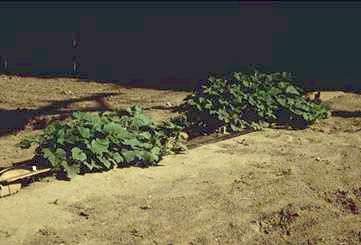
Part of the idea was
to start vines before the rainy season, and give them a chance to spread out.
Then, when the rains come, the vines will drop roots and extract additional
nutrients from the soil.
Beauty in Simplicity
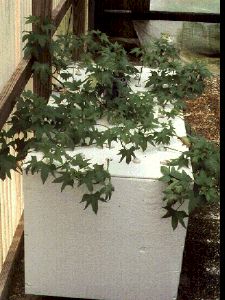
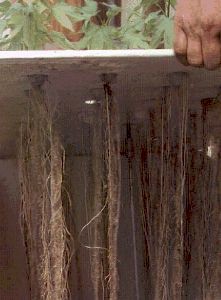
The common white styrofoam is an open cell foam. It will absorb water over
time and will sink if left in water.
The blue styrofoam, is a closed cell foam. It resists water and holds up much
better over time.
Here is a "trade-off".
Light is precious, and excess heat is hard to remove. The white styrofoam
reflects light back onto the plants better, and keeps the plant shoots cooler.

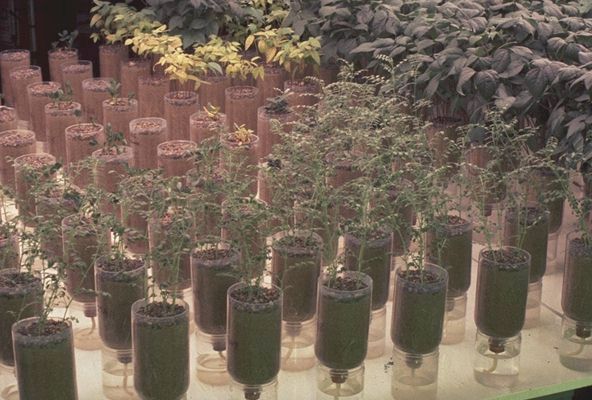
A simple and reusable, plastic nursery grow cup, for larger plants.
This medium is Excelsior ("wood thread") from "Swamp Cooler" (evaporative cooler) pads.
Your medium should wick water, and breathe well.
In the photo below, taken from the moon by Apollo 16,
we see the effects that light has on our planet's atmosphere.
Photons from the sun, knock electrons out of their orbitals, around
atmospheric gases. The electrons are pushed towards the surface of the
Earth. The Earth's magnetic field, then, helps arrange them into the
bands of energy shown in the photo.
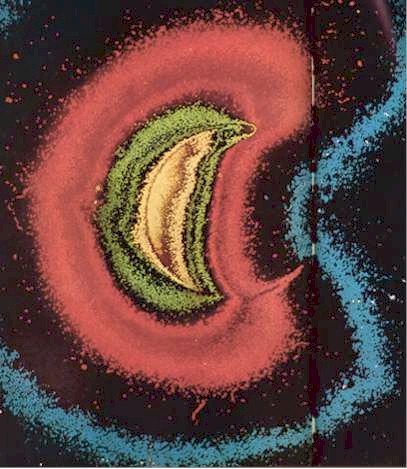
The earth has a very Strong Electric Field surrounding it.
The highest Energy Zone, reaches +350,000 volts.
I have done experiments that have convinced me that this electric field
affects plant growth.
Another "Trade-off" !!!
Foam and plastics, don't conduct electricity !!!
(It has been demonstrated, that plants, grow best in
(non-toxic) metal
containers.)
(See ... Understanding Colloidal Suspensions)
The "Flowing River" system above, has a special electrical system built into
it. On top of the plastic, in the river, extends an uncoated iron wire.
The wire is electrically attached to a long (and good) ground rod.
The wire
is meant to be sacrificial. Over time, the acid hydroculture solution will
eat the wire away. This is beneficial. The wire becomes a controlled source
of iron for the system, and also a "Source / Sump" for Electrons!
Aeroponics
Growing plants with an air medium and a "sprayed" hydro-solution.
The largest aeroponic operation I explored, was the Froedtert Malt Company.
They sprout tons of barley aeroponicly each month, and then toasted and
powered the sprouts to make malt.
My brother manufactured components for a heat recycling system at
his fiberglass factory, today known as
Wenonah Canoe.
Recycling the heat from the drying ovens was
straightforward. The system used a glass tube heat exchanger.
Recycling the heat from the growing sprouts, and removing the excess carbon
dioxide, was the task of the aeroponic misting unit.
Although no nutrient solution is involved, the system is classical.
A powerful blower pulls air through a misting chamber, and up through the
bed of sprouts. The heat that is collected in the water is recycled to other
parts of the building.
Plants can tolerate higher carbon dioxide levels than humans, about
3,000 ppm. But plants too will suffocate, if the carbon dioxide levels
get too high, even if the oxygen level is normal.
Cool water readily absorbs carbon dioxide, forming carbolic acid. When the
water is heated, it looses its ability to hold the carbon dioxide.
It is yet to be determined, if aeroponic growth can be increased by
paying attention to the plants electrical needs. Studies have shown
links to growth and electricity. This concept needs more study and
thoughtful experiments.
Getting Started
THE FIRST THING YOU NEED TO DO IS — TEST YOUR WATER !!!
Madison WI Soil Test Report
Here, Water is your Soil.
The nutrient solution needs to be very dilute, and is unique for Each
Species of Plant. Light intensity / duration, temperature, humidity and
wind are other considerations that will determine the salt concentration
range.
The TOTAL Salt Concentration will need to be in the range of 400 –
1000 ppm. for most plants. Plants like tomatoes favor even higher levels.
In some environments, tomatoes favor concentrations as high as 2,000 ppm.
This includes the mineral concentration of your "feed water".
You should include in your water test, all the atoms in the linked list below.
Special Atoms in the Water
of Life
It is possible, to have a sensor on the plants to control the watering cycle.
A number of systems have mastered this control issue. What could be better,
than allowing the plants to determine their own feeding schedule?
It is also necessary to understand the Electrical Dynamics of your plant
food solution. —
Understanding Colloidal Suspensions
Here are some hydroponic links to check out.
www.aeroponics.com/aero6.htm
www.aeroponics.com/aero18.htm
www.thegrowroom.com/system.html
www.nahydroponics.com
www.melbourne.citysearch.com
ipm-www.ncsu.edu/cernag/commercial/science.html
Commercial Vegetable Production Guides
Agronics Inc. - Colloids, Soil Services and Supplements for Biological Farming.
Hydroponic Reference Center Front Page
Hydroponic Reference Center Data base
Color Pictures of Mineral Deficiencies in Plants
Keeping Ourselves Alive
Radio Talk Show Transcript
Wonderful "New" Possibilities
Radio Talk Show Transcript
Tommy's Shoe Box of Notes on Plants
Web Site Link List
Element List
Hydroculture Salts
 "Happy Midi Tune"
Load a Happy MIDI tune into your MIDI Player,
so, you can bring Music Along on the rest of your tour.
The Tortoise Shell "Science of Health" Newsletter
— Putting an End to Disease on Our Planet —
The Tortoise Shell Life Science Puzzle Box – Front Page