The Diagnosis of Mineral Deficiencies in Plants by Visual Symptoms
Published by His Majesty's Stationary Office — 1943
— Crown Copyright Reserved —
PAESNIP IN SAND CULTURE — from the 1951 edition
by Thomas Wallace, M.C., D.Sc., A.I.C.
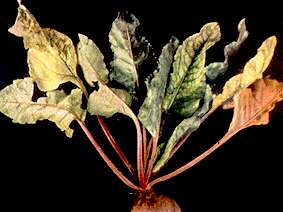 146. Table Beet Plant
Magnesium deficiency
Older leaves, intervenal chlorosis and reddish tinting.
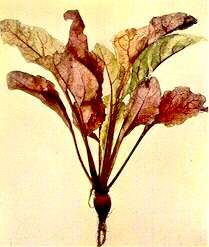 147. Table Beet Plant
Iron deficiency
Younger leaves chlorotic and high red tints.
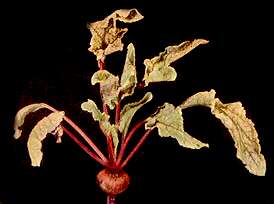 148. Table Beet Plant
Manganese deficiency
Leaves triangular shape, margins curled forward; older leaves severely
speckled; root dwarfed.
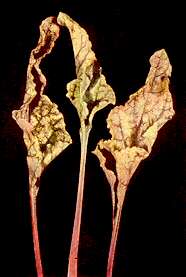 149. Table Beet Leaves
Manganese deficiency
Leaves triangular shape, margins curled forward and severe intervenal
speckling.
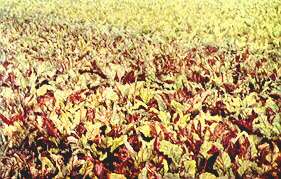 150. Table Beet
Manganese deficiency
General field view. Foreground: susceptible "globe" variety severly
speckled; Background: resistant long variety.
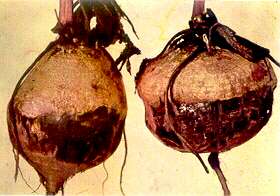 151. Table Beet Plants
Boron deficiency
Collapse of foliage, beginning with young leaves; rotting of outer tissues
of the roots. ("Canker")
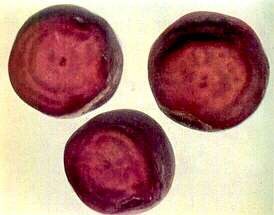 152. Table Beet Roots
Boron deficiency
Transverse section. "Canker" lesions, mainly in outer tissues.
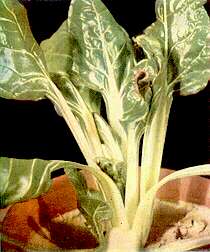 153. Seakale Beet Plant
Calcium deficiency
Hooking distortion and marginal scorch of young leaves; growing point killed.
| Index | ||
|---|---|---|
|
|
|
|
| Top of Page | ||
Color Pictures of Mineral Defeciencies in Plants – 1943
Using Hydroponics to Understand the Earth's Life Processes
Understanding Colloidal Suspensions
" The Art of Healing Ourselves "
The Diagnosis of Mineral Deficiencies in Plants by Visual Symptoms
by Thomas Wallace, M.C., D.Sc., A.I.C.
on the Atomic Level
The Tortoise Shell Hydroponic Reference Center
Plants need to absorb what you feed them.
Only You can bring Good Health and Healing into Your Body.