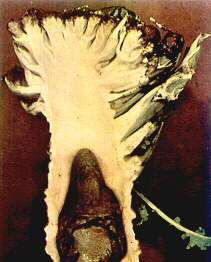
The Diagnosis of Mineral Deficiencies in Plants by Visual Symptoms
Published by His Majesty's Stationary Office — 1943
— Crown Copyright Reserved —
CAULIFLOWER IN SAND CULTURE — from the 1951 edition
by Thomas Wallace, M.C., D.Sc., A.I.C.
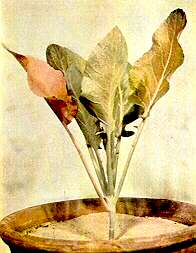 063. Cauliflower Plant
Nitrogen dificiency
Growth dwarfed, erect and stem thin; leaves pale green and older leaves bright orange, red and purple tints.
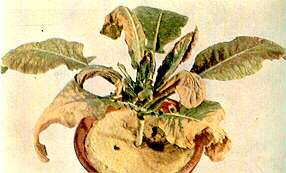 064. Cauliflower Plant
Calcium deficiency
Hooking of young leaves and severe collapse of tissues.
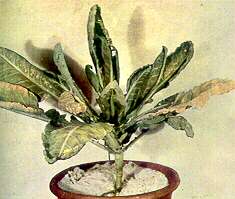 065. Cauliflower Plant
Calcium deficiency and manganese toxicity (soil scidity complex)
Calcium deficiency shows as collapse of mesophyll tissues and manganese toxicity as incurling of leaf margins followed by marginal spotting and scorching.
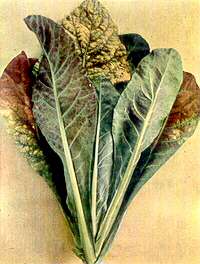 066. Cauliflower Plant
Magnesium deficiency
Older leaves chlorotic marbling followed by strong orange, red and purple tinting.
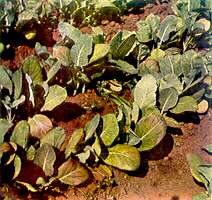 067. Young Cauliflower Plants
Magnesium deficiency
Plants in seed bed. Older leaves strong yellow, red and purple tints as "marbled" pattern.
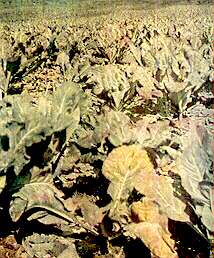 068. Cauliflower Plants
Magnesium deficiency
General field view at cutting time. Older leaves strong chlorotic marbling and tinting.
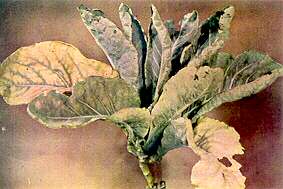 069. Cauliflower Plant
Magnesium deficiency and Manganese toxicity (soil acidity complex)
Magnesium deficiency shows as chlorotic marbling of older leaves and manganese toxicity as incurling and necrosis of margins of younger leaves.
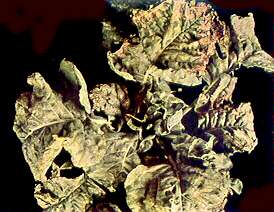 070. Cauliflower Plant
Potassium deficiency
Leaves bluish green and slight intervenal chlorosis near margins; backward curling of laminae, and scorching and forward curling of margins.
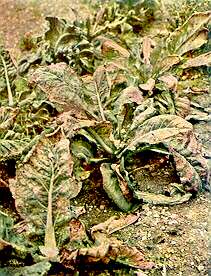 071. Cauliflower Plants
Potassium deficiency
General field view at cutting time; curling and severe marginal and intervenal scorching of leaves.
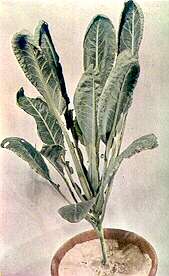 072. Cauliflower Plant
Manganese toxicity (soil acidity complex)
Restricted lateral growth of leaf laminae and incurling and brown spotting of margins (cf.
Plate No. 079, molybdenum deficiency).
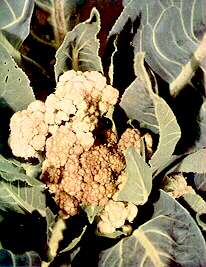 073. Cauliflower Head
Boron deficiency
Browning of curd.
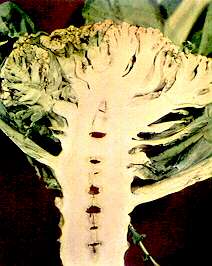 074. Cauliflower Head and Stem
Boron deficiency
Longitudinal section. Browning of curd and lesions in pith. (Not specific for boron; may be due to other causes in the field)
075. Cauliflower Head and Stem
Boron deficiency
Longitudinal section; Secondary infection of Bacillus Carotovorus.
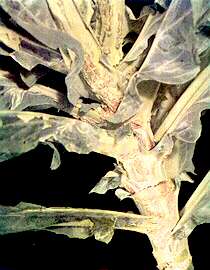 076. Cauliflower Stem and Petioles
Boron Deficiency
Corky condition of epidermis.
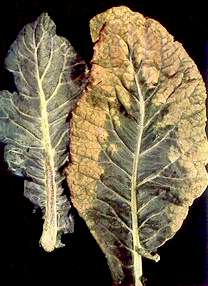 077. Cauliflower Leaves
Boron deficiency
Marginal mottling; corky upper surface of midribs.
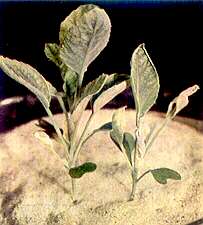 078. Young Cauliflower Plants
Molybdenum deficiency
Leaves slightly cupped and show chlorotic mottling; tips develop dead patches; cotyledons remain dark green. (Similar to manganese toxicity) (cf.
Plate No. 072)
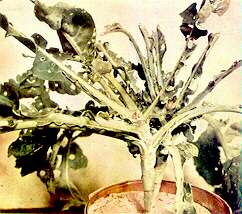 079. Cauliflower Plant
Molybdenum deficiency
Laminae of leaves restricted and may fail to develop, leaving only bare midribs. Growing point dies.
| Index | ||
|---|---|---|
|
|
|
|
| Top of Page | ||
Color Pictures of Mineral Defeciencies in Plants – 1943
Using Hydroponics to Understand the Earth's Life Processes
Understanding Colloidal Suspensions
" The Art of Healing Ourselves "
The Diagnosis of Mineral Deficiencies in Plants by Visual Symptoms
by Thomas Wallace, M.C., D.Sc., A.I.C.
on the Atomic Level
The Tortoise Shell Hydroponic Reference Center
Plants need to absorb what you feed them.
Only You can bring Good Health and Healing into Your Body.