atomic no. 8, atomic wt. 16.000, non-metal, row 3, col 6A, val. 2, orbits 2-6
Oxygen. O;
at. wt. 16.00; at. no. 8; valence 2. First obtained by Scheele in 1771 and independently by Priestley in 1774.Colorless, odorless, tasteless, neutral gas; nonflammable but supports combustion. Condenses to a liquid at –119° and 50 atmos., at –183° at ordinary pressure. d. gas (air = 1) 1.429; liquid, 1.14. m. –218°. b. –183°. Usually marketed under pressure in metal cylinders. One vol. gas dissolves in 32 vols. water at 20° in 7 vols. alcohol at 20° also soluble in other organic liquids and usually to a greater extent than in water.
Use: As oxyhyclrogen or oxyacetylene flame for welding metals and for lighting (calcium light, etc.); submarine work by divers, etc.
Grades available: U.S.P., technical / welding, breathable.
Med. Use: To treat or prevent hypoxia.
Caution: Concn. of 100% should not be used continuously for more than 48 hrs.
The Scientific World is in turmoil over allegations that one of its most respected eggheads was a fraud.
Joseph Priestley, the 19 th. century scientist who discovered oxygen and paved the way for much of modern science and medicine, coud have been beaten to the punch by an obscure Polish alchemist 150 years earlier.
The evidence which could oust Priestley from the history books comes from an account of a 1621 voyage down the River Thames in London by the world's first submarine.
The sub's 12–man crew breathed oxygen provided by a flask of saltpeter which gave off oxygen when heated.
That discovery was made in 1604 by the Warsaw alchemist Michael Sendivogius who described how saltpeter generates "the elixir of life" — Oxygen — when warmed.
"The bottom line is that Priestley's discovery was 150 years old when he made it," claims Professor Marilyn Butler, a science historian at England's Cambridge University.
Oxygen is highly paramagnetic; (attracted to a magnetic field, but not magnetized).
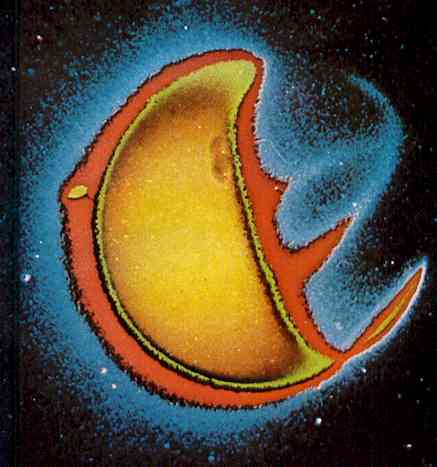
This is a color-enhanced ultraviolet photograph of Earth, taken from the moon.
Sensitive to radiation unseen by the human eye, the camera recorded oxygen { O2 } levels surrounding the earth at various altitudes — a look at the upper atmosphere that could benefit communications and help measure long-term effects of air pollution.
Scientists added color to black-and-white photographs to enhance differences in the brightness of the oxygen glow. Reacting to, and absorbing the sun's ultraviolet radiation, oxygen atoms fluoresce, appearing here as a cloak of gold closest to the Earth's surface, where the oxygen gas lies heaviest. As it thins with altitude, oxygen is colored green, red, and finally blue. On the Earth's night side the gas shows blue in two intersecting arcs over the Equator — a phenomenon scientists do not yet understand. An aurora shimmers over the south magnetic pole, extreme right.
Hydroponic Reference Center Project Page
Using Hydroponics to Understand the Earth's Life Processes
On the Atomic Level
Color Pictures of Mineral Defeciencies in Plants
Site Link List - Element List - Hydroponic Salts