in my machine's electro-mechanical logic system.
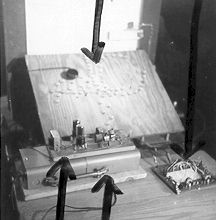
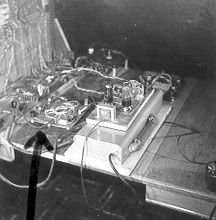
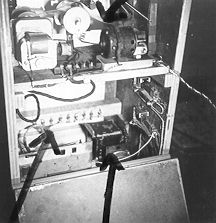
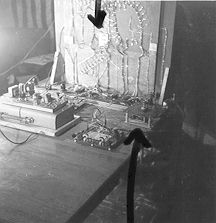
(From the accompaning discriptive booklet.)
My Sophmore High School Science Fair Project
" Charlie "
My First Teaching Machine
This was entered in the biology category.
Later, I was told, that it should have been entered with the electronic
projects.
Good Mentors are hard to come by !
The front interactive display would respond to light, sound, touch, nasal
and tongue stimulation.
This is an interactive multi-media presentation device. The graphic
presentation is on a roll of paper with a bar of lights in back. The audio
comes from a quarter inch tape. The lights, paper and audio are syncronized
by a set of switches operated through holes in another plastic tape, much
in the same way as the old player pianos.
(From the accompaning discriptive booklet.)
This is an electronic arrangement to effectively show a class, in an interesting way, the basic principles of the human nervous system. Through the use of electronic circuits, one is able to produce a unit that, more or less, responds in the same manner, as human nerves respond to a stimuli.
Let's first look at the sense of sight. We start out with a source of light extending rays of light in all directions. The light travels through space until it reaches the eye. Then the light is refracted by the cornea the outer transparent part of the eye) through the pulpal (which regulates the amount of light reaching the retina) to the lens which faces it on the retina.
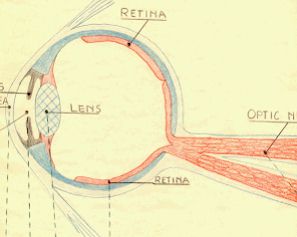
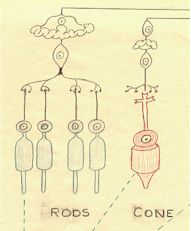
In the retina there are cells called rods and cones. When light strikes these cells they are excited and send electrical impulses through the optic nerve to the brain. This is the operation of the eye.
Now let's see how I reproduce this effect.
Again we start out with a light source. This time it is a flashlight. The light reaches the photocell unit and passes through a protective transparent outer cover, then is refracted through the diaphragm. which limits the amount of light reaching the photocell. Then the light is passed through the lens, which concentrates the light on the photocell (self-generating type), which acts as the retina. The action of the cell then acted upon by light produces a small current which is transmitted to the amplifier where it is amplified and then sent to the brain which operates the electronic illustration.
Next we have the sense of hearing. Sound waves travel through the air in the same way ripples circle outward when a pebble is thrown into still water.
Let's see what happens from the moment a harp string is plucked until the note is heard.
The vibrating string makes the air around it vibrate at the same rate of speed, These vibrations are caught by the outer ear which directs them into the auditory canal. They next strike the ear drum. The vibrations set up on the ear drum are carried across the air–filled middle ear by a chain of three bones; the hammer, the anvil and the stirrup. In the inner ear the vibrations travel through the fluid in the spiral cochlea, where thousands of tiny hair cells are suspended. Each hair cell is attuned to respond to vibrations at a certain rate of speed; frequency. Those responding to higher notes are at the beginning of the spiral. Those responding to low notes are at the inner end. When a cell responds to the vibrations set up by any sound an impulse is sent to the brain over the auditory nerves and the sound is heard.
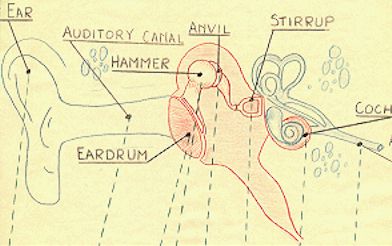
Now let's take a look at the construction of my unit.
Because our diagram is drawn on a flat surface, we don't have an outer ear. Our auditory canal is the space between the outer covering and the diaphragm of the diagram. The diaphragm, of the magnetic microphone is very much like the ear drum of our ear. When the vibrations from the outside reach the diaphragm, they cause it to vibrate. This vibrating causes the diaphragm to change the pattern of magnetic fields set up by a magnet, which acts somewhat like the fluid in the spiral cochlea. This change in the pattern of the magnetic fields causes a small current to be inducted in two magnetic coils, Which act like the hair cells in our ear. From here the current is sent over wires, which act as nerves, to an amplifier, where it is amplified and activates the relays.
Let's now take a look at the sense of touch.
All over the body there are thousands of tiny nerve endings, near the surface of the living skin. When pressure is applied to these cells, they are excited and send electrical impulses through the nerves to the brain where the sensation is felt. This is the operation of the nerve endings.
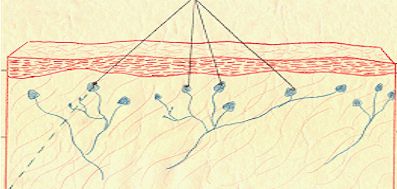
Now let's see how I reproduced this effect on my illustration.
First, we have a representative skin. Under the top layer of this skin are electroids. When pressure is applied to these electroids an electric current is sent to the electrical brain. The brain then acts upon the illustration.
Another of our five major senses is the sense of smell.
Just under the boney roof at the back of the nose is an area of mucous membrane containing many nerve fibers. These fibers pass through small openings in the roof of bone and enter the olfactory bulb. This is a collection of nerve tissues. From the olfactory bulb the fibers from the nose go to the region of the brain, which takes care of the sense of smell. This is called the olfactory lobe.
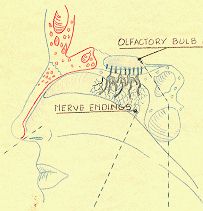
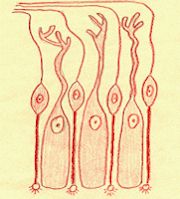
An odor is probably a collection of tiny particles floating through the air as gas. When these particles enter the nose they affect the nerve cells in the small fibers of the olfactory nerve. An impulse travels along the fibers into the olfactory bulb and from there to the olfactory lobe, part of the brain which makes us aware of the smell.
Once again we use the electronic switch, only this time we couple it to a sensitive sensing element. When an odor is introduced, the electrical resistance of the element is changed, causing an increase in the flow of electrons through it. This flow is amplified and causes the relay contacts to close and activate the brain relays.
Finally, we come to the sense of taste.
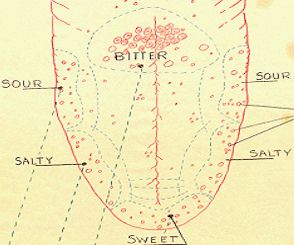

Our tongue is the main organ of taste. On our tongue are four main groups of taste buds, These buds are sensitive to substances which are sweet, sour, bitter, or salt. When a substance, which is one of the above, is placed on the tongue, the nerve endings are excited and the message is transmitted to the brain.
In my unit, I have an electronic switch, which is activated by a substance able to conduct a small current. In this way, the effect of the tongue can be reproduced. This unit also can be set to detect one of the above, if placed in a solution. Change in electrical resistance caused by the adding of one of these substances is enough to set off the switch. The small current which is passed through the electrodes is greatly modified by the tubes in the circuit. By changing a variable resistor the sensitivity of the unit can be greatly varied, so as to be able to detect changes in numerous solutions. When the resistance changes, the flow of electrons through the relay coil is greatly increased, causing the relay contacts to close and activate the brain relay.
The unit at your right contains the synchronization and illustration units.
The synchronization unit employs the player piano method, using a perforated role of plastic. The illustration unit, employes a roll of paper, an automatic advancer and an automatic stop. It also has an illustrating light bar, used to highlight the item being discussed.
The audio portion of the presentation, uses a tape recorder, controlled by the synchronization unit.
— Onward —
The Quest for a Practical "Teaching Machine"
While multitasking ...
Bubble Gum Rock and Roll with "The Messengers"
Hydroponic Reference Center -
Site Link List -
The "Water of Life"
S.A.D. -
A.D.H.D. -
"Keeping Ourselves Alive" - (Talk Show)