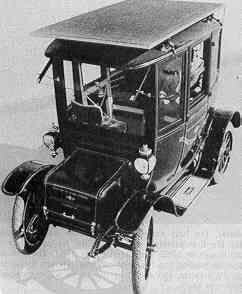
Long before energy conservation became a burning issue, International Rectifier in 1959 built a solar–cell energy source for autos and mounted the source on a 1912 Baker Electric. The solar cells put out about 200 watts.
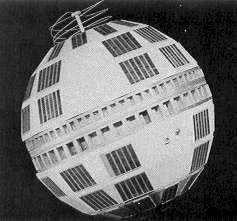
Telstar, the first active communications satellite, was also the first privately owned satellite. Its construction and launch in 1962 were financed by AT&T. The 170-lb. satellite marked the first international attempt to transmit TV pictures and sound by use of an active–repeater station in space.
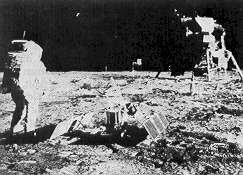
July 20, 1969: Apollo – 11 astronauts land on the moon. Neil Armstrong and Edwin Aldrin spent a day there, while Michael Collins circled the moon in a command module. The successful landing and return from earth's nearest neighbor in space culminated a decade of breakthroughs in electronics.
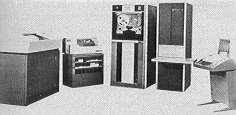
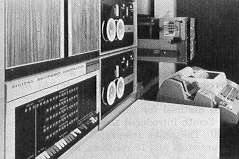
The first commercial minicomputer, a 12–bit machine with 1–k of memory, was introduced by Digital Equipment Corp. in 1963 as the PDP–5. It sold for $27,000.
A computer the size of a two–drawer file cabinet, the PDP–8 became popularly known as a minicomputer. When Digital Equipment Corp. offered it in 1965, the mini cost $9000 less than its less powerful and larger predecessor, the PDP–5.
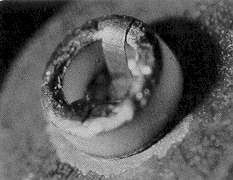
A solid–state device could oscillate at microwave frequencies. The unexpected development was discovered in 1963 by IBM's John Gunn, whose work lead to the active diode that bears his name.
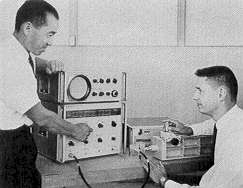
A 1964 microwave spectrum analyzer came with all basic functions fully calibrated. Hewlett–Packard developers Arthur Fong (left) and Harvey Halverson produced a unit with a 2–GHz bandwidth from 10 MHz to 40 GHz, and helped establish HP as an important supplier of spectrum analyzers.
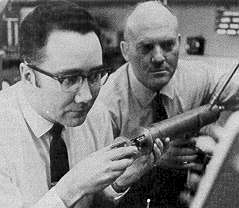
A new microwave source, the Impatt diode, was discovered in the mid 1960s by Bernard LeLoach (left) and Ralph Johnston (right), along with Barry Cohen. The three Bell Labs researchers made the diode emit microwaves by pulsing it until an avalanche of carriers had been produced internally.
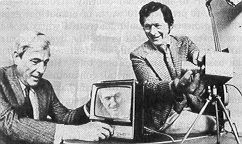
Charge–coupled devices found use in experimental TV camera demonstrated by Bell Labs' Willard Boyle (left) and George Smith — the inventors who received a patent for charge–coupled devices in 1974.
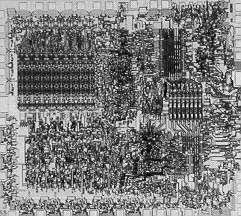
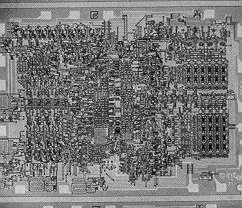
Not quite computers on chips, microprocessors do perform many of the functions of central processing units in conventional computers. The first emerged from Intel in 1971. It was a 4–bit unit called the 4004.
The 8008, the first 8–bit unit, followed shortly thereafter. Three years later Intel came out with its current highflying 8080 an 8–bit processor. By that time microprocessors had formed an entire industry.
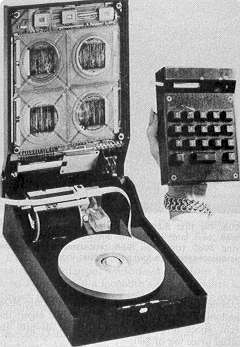
An IC array performs all computations in the first handheld electronic calculator. From Texas Instruments, the battery–operated instrument prints answers without impact on a narrow strip of heat–sensitive paper tape.
Vol 24, number 4 Feb. 16, 1976
© 1976 Hayden Publishing Company Inc.
50 Essex St. Rochelle Park, NJ 07662
Historical Time Line — Introduction
The Foundation Years The Era of Giants The Communications Era
The Vacuum Tube Era The Transistor Era The Integrated Circuit Era
AM Broadcast Basics
The Original Theory for Radio was Presented by James Clerk Maxwell in 1873.
Nikola Tesla was the first to patent a workable system.
Gravity Site Link List Crossed-Field AM Antenna
Magnetism Maxwell's Equations in Magnetic Media
The Tortoise Shell Life Science Puzzle Box Front Page