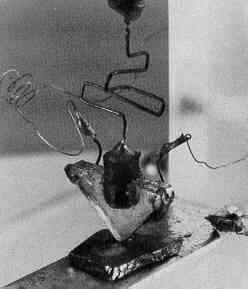
This crude version of the germanium point–contact transistor was developed by the research team of John Bardeen, Walter Brattain and William Shockley at Bell Laboratories in 1948.
The seeds, of development that were planted during World War Two and nourished by urgent military requirements started to flower after the war and produced technological marvels that kept the United States in the forefront of science. Two of the major events include the development of the digital computer and the germanium point–contact transistor. The trillion–dollar economy of many large countries and the landing of men on the moon would not have been possible without these two essential inventions.
The first digital, computer evolved from theories put forth by John Mauchly and John Presper Eckert in a proposal to the U.S. Army in 1943, when a machine that could rapidly calculate ballistic trajectories for large guns was desperately needed. However, it wasn't until 1946 at the University of Pennsylvania that Eckert and Madchly had a working machine — the ENIAC.
But programming the ENIAC required large wiring panels and was not very flexible; a simple program change could take hours. Later that year John von Neumann, a mathematician who helped develop the atom bomb during World War Two, proposed an electronic computer, which he would eventually help develop, with a memory that would permit stored programs and other internally stored information.
This crude version of the germanium point–contact transistor was
developed by the research team of John Bardeen, Walter Brattain and
William Shockley at Bell Laboratories in 1948.
The original ENIAC computer did over 5000 arithmetic calculations per second, weighed over 30 tons, contained more than 18,000 vacuum tubes and consumed 130 kilowatts. Large quantities of tubes, such as ENIAC used, were incorporated into many telecommunications networks being built at that time. But tubes, when grouped in large numbers, are power hungry. Many companies started to look for a low–power alternative.
Finally, in late 1947, the Bell Laboratories research team of John Bardeen, Walter Brattain and William Shockley succeeded. They developed what was later named the germanium point–contact transistor, considered the beginning of the modern electronics industry. If Edwin Land had been in the building when the team announced their discovery he could have snapped their picture with his new invention — the Polaroid camera.
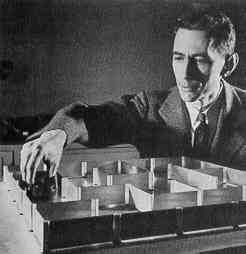
Claude, Shannon, founder of information theory, uses an electrical mouse
and maze to demonstrate at Bell Laboratories the capability of telephone
relays to act as memory elements in communications systems.
Actually, the team only "rediscovered" the transistor concept, for back in 1929 an engineer named Julius Lillienfeld patented what today would be called a metal–oxide field–effect transistor.
His discovery faded away in a short time since the materials required to build the device just couldn't be made pure enough, and worse, the money needed for further development wasn't available because the U.S. was just entering the Great Depression and venture capital for research projects just was not around.
As a result, the semiconductor age started in the late 1940s. Highlights of the day included the breaking of the sound barrier — a feat considered impossible only a few years earlier — by the experimental jet aircraft X–1, piloted by Charles Yeager. While the plane set speed records, Thor Heyerdahl left the shores of Peru in a balsa raft named Kon–Tiki, and headed toward Polynesia to prove a migration theory. At the same time a Bedouin shepherd came across caves in the northwest corner of the Dead Sea in Palestine. Inside he found some of the most important ancient documents ever discovered — the Dead Sea Scrolls — detailing life almost 2000 years ago,.
In the following year, 1948, James Clapp, an engineer for the General Radio Co., found a way to make the Colpitts oscillator more stable and extend its tuning range. At that time the Colpitts oscillator was preferred because all the tuning elements were in the grid circuit where no high voltages were present.
The new version, known as the Clapp oscillator or series–tuned Colpitts, added a variable capacitance in series with the tank inductance to permit an increase of 400 times the frequency variation of the conventional Colpitts.
Another invention that year was the carrier frequency voltmeter, designed by Paul Byrne, an engineer for Sierra Electronic Corp. (now a division of Phileo). Because it could take noncontacting measurements of power lines this instrument was a great boon to personal safety. The carrier–frequency voltmeter has since been adapted to take measurements in communications applications and wave–analysis research.
At the United States National Bureau of Standards a group of scientists measured atomic time to within 1 part in 20 million by measuring the absorption by molecules of ammonia of radio waves of a certain frequency. Today atomic clocks can be built with accuracies of better than 1 part in 100 billion — an error of only one second every 300 years. These clocks are used as time standards for both the astronomer and the electronic designer, and as frequency standards for many broadcasting stations.
Political events in 1948 included the assassination of India's Mahatma Gandhi and the independence of Israel. The Soviet Union blockaded the western half of Berlin after the city was divided into east and west sectors and the United States set up an airlift from Western Europe to carry in supplies. Harry Truman defeated Thomas Dewey in the race for President; his inauguration the following year, was the first of its kind to be telecast, and had an estimated audience of 10 million as the black–and–wbite receiver began to make its way into nearly every home in the United States.
The point–contact transistor developed by Bell Laboratories in late 1947 and announced to the world in 1948 was a delicate device and very hard to produce. The hardest problem was the manufacture of the semiconductor material itself. Germanium was readily available, but it had to be purer than available processing methods could produce in quantity.
Work was started on refining processes by Jack Scaff and William Pfann at Bell Laboratories. Research at General Electric, RCA, and at Bell Labs paid off in an alloying technique that produced commercially feasible transistors. The Czoehralski technique of growing large quantities of single crystal germanium was perfected, an absolute necessity if transistors were to be produced in high volume and at low cost.
At Cambridge University, in England, Stanley Gill, David Wheeler and Maurice Wilkes managed to apply some of von Neumann's theories about stored–program machines and developed EDSAC, one of the first stored–program digital computers. IBM (International Business Machines Corp.) introduced its first large–scale digital calculating machine the selective–sequence electronic calculator. Development work started on machine programming led, in the late 1950s, to the computer language called Fortran.
The public benefited from many of these laboratory developments. RCA, then called Radio Corporation of America, introduced the 45–rpm phonograph record. Peter Goldmark of the Columbia Broadcasting System developed the 33–1/3 rpm record. Both the 45 and 33–1/3 records have totally replaced the 78–rpm disc and are still in use today — the 45 as the "pop" medium and the 33–1/3 as the primary recording medium for serious" music.
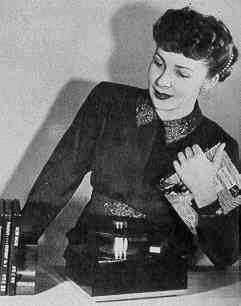
In 1949 the 45–rpm phonograph record was developed by RCA, which also
developed a fast record changer that connected to TV sets and played
the records through the TV amplifier. Today, the 45–rpm disc is
still the "pop" recording medium.
1984, George Orwell's frightening novel of the future, was published. It described a totalitarian government that used electronics to maintain a watch over every individual, and coined the expression "Big Brother is Watching."
As the Korean conflict started off the 1950s with a bang the concept of the plug–in circuit module took form and began to speed the production of electronic equipment. It permitted circuits to be assembled in different areas and then simply connected together. Dip soldering, still one of the simplest and fastest soldering methods available, was developed at this time.
Computers were in a constant state of revision, with improvements being made by many different researchers. For instance, L. R. Harper developed the stepping register (a form of today's shift register), which was adapted and used by IBM.
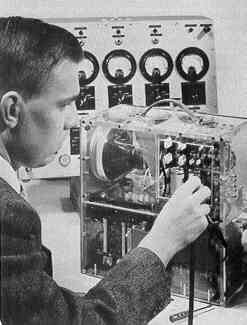
Researcher Gerald Herzog at RCA is shown making some laboratory tests in
1952 on the first all transistorized television set. It contained 37
semiconductors, could receive only a single channel and weighed
27 pounds. Herzog is now a staff vice president at the RCA solid–state
Technology Center.
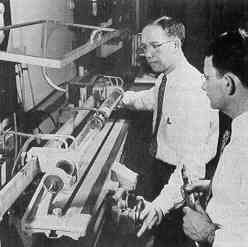
Extremely pure germanium, the key to
semiconductors, was developed by
this team of William Pfann (left) and Jack Scaff (right) at Bell
Laboratories in 1954. The purity of the refined germanium can be
likened to one pinch of salt in 35 boxcars filled with sugar.
At the Massachusetts Institute of Technology (MIT) Jay Wright Forrester developed the theory of data storage in small toroidal magnetic cores. Today every large computer system uses such cores for mass storage of data.
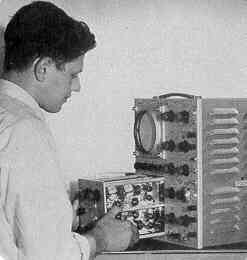
Putting the plug–in amplifier into the Model 535 oscilloscope is
Bill Polits, a design engineer for Tektronix in 1954. The concept of
the plug–in was first introduced in the Model 531 oscilloscope that
was released several months earlier than the 535. Polits is presently
a group vice president at Tektronix.
At about the same time, scientists at RCA finally, developed an electron emission system for reasonably simple and inexpensive multi–gun color picture tubes and color television receivers. Although RCA's all–electronic color television system was not at first accepted by the Federal Communications Commission it is now (with several modifications) the only system in use in the United States.
During their experiments with radioactive elements Glenn Seaborg, Kenneth Street Jr. and Stanley Thompson created elements 97 and 98 californium and berkelium — at the University of California at Berkeley.
Engineers at Berkeley Scientific devised an instrument that could count particles at rates of up to 40,000 per second to measure the quantities of neutrons or other atomic particles bombarding an atom. It used columnar readouts and electronic decade counters, enabling scientists for the first time to count almost the exact number of particles emitted by a source.
Today the event counter has changed its name to a frequency counter, has accuracies approaching that of oven–controlled crystals, and is used in communications for monitoring frequencies of over 1 gigahertz; in servicing, to set frequencies; and in many other areas.
Along with the promises that zone refining and crystal growing were soon to keep, improved semiconductor devices were starting to appear in the laboratory.
The junction transistor made its appearance as a result of work by Morgan Sparks at Bell Laboratories. It was free of the mechanical problems of the point–contact transistor and was much more rugged. The junction was constructed by heat alloying two "blobs" of indium (one on each side) onto a germanium crystal. The alloying process produced the collector and emitter regions on the crystal; the area in which no alloying occurred served as the base.
The alloy transistor offered the possibility of ultra–low–power operation because just one or two microwatts were needed to power the transistor. Hundreds or even thousands of these transistors could operate from the same power needed to heat the filament of a single vacuum tube.
With transistors on the verge of replacing vacuum tubes, many other advances were making the change a necessity rather than a nicety. The power drain of complex digital and telecommunications systems had to be cut.
Maurice Wilkes, at Cambridge, developed theories of microprogramming so that basic computer operations — such as all the steps needed for storing a number — could be permanently within the machine. Others tried with moderate success to program computers to play chess and other games.
Mauchly and Eckert, originators of ENIAC, the first digital computer, ran into a few legal entanglements with the University of Pennsylvania and in 1951 formed their own company the Eckert and Mauchly Computer Corp. Under their direction the company produced a general purpose machine, UNIVAC I, that could be used for many scientific and record keeping applications. Soon after it was introduced Remington Rand purchased the firm. It became part of Sperry–Rand in 1955.
In 1952, less than a decade after the A-bomb was used to end World War II, the U.S. exploded an even more powerful weapon — the hydrogen bomb — on Eniwetok Atoll in the Pacific In November, General Dwight D. Eisenhower was elected president.
The same year, at Non Linear Systems, Andrew Kay decided to package the digital voltmeter, an instrument that was part of many analog computers, as a separate instrument. In so doing, he provided the engineer with a tool that increased the accuracy of typical laboratory measurements by more than an order of magnitude over the analog instruments. Kay's digital voltmeter offered 0.01% accuracy and paved the way for digital–readout instruments.
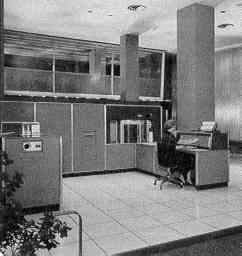
The RAMAC disc operating system, introduced by IBM in 1957, was the
first data processing system to use record–like discs to store
digital data. Each disc had a storage capacity of about 100,000
characters and could be randomly accessed.
Computer memory circuits and switching systems were undergoing revolutionary changes when Claude Shannon devised an experiment at Bell Labs that showed the memory capabilities of telephone relays. His electronic mouse found its way through a maze the first time by trial and error, and then unerringly repeated the correct path by using relay circuits to remember its mistakes.
With the advent of transistors and transistorized circuitry the large potentiometers used to control voltages and currents were just too bulky. Bourns Corp. saw this and developed a potentiometer designed just for trimming voltages in transistorized circuits. The new device was called the Trimpot and today, in all sizes and shapes, is found in nearly every instrument. RCA probably used the Trimpot in its experimental solid–state (except for the picture tube) TV. The receiver used 37 semiconductor devices, had a five–inch screen and weighed only 27 pounds.
After President Eisenhower took office in 1953, the Korean conflict was finally brought to an end. In the United States, nonstop commercial flights between the east and west coasts were initiated while Elvis Presley and groups like Bill Haley and the Comets started the rock–and–roll era. In England, Ian Fleming introduced his fictional character, James Bond, super spy, in his novel Casino Royale.
Ian Fleming's super spy wasn't too far from reality for in 1953 Charles Townes, J. P. Gordon and H. J. Zeigler at Columbia University in New York, developed the beam maser — a device that could amplify microwave signals with light. The main advantage of the maser was its ability to amplify without adding any noise to the signal, since the amplifier could work at temperatures approaching absolute zero. This amplifier was the forerunner of the laser —a coherent light amplifier.
While Columbia developed microwave amplifiers, Tektronix developed a series of plug–in amplifiers for its oscilloscopes. The plug–in amplifiers for its Model 531 oscilloscope revolutionized the test–equipment industry by making it possible to change the input characteristics of an instrument just by plugging in different low cost amplifiers. Many companies have adopted this technique to offer high versatility instruments.
Until 1954 many companies had been striving to perfect the germanium transistor. In the process, the team of Gordon Teal and Ernest Buehler at Bell Labs perfected a method of growing single–crystal silicon. This development, combined with the groundwork done by William Pfann in creating the material–purification process known as zone refining, laid the foundation for today's multibillion–dollar semiconductor industry.
Texas Instruments, building on the work of Calvin Fuller of Bell Labs, introduced the first silicon transistors in 1954. Fuller developed the process of diffusing impurities into the surface of a silicon wafer, paving the way for the development of the integrated circuit, which was announced a few years later by TI.
The first consumer products that contained transistors appeared on the market between 1952 and 1954. A transistorized hearing aid and a four–transistor radio were two of the first.
William Shockley extended his original two–junction transistor with three and four–junction devices. His theories were put to use by Gerald Pearson at Bell Laboratories in 1954, in the development of thyristors.
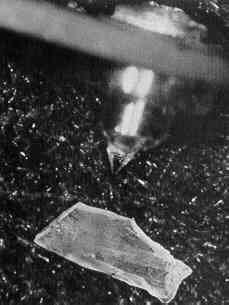
The first man–made diamonds, produced by General Electric's
Dr. Herbert Strong in 1955, were only about 1/16 of an inch long.
This photo shows a diamond just below a "standard" high–fidelity
phonograph needle.
Different types of power sources were also being sought by these comparatively low–powerdrain appliances. At Bell Labs, for example, Fuller, Daryl Chapin and Gerald Pearson developed the silicon solar battery — the first usable source of solar–generated electricity. At first it could barely supply enough energy for a small transistor radio, but a few years later was powering satellites and space probes to the farthest reaches of the solar system.
The first years of the transistor era had not particularly affected tube manufacturers. Transistors were very expensive and at high frequencies they were still quite limited in power–handling capability. In 1954 the highest rated transistor could handle about seven watts at a frequency of 5000 hertz. To boost the capabilities of the transistor, N. H. Fletcher, an engineer at Transistor Products, reshaped the emitter and base patterns into finger–like interwoven structures in a process that soon became known as interdigitation. This pattern is still used in almost every high–frequency power transistor made.
After Fletcher's developments transistors started to threaten some tube applications and the vacuum–tube industry began to fight back. Sylvania, using ceramic insulators instead of mica, developed the stacked vacuum tube to produce greater ruggedness than had previously been available.
It still had a filament, though, and as transistors improved in performance, the stacked tube fell by the wayside.
One of the earliest commercial products to evolve from the development of single–crystal silicon was the zener diode, originally manufactured by National Fabricated Products. The zener diode was the first solid–state voltage–regulating element.
The first nuclear–powered submarine, the Nautilus, was launched in 1955, the same year Walt Disney opened the world's first "theme" amusement park, Disneyland. The park made extensive use of technological developments in robotics and animation, as well as sound production and transmission.
The homemaker benefited from developments too; 1955 was the year Tappan introduced an electronic oven with a magnetron tube generating high levels of microwave energy to cook food.
Mucon Corp. and Bell Labs developed the voltage–variable capacitor — actually a diode that changes its reverse–biased capacitance value in proportion to changes in impressed voltage. Both companies opened the way for electronic tuning with no moving parts — in radios and TVs.
The automobile industry also capitalized on the electronics windfall and in the mid–1950s introduced "hybrid" car radios in which tubes were used in the low–power stages, and germanium power transistors were used for the audio output.
Competition for the vast consumer market spurred companies to produce new products. In 1956 Bell & Howell introduced the all–electronic movie camera with a photocell-controlled iris, and TV set manufacturers started to add such convenience features as remote control. Bell Labs demonstrated the feasibility of the TV telephone. General Electric used a pressure of 150,000 atmospheres to produce small artificial diamonds — typically less than 1/16 of an inch long. These diamonds were suitable only for industrial grinding and machine use. Today, companies have managed to produce stones that weigh nearly 20 carats.
GE also commercialized the silicon–controlled rectifier originally proposed by Shockley. It provided a fast, solid–state alternative to the power consuming electromechanical relays needed to control large currents. SCRs are now found in everything from small appliances to power–generating plants and the most advanced satellites.
In 1957 Russia startled the world when it launched the first man–made orbital satellite, Sputnik. The United States was caught short, its space program was hardly off the ground.
Sputnik was followed in short order by another capsule from Russia that contained the first living space traveler, Laika — a Husky. The United States rallied, and in 1958 launched its own orbital satellite, Explorer I. These events led to manned landings on the moon and to probes sending back data from Venus, Mars, Jupiter and beyond.
What made these probes possible was the effort that many companies contributed to make the necessary equipment lighter, more precise and more efficient.
Burroughs Corp., for example, developed the gas–discharge numerical–readout tube — the Nixie. Until the late 1960s this display had almost no competition. Today, light emitting diode, incandescent, liquid–crystal and gas–discharge displays compete vigorously for many of the same applications.
In 1957 Hughes Aircraft developed the storage oscilloscope. Since it could capture a waveform and store the information indefinitely on the screen of a special cathode–ray tube, it was a great boon for analog waveform analysis.
In the same period, U. Gianola of Bell Labs developed the plated–wire memory. At IBM, large rotating discs were used for the first time to make a random–access memory capable of storing up to five million characters. This system, called RAMAC, was used with the Model 305 computer to provide huge amounts of on-line data storage.
About the same time, RCA unveiled an FM radio transmitter small enough to be swallowed by a patient that made possible body measurements while the patient was moving around. Today's astronauts use modern versions of these pills to help send data back to earth.
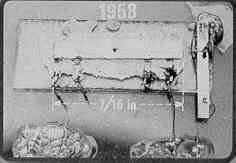
The first integrated circuit, developed by Jack Kilby at Texas Instruments,
paved the way for today's pocket-sized computers and for men, traveling
to the moon.
Texas Instruments and Fairchild Corp. announced their development of integrated circuits in late 1958. The circuits were crude — they contained several transistors, a few resistors and some capacitors — compared with the ten thousand or so transistors now possible on a single silicon chip.
General Electric and Crystalonics introduced commercial field–effect transistors in 1958 as an outgrowth of theories put forth by Shockley in the early 1950s. Stereo phonograph recordings were starting to appear by then and even some radio stations were broadcasting music over two channels.
In the last year of the 1950s' both Alaska and Hawaii were admitted to the United States and a giant quiz scandal erupted over the television show "The $64,000 Question." With RCA's introduction of the nuvistor vacuum tube, 1959 heralded the last attempts of tube manufacturers to hold onto a major portion of the small–signal amplification market. The nuvistor was a thimblesized tube that offered high reliability and low power operation.
And at Brookhaven National Laboratories Dr. Robert Sugarman developed the sampling oscilloscope. In 1959 it was the only instrument that could display repetitive waveforms of frequencies above 1 gigahertz. It was first commercialized by Lumitron (now defunct) and is presently available in the same basic form from several companies.
Developments announced earlier by Texas Instruments and Fairchild had marked the beginning of the era of the integrated circuit. Within a few years the complexity of the circuits had grown so that entire systems could be economically placed onto a single quarter–inch–square silicon chip.
The space age was also beginning — with orbital satellites and attempts to get close–up pictures of the moon. When we looked at those attempts then, we marveled at them. And yet, on July 4, 1976 we will land an automated probe on the surface of the planet Mars.
Vol 24, number 4 Feb. 16, 1976
© 1976 Hayden Publishing Company Inc.
50 Essex St. Rochelle Park, NJ 07662
Historical Time Line — Introduction
The Foundation Years The Era of Giants The Communications Era
The Vacuum Tube Era The Transistor Era The Integrated Circuit Era
AM Broadcast Basics
The Original Theory for Radio was Presented by James Clerk Maxwell in 1873.
Nikola Tesla was the first to patent a workable system.
Gravity Site Link List Crossed-Field AM Antenna
Magnetism Maxwell's Equations in Magnetic Media
The Tortoise Shell Life Science Puzzle Box Front Page