 |
The Vacuum Tube Era (1905 — 1948) |
 |
|---|
|
|
The Vacuum Tube Era (1905 — 1948) |
|
|---|
An era was dawning that would produce more new technology than was born during the entire history of man until then. Starting with the vacuum tube, the 1905 to 1948 period was to produce radio, television, sound movies, computers, radar, inertial guidance and the transistor. But those are just a few of the highlights.
The world would not have been ready for the post–1948 developments in technology, most of them based on the transistor, if it were not for the work of those who had gone before. Among the important developments of the period were Einstein's Theories of Relativity, Bohr's studies of atomic structure, Carson's single–sideband transmission, Alexanderson's high–frequency alternator, Armstrong's superheterodyne circuit, Johnson's analysis of noise and Shannon's information theory.
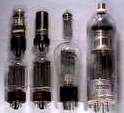
In 1903, the Wright brothers' flight at Kitty Hawk, NC, put the world on notice that man was going to reach faraway places easier and faster than before. At the same time, Sir John Ambrose Fleming was working on a glass–enclosed device containing an anode, a cathode and a vacuum. In 1904, he found his device could be used as a rectifier. He called it a valve; Others started to call it a tube.
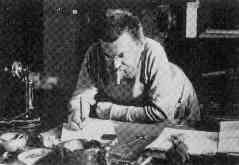
Charles Proteus Steinmetz pioneered research in alternating current,
artificial lightning, power transmission systems and several other areas
while working for General Electric in the early 1900s; —
Expanding the work of
Nikola Tesla, the man who conceived and
patented these concepts.
Times were simple in those days. The Great War was not yet in sight, and the mood of the times was relatively carefree. Neon signs showed up for the first time, and all over America, people were humming and whistling "Meet Me In St. Louis, Louis," written to commemorate the St. Louis Exposition, which had opened the previous year.
While Albert Einstein revolutionized the world of physics with his Theory of Relativity, a whole new kind of science began to arrive. The publication that heralded it was Three Treatises on the Theory of Sex, by Sigmund Freud.
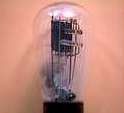
In 1906 Lee De Forest inserted a third element — a grid — into Fleming's valve, and created the triode, which permitted electronic amplification. He noticed that the stream of electrons moved from the filament to the plate at a rate that varied markedly with the charge placed on the grid.
A varying but very weak electric potential on the grid could be converted into a similarly varying but much stronger electron flow in the filament–plate combination. De Forest called the tube the "Audion." When it was incorporated into Guglielmo Marconi's wireless system, communications could take place over much greater distances.
Much else was happening in 1906. Ernst Alexanderson was developing the high–frequency alternator that was to make world–wide wireless possible. General H.C. Dunwoody had developed a carborundum–crystal detector to replace the coherer in primitive radios, and Greenleaf Pickard demonstrated a silicon–crystal detector.
Radios were becoming available to the general public. In 1906 the first advertisement for a radio appeared in print on Jan. 13, in Scientific American. The Electro Importing Co. of New York offered "a complete outfit comprising one–inch spark coil, balls, key, coherer with auto coherer and sounder, 50–ohm relay, 4–cell dry battery, send and catch wires and connections with instructions and drawings. Will work up to one mile." The cost: only $7.50.
That year San Francisco was destroyed by the great earthquake and fire, and Reginald Fessenden broadcast phonograph music for the first time — from Brant Rock, MA, using a high–frequency alternator.
In 1907, the coherer officially died. Its death knell was sounded by a raft of crystal, magnetic, thermal and electrolytic detectors. In 1908 oil was discovered in the Middle East.
Charles Proteus Steinmetz was working for General Electric in 1909 — on arc lamps, artificial lightning and power transmission lines. He had already set down the basic principles of alternating current. Robert E. Peary caught the imagination of the world that year when he reached the North Pole for the first time. And Henry Ford made traveling easier in 1909 by introducing the Model "T" automobile. Mass production was on its way.
Wireless continued to make great strides. In 1910 Enrico Caruso and Emmy Destinn sang arias backstage at New York's Metropolitan Opera House and were heard as far away as Bridgeport, CT. The De Forest Radio–Telephone Co. broadcast the concert by means of an arc–transmitter radiophone. Forty years later De Forest remarked: "I used the arc because I had yet to discover that the Audion would oscillate."
Wireless also played its first detective role in 1910 when Captain Kendall of the S. S. Montrose approaching Canada was notified by Scotland Yard that two fugitives, Dr. H. H. Crippen and Ethel le Neve, were on board.
The efficiency of the Audion as an amplifier was vastly increased when the vacuum was improved by Irving Langmuir at General Electric and Harold Arnold at AT&T. In 1912 they both developed high–vacuum tubes, — tubes that were also more stable than De Forest's.
That was the year the Titanic sank, and the year Charles Pathè produced his first news film. Igor Stravinsky was busy writing his ballet Petrouchka, and major races were being timed electrically for the first time at the Olympic Games at Stockholm.
In 1913 the physics world was startled by Niels Bohr's theories of atomic structure and introduction of the "Bohr atom" model, with electrons spinning in orbits around a nucleus composed of neutrons and protons.
Even more startled were those who viewed modern art" for the first time at the infamous "Armory Show" of contemporary French painting in New York City. Most viewers were puzzled by the canvases of such artists as Picasso, Matisse, Braque and Marcel Duchamp — whose "Nude Descending a Staircase", undoubtedly evoked the greatest comment.
The first war where air power meant something took place in 1914 to 1918. The keys to the war effort on both sides were wireless communications to aircraft, and better means of navigation.
In 1914, Lawrence Sperry dramatically introduced his gyropilot to the world demonstrating a hands–off low–level flight of his Curtiss flying boat while his mechanic walked along the wings to show the plane's stability.
Reginald Fessenden presented the theories of echo ranging that were later to be the basis of sonar and radar. And Edward Kleinschmidt invented the teletypewriter that year.
In an attempt to get people's minds off the war, the movie industry came out with a series of comedies and introduced Charlie Chaplin to the world. And in Providence, RI, Howard P. Lovecraft, the greatest horror–story writer since Poe, wrote his first piece of fiction.
The war got worse in 1915, as London was subjected to the first of many Zeppelin attacks. But science continued. Einstein presented his general theory of relativity; German scientist Walter Schottky further improved on vacuum tubes by developing the screen–grid tube, and the vacuum–tube voltmeter was developed by R. A. Heising to minimize a voltmeter's influence on the circuit it's measuring.
John Carson of AT&T invented single–sideband transmission in 1914 by showing that either side frequency of a modulated carrier could carry as much information as the two sides together. The power and channel space saved made single–sideband an important method of radio communications for years to come.
By then the need for a better voice transducer was evident, so E. C. Wente invented the condenser microphone. At the Marconi Wireless Telegraph Company of America a famous memo was written that year by assistant traffic manager David Sarnoff. He proposed a "radio music box," and outlined the future possibilities of public broadcasting as well as its popular appeal. The recommendation was ignored. George Campbell developed the first electrical wave filter in 1917, making communication channels possible, and Ernst Alexanderson got his high–frequency alternator up to 200 kilowatts.
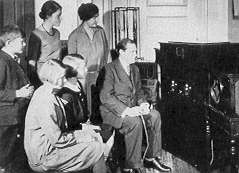
Ernest F. W. Alexanderson and his family watched the first home
demonstration of television in 1929. He developed the broadcasting
system based on mechanical scanning disc technology.
Even as the people in the U.S. became tired of hearing about the European war in 1917, the United States began sending its own men into the fray in an effort "to make the world safe for democracy."
World War I ended in 1918. The key technical events of the year were the introduction of H.M. Stoller's electronic voltage regulator and the three–color traffic signals that showed up in New York for the first time anywhere.
After the war people started looking for new interests. Amateur broadcasting became popular and Peter Jensen and Edwin Pridham interested the world in stereo by installing their system in a San Francisco nightclub called the "Hoo Hoo House."
A five–piece orchestra on the second floor had microphones attached to each instrument. Each microphone was connected to an individual amplifier that was then connected to a corresponding speaker on the main floor. The speakers were arranged in the same manner as the musicians and produced a stereophonic effect so startling the audience forgot to dance.
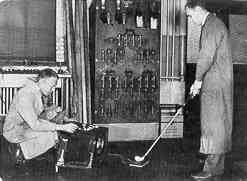
Harold E. Edgerton is about to take a swing at a golf ball.
A unique electronic circuit for high–speed photography called
the stroboscope is operated by Kenneth Germeshausen to record the event.
Edgerton is credited with invention of the device. Germeshausen aided
in the design. (Photo courtesy of Massachusetts Institute of Technology.)
As the "Roaring Twenties" began the N.Y. Yankees had just purchased Babe Ruth from the Red Sox, and Mary Pickford had just married Douglas Fairbanks. In 1920 the League of Nation was formed. Prohibition began, and the world's first broadcast radio station, KDKA in Pittsburgh, started up. Alexanderson greatly improved ac–motor controls and the first radio communication network began, using the Alexanderson high–frequency alternators.
1920 also brought a pair of developments that have had a lasting impact on communications and radar. Major Edwin Howard Armstrong designed the superheterodyne circuit — the circuit that made modern radio possible, by allowing a simple, tunable receiver that was stable and had high sensitivity.
Albert W. Hull of General Electric designed the magnetron. Magnetrons later became the first efficient source of microwaves and helped make modern radar possible.
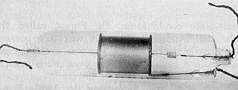
The magnetron, a vacuum tube whose electron current is controled by a
magnetic field, was invented by Albert W. Hull in 1920.
The superheterodyne circuit was applied to radio by Harald Friis of Western Electric while he was working in a small shack in Elberon, NJ, in 1922. Also, that year, W. G. Cady built the first piezoelectric–resonator crystal oscillator.
It was becoming apparent that large amounts of capacitance would be needed for certain types of circuits. In the hope of minimizing the space needed for capacitors, H. O. Siegmund developed the electrolytic capacitor in 1921.
Marconi proposed a fairly practical radar system in 1922. He said: "As was first shown by Hertz, electric waves can be completely reflected by conducting bodies. In some of my tests, I have noticed the effects of reflection and deflection of these waves by metallic objects miles away."
That year RCA put out its first catalog of radio equipment, entitled "Radio Enters The Home." The cheapest receiver listed was a steel box containing a single–circuit tuner and crystal. It sold for $25.50 with headphones, antenna equipment and full instructions.
More elaborate crystal sets were available at $32.50 and $47.50. The most expensive was Westinghouse's "Aeriola Grand." It had four tubes, a regenerative detector and, in addition, four ballast tubes to avoid the use of a filament rheostat. This set sold for $401. That year RCA's "Radiola II" became the first portable radio.
Although ideas about sending pictures through the air date back many years, the first practical developments leading to television came in 1923, the year Vladimir Zworykin of RCA received a patent for the Iconoscope, the tube that would go into all of the early TV cameras.
He actually had a complete television system operating on 60 hertz and demonstrated a rough test pattern on the face of the cathode ray tube. He also demonstrated the kinescope — the picture tube in the system.
At AT&T Herbert Ives was also interested in sending pictures. In 1923 he invented telephotography — a means of sending pictures over telephone lines.
Lloyd Espenschied's radio altimeter and Louis Hazeltine's tuned–radio–frequency circuit both came in 1924.
Edward Appleton and M. F. Barett measured the Heaviside Layer of the earth's atmosphere, and coast–to–coast radio was carried over telephone lines for the first time in 1924.
A very practical method of TV was demonstrated in England by John Logie Baird in 1925, who showed it to about 40 members of the Royal Institution on Jan. 26, 1926. In April, 1925 the editor of an English journal visited Baird for a demonstration of the equipment.
"I attended a demonstration of Mr. Baird's apparatus," he later wrote, "and was very favorably impressed with the results. His machinery is, however, astonishingly crude and the apparatus in general is built out of derelict odds and ends. The optical system is composed of lenses out of bicycle lamps. The framework is an unimpressive erection of old sugar boxes and the electrical wiring a nightmare cobweb of improvisations. The outstanding miracle is that he has been able to produce any result at all with the indifferent material at his disposal."
In 1925 circuit noise was a major problem, and not very well understood. One of the giants of the time, John Bertrand Johnson at Bell Telephone Laboratories, was the first to demonstrate the existence of thermal and other noise effects predicted years before by Schottky. Johnson was then able to define the limits to which communication signals could be amplified usefully. As a result of this work, thermal or white noise is now usually called Johnson noise.
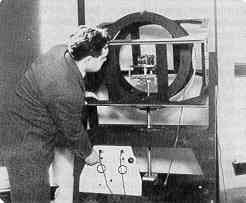
Charles Stark Draper is shown
with his compass analyzer. It used two Helmholtz coils and the
principles of Draper's gyroscope. This picture was taken about 1935
while Draper was developing inertial navigation. (Photo courtesy
of Massachusetts Institute of Technology.)
Johnson was a modest man. One day while answering a request for information about himself, he wrote ten short lines in longhand. The sixth line said, "Cleared up fundamental sources of circuit noise in 1925–1930."
1925 also saw Bell Labs license the Orthophonic phonograph to Victor. Clarence Birdseye extended the quick–freezing process to precooked foods; and IBM introduced the first horizontal sorting machine.
Henri Busignies invented the radio compass while still a student at Jules Ferry College in Versailles, France, in 1926. A related development was the work by H. Lowry of Vienna on using radio to determine the distance to an object. Lowry, who received the basic patent in 1926, called his technique "radio reflection ranging.
In 1927 Charles "Lucky Lindy" Lindbergh flew the Atlantic by himself, from New York to Paris, in 37 hours. Sound motion pictures advanced with "The Jazz Singer," starring Al Jolson. It was the first movie with synchronized voice.
The first overseas radiotelephone call was sent from New York to London in 1927. The call was placed by Adolph S. Ochs, publisher of the New York Times to Geoffrey Dawson, editor of The Times of London. Said Ochs: "Who now has the temerity to say that prayers are not heard in Heaven?" Ives at Bell Labs also demonstrated intercity TV transmission that year. He sent both image and sound on the same frequency band with a single radio transmitter from Whippany, NJ, to New York City.
At the same time, another worker at Bell Labs, Harold S. Black, invented the negative–feedback amplifier. It was used for minimum–distortion amplifiers in communication repeaters and later gave rise to feedback–control systems.
Black got the idea while on his way across the Hudson River by ferry to his laboratory on West St. in New York City. Shortly after, Harold Nyquist developed the Nyquist Diagram, which enabled designers to produce stable feedback circuits.
Five years after showing the first, crude model of a kinescope, Vladimir Zworykin at RCA demonstrated an improved version for viewing TV. This was 1928, the year the selenium rectifier was developed in Germany, the 80–column IBM punched card introduced, and the year Harold Wheeler developed the automatic–volume–control circuit.
It was 1929, the year of the great crash on Wall Street. Alexanderson developed a scanning–disc TV broadcasting system; Herman Affel and Lloyd Espenschied developed the first coaxial cable; and James K. Clapp and L. M. Hull designed the first commercial frequency standard, the C21H Harmonic Frequency Standard at General Radio. It put out harmonics of 1, 10 and 50 kilohertz.
That year David Sarnoff went to Zworykin at RCA, convinced of the inevitability and desirability of a television system employing the Iconoscope as its eye. He asked what Zworykin thought the system development might require in facilities and funds.
Zworykin, thinking only in terms of a working laboratory system, estimated optimistically that it might be handled with a couple of rooms and half a dozen men, at a cost of about $100,000.
What actually happened was a full–blown system development that cost about $50 million. Sarnoff was later to refer to Zworykin as the man who made the $49.9 million mistake.
Although it was kept secret at the time, 1930 brought the patent for America's basic radar system. Col. William R. Blair of the U.S. Army Signal Corps was issued a patent for pulse–echo direction finding and ranging. In 1937, a complete, working radar set based on Blair's principles was demonstrated for the Secretary of War and members of Congress.
1931 was an important year for electronics. A.H. Wilson presented a quantum–mechanics model of a solid semiconductor that has since become fundamental for understanding the behavior of semiconductors. He pictured electrons as waves throughout the solid or crystal lattice.
At certain frequencies there is interference between these waves and the lattice; waves of such frequencies cannot exist in the lattice. From the relation between frequency and energy, certain energies were thus excluded. His model led to the idea of energy bands existing in the solid.
Marcel Wallace at Panoramic Radio Corp. designed the first spectrum analyzer, an automatic scanning receiver with two bands — 355 to 555 kilohertz and 25 to 35 megahertz.
Great strides in vacuum tubes were made in 1933. RCA introduced the acorn tube, which operated down to 30 centimeters and laid the foundation for miniature high–frequency tubes in the future. At the same time Westinghouse was developing the ignitron as an efficient high–power rectifier. It was a steel–jacketed, water–cooled tube with a mercury-pool cathode. It ranged from a coffee canister in size, up to that of a two–foot tank, and was widely used during World War II.
Also, in 1933 Henrik Bode did important work with wave filters, General Radio developed the Impedance Bridge, and the first all–star baseball game was held. And on February 10 the Postal Telegraph Co. started to deliver singing telegrams.
Important events in 1934 included the introduction of the Q–meter by Boonton Radio and the development of the cyclotron at Berkeley by Ernest Orlando Lawrence.
Henri Busignies started a project in 1934 that spanned the next few years. He developed an automatic direction finder based on his earlier radio compass. The new device, used during World War II, was called a High–Frequency Direction Finder or "Huff–Duff." It quickly pinpointed the direction from which a radio transmission was coming.
IBM introduced the first commercially successful electric typewriter in 1935, Robert Watson Watt built the first practical radar for detecting aircraft and Arnold Beckman developed the pH–meter to measure the acidity of lemon juice for a friend from Sunkist. He used a null–type slidewire potentiometer bridge followed by a vacuum–tube voltmeter.
In the summer of 1937 Russell and Sigurd Varian and William Hansen invented the klystron. Hansen had developed cavity resonators, which he called rhumbatrons. The Varian brothers used Hansen's cavities and applied the principle of velocity modulation to come up with the klystron, a high power microwave oscillator that found a use during World War II in airborne radar. That year A. H. Reeves of ITT suggested pulse code modulation to allow for more bandwidth than was available at the time in communication systems. RCA built the first airborne radar system and the first scanning radar, and Joseph Sola developed the constant–voltage transformer. At Bell Labs, W. P. Mason devised a method for cutting crystals so that they would be virtually unaffected by temperature changes.
1938 saw William Hewlett and David Packard get together in a one–car garage behind Packard's apartment in Palo Alto, CA, to produce a diathermy machine for the Stanford Hospital, a thyratron drive for a telescope and foul–line indicators for bowling alleys.
But the product that really launched the partnership was the 200A Audio Oscillator. The circuit used was unique in applying an amplitude–dependent resistor — an incandescent lamp — as a stabilizing element in the feedback loop of a Wien–bridge RC oscillator; the crackle finish on the cabinets was produced in Mrs. Packard's oven. The cost was $85.
A presentation, made at an IRE meeting in Los Angeles, was heard by Walt Disney's chief sound engineer, who placed the largest order yet received — for nine units, to be used in connection with three–dimensional sound production in the movie Fantasia.
With 1939 came World War II.
On April 20 at the New York World's Fair RCA announced the first public television service. "Now we add sight to sound," said David Sarnoff. "It is with a feeling of humbleness that I come to this moment of announcing the birth in this country of a new art so important in its implications that it is bound to affect all society..."
In 1939, RCA announced the orthicon camera tube to replace the iconoscope in TV cameras and NBC broadcast the first televised big–league baseball game. RCA and Bell both developed radio altimeters that bounced FM signals off the surface of the earth and used a broadband receiver to track the reflections. To make microwave circuit analysis easier, P. H. Smith developed the Smith Chart for plotting impedance versus frequency.
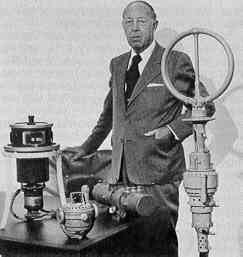
Henri Busignies gives the first model of his automatic direction finder
to the Smithsonian. His device, developed in 1936, was an outgrowth of
his earlier radio compass.
Henri Busignies developed the moving target indicator for wartime radar. It scrubbed off the radar screen every echo from stationary objects and left only echoes from moving objects, such as aircraft.
During 1940, most of the technological organizations were switching over to develop equipment for the war. Radar research was being pursued at the MIT Radiation Laboratory, Harvard's Radio Research Laboratory, Bell Laboratories, GE, RCA and elsewhere.
The British brought their cavity magnetron from the University of Birmingham to the U.S. where it was given to MIT for radar development. RCA introduced the first commercial electron microscope and TV started carrying a variety of sports for the first time.
In 1940 D. B. Parkinson and C. A. Lovell at Bell Labs conceived the fundamental idea for electronic analog computers. The first application was controlling World War II antiaircraft guns in the M9 gun director.
Arnold Beckman made a pair of significant developments in 1940. To improve the potentiometer in the pH–meter he invented the 10–turn helicalcoil potentiometer, which he named Helipot. He also developed the quartz ultra–violet spectrophotometer to measure accurately the vitamin A content of shark livers — a problem that arose as a result of wartime vitamin shortages.
Commercial FM broadcasting began on Jan. 1, 1941. That day 25 FM stations opened for business. Commercial TV was authorized on July 1 of the same year by the FCC. 21 stations started right up.
In Chicago and Los Angeles the Manhattan Project was begun to develop an atomic bomb. RCA contributed acoustical depth charges to the war effort and the Sniperscope infrared night–vision device.
On the early morning of Dec. 7, 1941, Private Joseph L. Lockard, just for practice, was scanning the skies off Pearl Harbor with a new radiodetection device. At 7:02 a.m. a swarm of aircraft swam into his detector's range. The detector told him their location, direction of flight and distance; They were offshore about 130 miles. At 7:20 a.m. he reported his findings to a superior officer, who dismissed them as a flight of B-17s expected from San Francisco. At 7:55 a.m. the Japanese Air Force hit Oahu. That was radar — and an historic example of the closed mind in action.
Magnetic tape was invented in 1942, and Chrysler built the first automobiles with alternators replacing de generators. Selenium rectifiers were used, which turned out to be too large, and they corroded easily. The experiment was dropped for a few years.
In 1943 the term "radar" was coined by Commander S. M. Tucker of the U. S. Navy. And Rudolph Kompfner invented the traveling wave tube in England and RCA developed the image orthicon TV camera tube. Both tubes were used during the war.
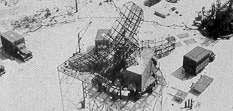
The V–beam radar was one of the most important developments to come
out of MIT's Radiation Laboratory during World War II. It was considered
the first practical do–everything radar.
(Photo courtesy of Massachusetts Institute of Technology.)
One of the first digital computers was developed in 1944, the Automatic–Sequence–Controlled Calculator invented by Howard Aiken at Harvard and used extensively by the U. S. Navy during the war. It had 78 adding machines and desk calculators all controlled by instructions punched onto a roll of paper tape.
Alamogordo, NM, was rocked in 1945 by the first detonation of a thermonuclear device. On Jan. 9, Gen. MacArthur's promise "I shall return" was fulfilled as American soldiers invaded Luzon in the Philippines. In all, 68,000 men landed.
On Feb. 23, six members of the Fifth Division of the U.S. Marines planted the American flag atop Mount Suribachi in Iwo Jima. Associated Press photographer Joe Rosenthal recorded the event in the most memorable photograph of World War II.
On Aug. 6, the atomic bomb was dropped on Hiroshima. On Aug. 8, another was dropped on Nagasaki. On Sept. 1 the war in the Pacific ended. Formal signing on board the U. S. S. Missouri in Tokyo Bay of the document of Japanese surrender was described in a world–wide radio broadcast.
In the May, 1946 issue of the Proceedings of the IRE, Harald Friis finally published his formula for radio transmission in free space — a formula evolved in the thirties. All microwave communication systems are based on this formula.
Since the war was over, RCA and others got back to the business of television. Television's "Model T" was the RCA Victor 630TS. This 10–inch picture–tube set sold for $375 and was the first postwar TV to be mass–produced and marketed.
RCA demonstrated the first all–electronic color TV. It used red, blue and green transmitted images which were combined and displayed on a 15 x 20-inch screen. The same year saw the formation of the group at Bell Labs that would invent the transistor.
First amplification of a voice signal by a semiconductor crystal was seen at Bell Labs by John Bardeen, Walter Brattain and William Shockley in December, 1947.
In 1948, the transistor was announced. By that time 600,000 TV receivers were in use and 45 TV stations were on the air. Kinsey issued his revolutionary report on Sexual Behavior in the Human Male.
But when Claude Shannon's treatise on information theory was published the nation was at the dawning of a new era. The computer and the transistor were about to burst forth.
Vol 24, number 4 Feb. 16, 1976
© 1976 Hayden Publishing Company Inc.
50 Essex St. Rochelle Park, NJ 07662
Historical Time Line — Introduction
The Foundation Years The Era of Giants The Communications Era
The Vacuum Tube Era The Transistor Era The Integrated Circuit Era
AM Broadcast Basics
The Original Theory for Radio was Presented by James Clerk Maxwell in 1873.
Nikola Tesla was the first to patent a workable system.
Gravity Site Link List Crossed-Field AM Antenna
Magnetism Maxwell's Equations in Magnetic Media