While some audiences in 1879 were being outraged by Ibsen's A Doll's House, others were listening to lectures on the latest electrical discoveries and inventions at England's Royal Institution, which held meetings each Friday during October and June. Ibsen dramatized the awakening of women from Victorian restrictions; the lecturing scientists sought to explain how electrical communications could liberate mankind from the tyranny of isolation.
These were forward looking men, but they could barely imagine all the implications of their work. Could Ibsen foresee Sigmund Freud's Three Treatises on the Theory of Sex, published 25 years later, or today's women's movement? Could Sir William Henry Preece — scholar, electrical researcher, inventor and lecturer — predict radio broadcasting, color TV, radar, and satellite repeaters, for reliable world–wide communications and navigation?
In one of Preece's lecturer at the Royal Institution in 1880, he described the "tremendous" improvement, that Wheatstone's alphabetical telegraphic apparatus had made possible in Great Britain's telegraph network. He reported about 5000 units then in use — an increase from the 1200 units of only 10 years earlier.
The eight telegraphic circuits of 1870 had by then grown to the "enormous" quantity of 150, and where earlier equipment could handle only 70 to 80 words per minute, the improved units could carry 150 to 180 words per minute.
In his enthusiastic report Preece said the Wheatstone apparatus had reached a peak of perfection — "at the head of the world, and the time is not far distant when even America will take advantage of the invention we are now using."
But the U.S. had its own inventors. They were busily tinkering with the next step in communications — telephony, which was destined soon to overshadow telegraphy.
Elisha Gray, co–founder of the Western Electric Company, and Alexander Graham Bell, were in a race to perfect a practical telephone. Gray was an expert electrician and Bell barely understood electrical principles, but ironically, Bell won the race. By 1880, when Preece was trumpeting the praise of Wheatstone's telegraphic apparatus in England, Bell in America was already selling some of his, shares in the Bell Telephone Company, putting himself in the millionaire class.
However, because Bell and most of the telephone company founders sold too soon, no heirs to mighty telephone fortunes survive.
The U.S. also was making great strides in other electrical fields. In 1880 as telephone lines began to span the country, Thomas Alva Edison was directing the installation of street lighting in New York City after patenting the electric–light lamp. He was self–educated, with only a minimal understanding of the work of Ampère, Faraday, Maxwell, Henry and Hertz.
It was only 1879 when William Edward Ayrton, an electrical engineer who did a great deal of work in electrical measurements and better known for his Ayrton shunt and the Ayrton–Mather galvanometer, pioneered electricity as a motive power for railways. Electric trolleys soon traversed the larger cities in the United States, and by 1895 the first main–line railway was electrified. Electric automobiles, such as the Runabout and the Electric Brougham (1900), made a tentative appearance, but were soon replaced by "gas guzzlers." However, it was 25 years after electric motive power was first used for railways before the Broadway–City Hall, electrically powered subway opened in New York City (1905).
Of course, Europe did a great deal of the pioneer work in electric–motive power. Siemens and Halske, a German company, exhibited what it claimed was the first electric railway at the 1879 Industrial Exhibition in Berlin; the Paris subway became operational in 1898, seven years before the New York system; and the first trolley bus, a light wagonette, is said to have run along the Kurfurstendamm in Berlin in 1882. Its rear axle was driven by two motors, each about 3 hp.
The end of the 70's ushered in a period of great activity and jealous competition among U.S. and foreign inventors. The outcome of patent battles in the courts often hinged on proof that an idea was conceived days or even hours prior to another inventor's claim. Bell and his backers defended thousands of suits against his patent — No. 174,465, issued March 7, 1876. All the attacks proved unsuccessful.
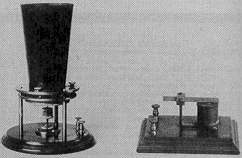
The first sentence ever spoken over the electric telephone was heard on this receiver (right) on March 10, 1876. The historic words: "Mr. Watson, come here; I want you," were uttered by Alexander Graham Bell into the transmitter. (Photo courtesy of Bell Labs.)
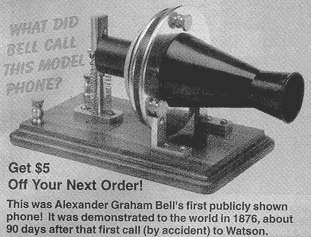
This first commercial telephone unit served as both a transmitter and receiver, and needed mouth–to–ear shifts. It went into service in 1877 when a Boston banker leased two instruments that were attached to a line between his office and his home in Somerville, MA. (Photo courtesy of Bell Labs.)
Even in his days of success, Bell was not above envying other inventors. When Edison invented the phonograph (1876-1878), Bell was deeply upset. Although busy with his responsibilities of improving and promoting his telephone and battling patent–infringement cases in court, he is said to have remarked, "It is a most astonishing thing to me that I could possibly have let this invention [the phonograph] slip through my fingers."
Edison again topped Bell when he created a practical carbon microphone (patented 1886) that made long-distance telephone practical. (Some historians attribute the carbon microphone to David Hughes in 1878.)
Bell's first liquid microphone wasn't practical, but his magnetic–inductive, or rather variable–reluctance, device, which he used as a microphone in later demonstrations and his first commercial system, developed very–low electrical outputs. Fortunately, the inductive device when used as a receiver was very sensitive, and allowed communications up to about 35 miles, but with a lot of shouting.
The carbon microphone, on the other hand, had amplifying qualities and could develop more power output than was present in the input energy of the sound, because of its valve–like modulation action. The induction microphone directly converted sound to electrical energy, but very inefficiently.
Edison's carbon microphone and Bell's magnetic receiver became, and remains to this day, the mainstay of the world's telephone systems. By 1887, the year Giuseppe Verdi composed the opera Otello, Hertz demonstrated, that electromagnetic waves behave like light waves and Edward Bellamy was writing, Looking Backwards, Bell Telephone's subscribers had grown from hundreds to millions; calls once made by names, now were done by numbers.
The phonograph was being invented and developed almost simultaneously with the telephone. In the beginning, many experimenters tried — most were unsuccessful — to reproduce sound by mechanical means. At best, they created musical tones. The human voice eluded clear reproduction.
Sound was studied, analyzed and even recorded. In 1857 a French scientist named Leon Scott developed the "phonautograph" that could record sound on a rotating, lamp–blackened cylinder, but the sound could not be played back. It was not until 1877, while experimenting with an automatic telegraph repeater, that Edison invented a recorder and reproducer of sound.
Interestingly, the U.S. Patent Office found no prior claims to any device bearing any resemblance to Edison's device. His phonograph used a spirally grooved, tinfoil–coated cylinder with a mouthpiece for recording sound by scratching "hill–and–dale" impressions, in the foil with an attached needle. A crank rotated the cylinder. For listening, a funnel horn replaced the mouthpiece.
Four years later, inventors Chichester Bell and Charles Tainter developed the idea of using a wax cylinder as an improved sound recording medium. In 1887, ten years after Edison's basic patent, the Volta Graphophone Company was formed to manufacture and merchandise the Graphophone, based upon the work of Bell and Tainter.
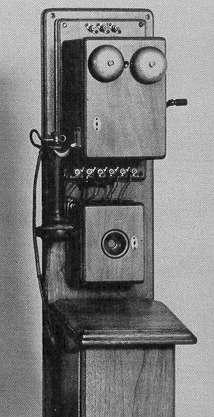
This 1882 magneto wall set, which used a Blake transmitter and Bell's
hand receiver, was the first telephone built for the Bell System by
Western Electric. You turned the crank to signal the operator.
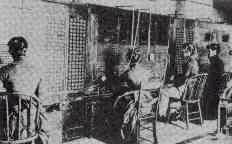
Switchboards in 1883 were separated by panels, known as annunciator drops,
which gave visual indications of telephone lines requesting service.
(Photo courtesy of Bell Labs.)
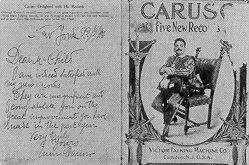
Enrico Caruso, the golden–voiced tenor, was as important to the initial
success of the recording industry as the industry was to the widespread
popularity of Caruso. Early recording techniques needed his powerful
voice to achieve good results. (Photo courtesy of RCA.)
Other inventors also were at work. During 1888 to 1901, Emile Berliner and Eldridge Johnson developed flat–disc records that could be mass-produced in hard rubber or shellac from a master record. These discs used lateral recording, as do today's records, a significant departure from Edison's hill–and–dale approach. To exploit these inventions, the Victor Talking Machine Co., forerunner of a major division of today's RCA, was founded. The rival Columbia Phonograph Company was organized by Edward D. Easton in 1888. Columbia later became RCA's competitor not only in records but also in broadcasting, color TV, and now in home–recorded TV, still in the development stage.
In England, an important merchandising innovation was tried in 1901, when the British Victor Talking Machine Company began recording noted opera singers. Under the name Monarch, it marketed recordings of dozens of celebrated European singers in 1903. A year later Victor released its first comprehensive Red Seal list of artists.
By 1905 Edison's phonograph company, following the lead of the British company, secured stars of New York's Metropolitan Opera for its recordings, featuring them under the trade name Diamond Disk records.
One of the most famous opera stars, who contributed substantially to the commercial success of the phonograph industry, was the "golden tenor" Enrico Caruso. Born in Naples, Italy, in 1873, he became a tremendous success at the Metropolitan in 1904 after initial success in Europe. His powerful, melodious voice made hundreds of recordings, now valuable collectors items.
The early crude mechanical recording systems needed a powerful voice like his to produce effective results. Thus there was a perfect "marriage." There is no doubt that phonograph records, which easily could distribute music to the masses, contributed as much to Caruso's widespread popularity as Caruso's voice contributed to the phonograph's initial success.
Mechanical improvements followed along with improved marketing techniques. A spring–wound motor and mechanical speed governor replaced the crank, and a radial tone arm carried the sound from a pick–up needle to a large Victor–phonograph "morning glory" horn. By 1905, the horn disappeared into a cabinet and the phonograph was called a Victrola.
During all this time (1877 to 1905) Edison continued to make improvements on the phonograph, his favorite invention and one of his biggest moneymakers. By 1910 the phonograph and record market had reached $7 million in sales.
The main use of the phonograph, of course, was for entertainment. Yet when he first invented it, Edison is said to have stated, "I don't want the phonograph used for amusement purposes. It is not a toy." Since today's multimillion recording industry is mainly for entertainment, though it serves also many serious purposes, historical, educational and artistic — it's interesting to speculate if Edison would consider today's phonograph a toy.
In the 1860's and 1870's the very idea of telephony or speech reproduction was equated by the public with supernatural phenomena. Voices that traveled over wires and came out of a box could only be mystical, or the result of insane hallucinations. How would the public react to communication without even the wires? The answer was soon to come.
In 1884 messages sent through buried insulated wires — no doubt
some carrying press releases of the success of Mark Twain's new novel,
Huckleberry Finn — were picked up on telephone circuits
erected on poles 80 ft above the ground. Telegraph circuits created
electrical disturbances in telephone lines 2000 ft away, and distinct
speech could be picked up from phone lines as far as a quarter
mile away. By 1892 messages were deliberately sent, by such inductive
methods, a distance of 3.3 miles across the Bristol Channel in England.
Weston Electrical Instrument Co.
Patented - Nov. 6, 1888
Meter #3926
(Nikola Tesla, almost for certain, had one of these in his lab.)
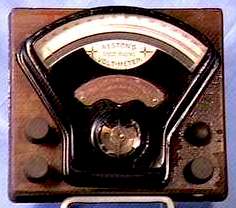
Weston's Direct-Reading Volt-Meter
On June 4, 1897, Sir William Preece reported to the Royal Institution on progress in "Signaling Through Space Without Wires." His concluding remarks again show the difficulty of farseeing beyond solutions to immediate problems.
After tracing the developments of wireless communication from James Clerk Maxwell (1864) and Heinrich Hertz (1887) to Guglielmo Marconi, he concluded, " . . . . enough has been done to prove its (wireless') value; for shipping and lighthouse purposes it will be great.
Preece observed that many critics claimed: "Marconi invented nothing new; his transmitter was old — not much different from the one Hertz used over 10 years ago and his receiver was based upon Branly's coherer (1890), invented about seven years earlier." Preece, to his credit, nevertheless defended Marconi as a true inventor:
"Columbus did not invent the egg, but he showed how to make it stand on its end, and Marconi has produced from known means a new electric eye more delicate than any known electrical instrument, and a new system of telegraphy. . . ."
Unlike Bell, who was disappointed that he didn't think of the phonograph first, young Marconi, only 23 years old, marveled that other workers in the field didn't apply Hertz' and Maxwell's work before he did:
"When I started my first experiments with Hertzian waves, I could scarcely conceive it possible that their application to useful purposes escaped the notice of eminent scientists."
The seers of the Victorian Era &151; men like Jules Verne, who wrote Twenty Thousand Leagues Under the Sea — were seldom the educated theoreticians and ivy–tower scholars. The doers were ambitious, practical men like Marconi and dedicated tinkerers like Bell and Edison.
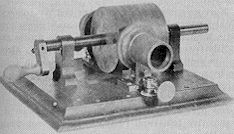
The early models of Edison's foil–on–a–drum recorders (1877-1880)
used a hill–and–dale cut for impressing the sound on the foil.
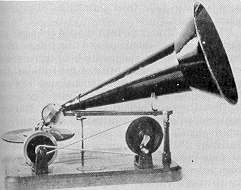
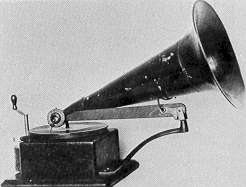
Later, improved disc-recording methods (1895) adopted a lateral–groove
technique.
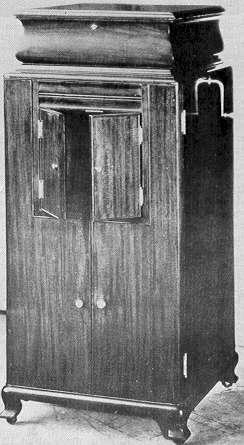
By 1901, governor–controlled spring drives replaced the hand crank
and then the horn disappeared into a cabinet as in the 1906
RCA Victrola. (Photos courtesy of RCA.)
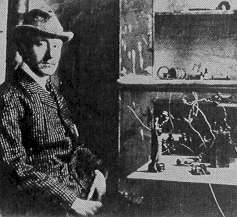
Guglielmo Marconi at the receiving set of his famous station in
St. Johns, Newfoundland, where on December 12, 1901 he picked up
the first transatlantic wireless signal–the letter "S" sent
from his transmitter at Poldhu. (Photo courtesy of RCA.)
Preece described his own approach to wireless communications as being based upon very low frequencies. "It depends upon the rise and fall of currents in the primary wire." Though Preece considered his system to use electromagnetic waves, in reality it mostly involved magnetic induction and perhaps some capacitive coupling.
By contrast, he explained, "Mr. Marconi utilizes electric, or Hertzian waves, of very high frequency, and they depend upon the rise and fall of electric force [?] in a sphere or spheres." He continued, "the peculiarity of Mr. Marconi's system is that apart from the ordinary connecting wires of the apparatus, conductors of very moderate length only are needed, and even these can be dispensed with if reflectors are used."
Marconi's transmitter was described by Preece as a form of Prof. Righi's Hertzian radiator: "Righi's waves are measured in centimeters, while Hertz's are in meters. For this reason the distance at which effects are produced is increased.
"Mr. Marconi generally uses waves about 120 cm long. The frequency of oscillation is probably. about 250 millions per second.
The distance at which effects are produced depends chiefly on the energy in the discharge that passes between the transmitter's spheres. A 6–in. spark coil has sufficed up to four miles, but for greater distances we have a more powerful coil — one emitting sparks 20–in. long."
Marconi's receiver was described as follows: "Marconi's relay consists of a small glass tube 4–cm long into which two silver pole pieces are tightly fitted, separated from each other by about half a millimeter — a thin space which is filled up by a mixture of fine nickel and silver filings mixed with a trace of mercury. The tube is exhausted to a vacuum of 4 mm and sealed. It forms part of a circuit containing a local cell and a sensitive telegraph relay. In its normal condition, the metallic powder is virtually an insulator. But when electrical waves fall upon them, they are 'polarized,' or as Prof. Oliver Lodge expresses it, they 'cohere.' The resistance of such a space falls from infinity to about five ohms.
"Mons. E. Branly in 1890 showed the same effect with copper, aluminum and iron filings. Marconi "decoheres" by making the local current very rapidly vibrate a small hammer head against the glass tube, and in doing so makes such a sound that reading Morse character is easy."
Then Preece described the distances Marconi achieved with his apparatus: "The distance to which signals have been sent is remarkable. On Salisbury Plain, Mr. Marconi covered a distance of four miles. In the Bristol Channel, this has been extended to over eight miles, and we have by no means reached the limit. It is interesting to read the surmises of others. Half a mile was the wildest dream."
But the dream, true to form, was not wild enough. By 1900, the year Giacomo Puceini's Tosca was being performed, Marconi was able to report to other audiences at the Royal Institution that the U.S. Navy easily communicated up to 36 miles in a demonstration to British authorities during maneuvers between the battleships New York and Massachusetts.
By 1902, he was able to report that with improved tuning techniques and new detectors he was able to pick up strong signals at a distance of up to 1551 miles and decipherable ones to 2099 miles — but only during the night. During the daytime, signals over 700 miles away failed entirely as a result of the Kennely–Heaviside effect.
By 1905 enough wireless activity had developed that Marconi was forced to report on how to cure radio–frequency interference among the growing number of radio stations. He noted: "One of the chief objections which is raised against wireless telegraphy is that it is possible to work only two, or a very limited number, of stations in the immediate vicinity of each other without causing mutual interference or producing a jumble by the confusion of the different messages."
Marconi pointed out that without organization and discipline similar problems can occur on telegraph lines: "Any message sent on a line will affect all instruments and can be read by all other telegraph offices on the line; but certain rules and regulations are laid down and adhered to by operators in the employ of the General Post Office. . . . It is obvious that these same rules are applicable to a group of equally tuned wireless telegraph stations that happen to be in proximity to each other."
Marconi then explained how his newly developed tuning system — "a proper form of oscillation transformer in conjunction with a condenser, so as to form a resonator tuned to respond best to waves emitted by a given length of vertical wire" — was a step in the right direction to a cure for the interference.
Marconi also worked on new detectors. He noted: "Up to the commencement of 1902, the only receivers that could be employed practically for the purposes of wireless telegraphy were based on what may be called the coherer principle." He claimed that his new magnetic detector "left all coherers and anti–coherers far behind." Improved versions of this detector could operate at 100 words per minute.
But the electrolytic detector, thermal detector crystal detector and the Fleming/Edison–Effect valve, which were more sensitive and better suited for continuous wireless and telephony were just being experimented with around 1905 and were to come into wide use to improve radio communications.
The Fleming valve, based on the Edison Effect, was the start of the science of electronics. Edison discovered in 1883 that a heated filament in one of his evacuated lamps produced a current flow to an adjacent metal plate, but he was 20 years ahead of the times. Professor John Ambrose Fleming of England in 1904 first put this effect to use as a rectifier to detect Hertzian waves. And Lee DeForest in 1906 discovered that when a mesh, or grid, of wire was placed between the filament and collector "plate" in such a Fleming two–electrode valve, a large voltage–amplifying effect was produced. This discovery led to the birth of the Audion, or triode, tube and the beginnings of electronics.
A revolution in physics that would help later to overshadow electronics, was taking place at the same time: the powerful new science of quantum mechanics was emerging. Albert Einstein was born in 1879, the same year that James Clerk Maxwell died at the early age of 48.
These events presaged the transition from continuum physics to quantum physics. The quantum concept was first formulated by Max Plank (1900), when he announced his theory of "black bodies." Einstein, though better known for his work in relativity (Special Theory, 1905; General Theory, 1915), contributed substantially to quantum mechanics with his work on electron photoemission phenomena, which helped establish the validity of quantum theory. In 1921 he received a Nobel Prize for this work. Quantum mechanics, of course, is today the basic tool in the design and understanding of solid–state devices.
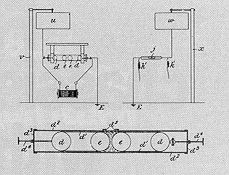
Marconi, in his U.S. Patent, issued July 13, 1897 his British patent
was issued July 2, 1897-shows versions of a transmitter (left)
and a receiver (right), and the blown–up section of the oscillator.
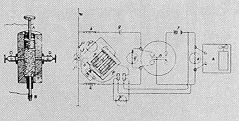
This diagram by Marconi of a Branly coherer shows how a tapper is
connected to decohere the unit after detecting an electromagnetic pulse
train.
The 26 years between 1879 and 1905 brought mankind from wired telegraphy and telephony to the beginnings of wireless communications.
The London Times of Saturday, December 21, 1901, reported in typically conservative fashion: "It would be difficult to exaggerate the good effect of wireless telegraphy if, as Mr. Marconi and Mr. Edison evidently believe, and as the Anglo-American Company [a transatlantic cable company] evidently fear, it can at no distant time be developed into a commercial success.... A cheap telegraphic service would unite families, however scattered, and would cement friendship between our own people and the Colonial nations, besides forging another link in the ties which bind this country to the United States."
Vol 24, number 4 Feb. 16, 1976
© 1976 Hayden Publishing Company Inc.
50 Essex St. Rochelle Park, NJ 07662
Historical Time Line — Introduction
The Foundation Years The Era of Giants The Communications Era
The Vacuum Tube Era The Transistor Era The Integrated Circuit Era
AM Broadcast Basics
The Original Theory for Radio was Presented by James Clerk Maxwell in 1873.
Nikola Tesla was the first to patent a workable system.
Gravity Site Link List Crossed-Field AM Antenna
Magnetism Maxwell's Equations in Magnetic Media
The Tortoise Shell Life Science Puzzle Box Front Page