The Vacuum Tube Era (1905 — 1948)
Taking the Crucial Step for Modern Technology
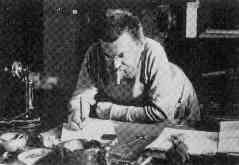
Charles Proteus Steinmetz pioneered research in alternating current, artificial lightning, power transmission systems and several other areas while working for General Electric in the early 1900s; — Expanding the work of Nikola Tesla, the man who conceived and patented these concepts.
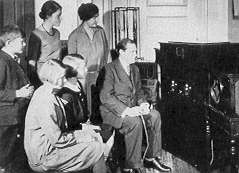
Ernest F. W. Alexanderson and his family watched the first home demonstration of television in 1929. He developed the broadcasting system based on mechanical scanning disc technology.
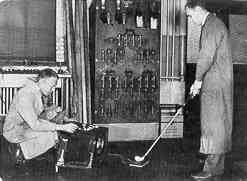
Harold E. Edgerton is about to take a swing at a golf ball. A unique electronic circuit for high–speed photography called the stroboscope is operated by Kenneth Germeshausen to record the event. Edgerton is credited with invention of the device. Germeshausen aided in the design. (Photo courtesy of Massachusetts Institute of Technology.)
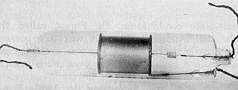
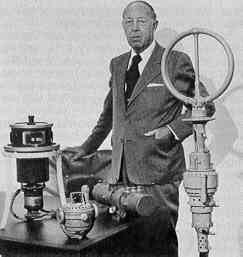
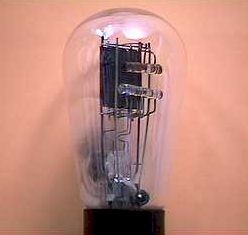
The magnetron, a vacuum tube whose electron current is controled by a magnetic field, was invented by Albert W. Hull in 1920.
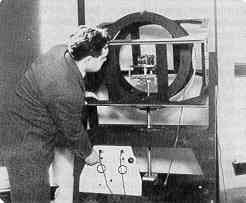
Charles Stark Draper is shown with his compass analyzer. It used two Helmholtz coils and the principles of Draper's gyroscope. This picture was taken about 1935 while Draper was developing inertial navigation. (Photo courtesy of Massachusetts Institute of Technology.)
Henri Busignies gives the first model of his automatic direction finder to the Smithsonian. His device, developed in 1936, was an outgrowth of his earlier radiocompass.
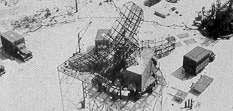
The V–beam radar was one of the most important developments to come out of MIT's Radiation Laboratory during World War II. It was considered the first practical do–everything radar. (Photo courtesy of Massachusetts Institute of Technology.)
Electronic Design
Vol 24, number 4 Feb. 16, 1976
Historical Time Line — Introduction
The Foundation Years
The Era of Giants
The Communications Era
The Vacuum Tube Era
The Transistor Era
The Integrated Circuit Era
AM Broadcast Basics
Gravity
Site Link List
Crossed-Field AM Antenna
Magnetism
Maxwell's Equations in Magnetic Media
The Tortoise Shell Life Science Puzzle
Box Front Page
for engineers and engineering managers
© 1976 Hayden Publishing Company Inc.
50 Essex St. Rochelle Park, NJ 07662
The Original Theory for Radio was Presented by James Clerk Maxwell in 1873.
Nikola Tesla was the first to patent a workable system.