Is This AM Antenna for Real ?
Engineers Wonder if the Crossed–Field Antenna
Could Revolutionize the Science of AM Radio Transmission
by W. C. Alexander — copied from
Radio World,
March 31, 1999
Imagine an AM antenna one–fiftieth of a wavelength long, that needs no
radial ground system, occupies a small parcel of land, produces little or no
RFI (Radio Frequency Interference), has great bandwidth and performs better
than a full–sized vertical radiator.
Does this sound like a fantasy?
Until recently, it would have been.
Now working models of such an antenna exist in the Middle East and at NAB99
(National Association of Broadcasters' 1999 Convention in Las Vegas — TRC — ).
( The "reversed form" (negative solution) of
Maxwell's Fourth Equation, states that a magnetic field can be produced
without current flowing in a wire. — TRC — )
On April 19, 1999, at the Las Vegas Convention Center, Brian Steward from the
Department of Engineering at Glasgow Caledonian University presented a
paper on what has been patented as the Crossed–Field Antenna.
Synthesized field
Most of us have known since early in our electronics training that any
conductor in which a radio frequency current flows can be an antenna.
When an Radio Frequency current flows in a conductor, an electric (or E)
field and a magnetic (or H) field are produced. These two fields are in
quadrature (Their amplitude phases are 90° from each other.) with one
another, and at some distance, presumably
{ (increment) / 2 pi }
combine into an electromagnetic field, which is the desired element. A
conventional antenna, be it a dipole, a vertical radiator over a ground
plane, a long wire or anything else, works on this principle.
More than a decade ago, Maurice Hately, a college professor in Scotland,
along with his then–student, Fathl Kabbary, began work on a completely
different antenna design. The basic premise of this radical design is that a
magnetic field can be produced without current flow in a wire. Hately and
Kabbary claim that using the reversed (negative solution) form of Maxwell's
fourth equation, they were able to prove that a magnetic field does exist
between two capacitor plates to which a Radio Frequency voltage has been
applied.
From this beginning Hately and Kabbary report they were able to produce
direct synthesis of the electromagnetic field using two large capacitor
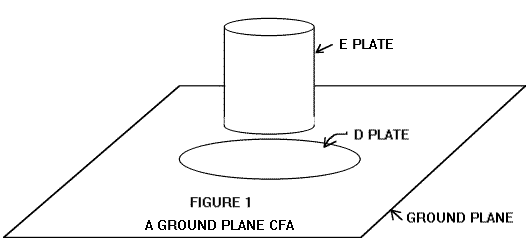
plates and two large cylinders of short length. The capacitor plates, called
"D plates" for the term "D" in the Poynting theorem, were positioned parallel
to one another to form a capacitor. The cylinders, called "E plates" were
positioned one above and one below the D plates. When the cylinders were
driven by a radio frequency power source, they produced high–frequency
E–fields, thus the designation "E plates".
Crossing effect
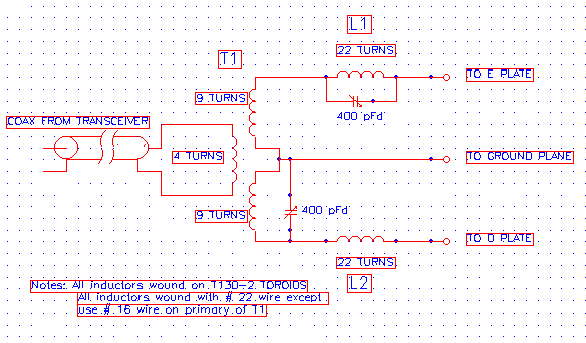
To synthesize the electromagnetic wave, radio frequency power is fed through
a power divider / phasing network to the D and E plates. The resulting
electric and magnetic fields are cross–stressed in phase to synthesize
the Poynting vector and produce radiated power within the small area
surrounding the antenna. This effect is what gives the Crossed–Field
Antenna (CFA) its name.
Several variations of the Crossed–Field Antenna were developed and
tested. The barrel–shaped CFA was first: it featured the same radiation
pattern as a dipole. The next evolution removed one of the cylinders and
one of the plates, substituting a ground plane instead.
Later, Kabbary returned to his native Egypt and continued experimenting with
a ground plane antenna for broadcast. He successfully built and tested a
couple of different configurations, settling on a design only 12–feet
high over a ground plane of only 10 square meters. He has documented the
successful testing of this antenna on 1161kHz at a power level of 60 kW.
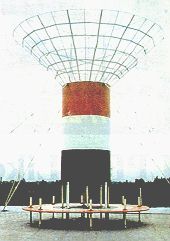
In 1995, Kabbary made some radical design changes to the antenna, adding a
funnel–shaped top (see photo).
This design reportedly produced the same inverse distance field with 30 kW
as the conventional one–quarter wavelength vertical it was intended
to replace produced with 100 kW.
The funnel–top CFA based in Egypt is
only 21 feet tall, less than 0.025 wavelengths long. The vertical antenna
it replaced was 211 feet long. Test results show up to a 9 dB (800%)
advantage over the one–quarter wavelength vertical antenna.
Reported advantages of the CFA over conventional radiators include:
- Very small size, typically around a one–fiftieth wavelength.
- High efficiency, with a 6 dB (400%) gain typical relative to a
conventional one–quarter wavelength vertical radiator.
- Little induction field, which produces very little coupling between
adjacent antennas.
- Broad bandwidth.
Today, four such antennas are reported on the air and operating in broadcast
service in Egypt. Two are at Tanta, operating from a rooftop at 22 kW and 100
kW respectively and separated by less than 20 feet. One is in operation at
Barnis at 110 kW and the other operates in Halaieb at 5 kW.
If the Crossed–Field Antenna proves to be everything the inventors
claim, it could revolutionize the state–of–the–art in AM
transmission systems, which has changed little since the days of Marconi.
The paper is part of the session "Radio Transmission Systems — Digital
and Analog". 1– 5 p.m. Monday, April 19, at the Las Vegas Convention
Center.
Patent 2,215,524 was issued in Great Briton, 626,210 in Australia and others
issued in Europe and Japan. In 1992 the U.S. issued Patent Number 5,155,495.
Cris Alexander is director of engineering for Crawford Broadcasting and a regular
contributor to "Radio World".
How to Build a 75 / 80 Meter CFA
Link to antenneX Online Magazine
From
"Radio World" — June 21, 2000
Optimizing the Signal
Thomas R. McGinley
This year's National Association of Broadcasters annual rite of Radio Frequency and Signal Optimization, included the
normal menu of transmitter and antenna topics.
It also included papers on emergency planning and preparedness, as well as
network and Web-based remote control of transmitters and facilities.
It also covered the distribution of broadcast audio over telecommunications networks.
Antenna Science
The final paper of the session featured Manohar Lal, chief engineer of "All India Radio", New Delhi India.
Lal presented theoretical details of a new concept antenna, which produces high efficiency and high gain with small dimensions. The concept is derived from the modification of Maxwell's displacement current.
In the 1860s, James Maxwell formulated the equations upon which the laws of electromagnetic radiation are based. Lal states in his paper that Maxwell identified a displacement current from the extrapolation of Ampere's law. It was merely a charging current such as that which exists between the plates of a capacitor and did not radiate a magnetic field. Its current was uniform in the whole area between the plates.
Lal suggests that this displacement current can be modified to flow only at the periphery of the plates and thereby produce a magnetic field around it.
He claims to have tested the hypothesis and can launch a signal with gain, bandwidth and directivity properties, which could revolutionize the science of building antennas.
Tom McGinley is a 35-year veteran of radio engineering. He is employed by Infinity Broadcasting, for which he recently assumed managerial duties in the Seattle market. He is technical adviser to Radio World.
The Crossed–Field Antenna Theory by Maurice C. Hately
& Ted Hart
link to antenneX Online Magazine
When is a Quarter Wave Not a Quarter Wave?
Maxwell's Equations in Magnetic Media
Fractal Antennas Offer Benefits
AM Broadcast Basics
The Original Theory for Radio was Presented by James Clerk Maxwell in 1873.
Nikola Tesla was the first to patent a workable system.
The Electric Force -
The Magnetic Force -
Gravity
Site Link List -
The Resonate Coil Project
The Tortoise Shell Life Science Puzzle
Box – Front Page
View this page Full Frame