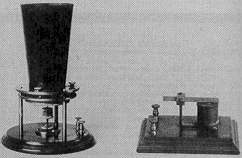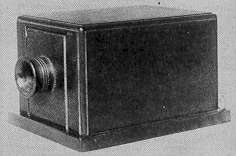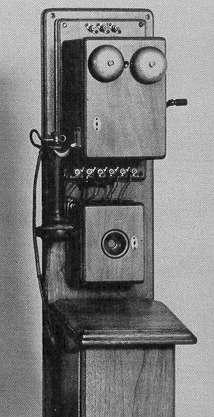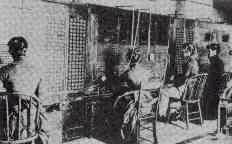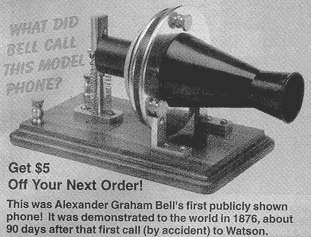
This first commercial telephone unit served as both a transmitter and receiver, and needed mouth–to–ear shifts. It went into service in 1877 when a Boston banker leased two instruments that were attached to a line between his office and his home in Somerville, MA. (Photo courtesy of Bell Labs.)This 1882 magneto wall set, which used a Blake transmitter and Bell's hand receiver, was the first telephone built for the Bell System by Western Electric. You turned the crank to signal the operator. Switchboards in 1883 were separated by panels, known as annunciator drops, which gave visual indications of telephone lines requesting service. (Photo courtesy of Bell Labs.)
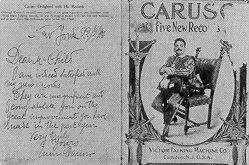
Enrico Caruso, the golden–voiced tenor, was as important to the initial success of the recording industry as the industry was to the widespread popularity of Caruso. Early recording techniques needed his powerful voice to achieve good results. (Photo courtesy of RCA.)
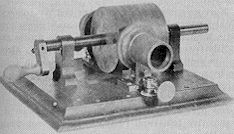
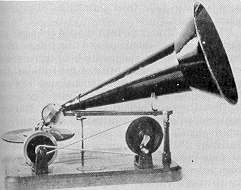
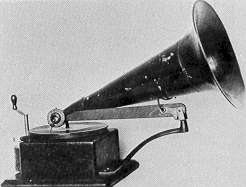
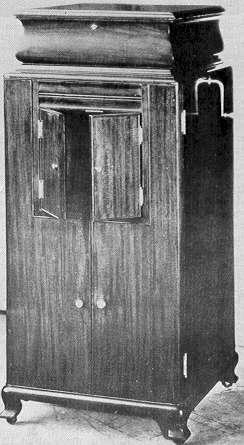
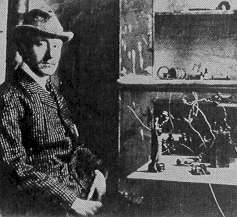
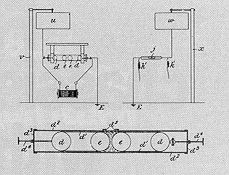
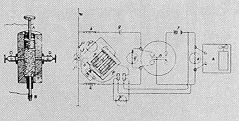
The early models of Edison's foil–on–a–drum recorders (1877-1880) used a hill–and–dale cut for impressing the sound on the foil.Later, improved disc-recording methods (1895) adopted a lateral–groove technique. By 1901, governor–controlled spring drives replaced the hand crank and then the horn disappeared into a cabinet as in the 1906 RCA Victrola. (Photos courtesy of RCA.) Guglielmo Marconi at the receiving set of his famous station in St. Johns, Newfoundland, where on December 12, 1901 he picked up the first transatlantic wireless signal–the letter "S" sent from his transmitter at Poldhu. (Photo courtesy of RCA.) Marconi, in his U.S. Patent, issued July 13, 1897 his British patent was issued July 2, 1897-shows versions of a transmitter (left) and a receiver (right), and the blown–up section of the oscillator. This diagram by Marconi of a Branly coherer shows how a tapper is connected to decohere the unit after detecting an electromagnetic pulse train.
Vol 24, number 4 Feb. 16, 1976
© 1976 Hayden Publishing Company Inc.
50 Essex St. Rochelle Park, NJ 07662
Historical Time Line — Introduction
The Foundation Years The Era of Giants The Communications Era
The Vacuum Tube Era The Transistor Era The Integrated Circuit Era
AM Broadcast Basics
The Original Theory for Radio was Presented by James Clerk Maxwell in 1873.
Nikola Tesla was the first to patent a workable system.
Gravity Site Link List Crossed-Field AM Antenna
Magnetism Maxwell's Equations in Magnetic Media
The Tortoise Shell Life Science Puzzle Box Front Page