The Diagnosis of Mineral Deficiencies in Plants by Visual Symptoms
London — Published by His Majesty's Stationary Office — 1943
— Crown Copyright Reserved —
by Thomas Wallace, M.C., D.Sc., A.I.C.
University of Bristol Agricultural and Horticulture Research Station,
Long Ashton, Bristol
CHAPTER III
Methods of Determining Mineral Deficiencies in Crops
Since 1840, when Liebig enunciated his mineral theory of the nutrition of crops, much attention has been given to methods of determining the mineral needs of plants.
Liebig put forward the view that it would only be necessary to make a sufficient number of crop analyses to ascertain their mineral requirements, and the amounts removed by crops, based on the data, could be returned to the soil by adding the requisite amounts of the minerals by means of chemical fertilizers.
This simple conception based on plant analysis was soon shown to be erroneous by Lawes, who in the course of carrying out field experiments on the manuring of turnips, showed that this crop required liberal treatment with phosphates, whereas Liebig had concluded from his analyses that turnips would grow with little phosphatic manuring.
Since then, methods of determining mineral deficiencies have been developed along the following lines:
1. The chemical analysis of whole plants or parts of plants.
2. Field and pot culture trials to determine the effects of withholding or adding mineral nutrients to the soil.
3. Soil analysis to ascertain the supply of nutrients in the soil.
4. The addition of mineral nutrients direct to the plant by injection and spraying methods.
5. Visual methods of diagnosis based on deficiency symptoms shown by plants.
From about 1920 great advances have been made in methods of plant analysis, and at the present time much information can be gained by their use.
The following are the main points requiring attention in using the methods:
1. Leaves are usually the most satisfactory parts of plants on which to make the analyses. They represent the seat of active growth processes. Other parts of the plants often function as storage organs and draw upon the various elements absorbed in a selective way. Stems and petioles also are usually suitable.
2. The leaves utilized should be metabolically active when sampled, otherwise senescent effects may have developed, i.e.; leaves should not be used in which deficiency effects have proceeded too far.
3. When leaves are to be compared they should be of similar physiological age, and should be taken at the same period during the growth season. These two conditions are necessary since, at any given time, leaves on the same plant, but at different stages, of development differ in mineral composition, and individual leaves or groups of leaves vary in mineral content during the course of the growth season. Thus the leaves on a given shoot show a decreasing K/Ca ratio from tip to base, i.e., from young to old, whilst if the composition of a given leaf or group of leaves is examined at intervals during the growth season, the actual mineral contents will be found to differ and the ratios of the various nutrients to alter in a systematic way. Changes of this kind are illustrated in the following data:
| TABLE II | % Ash in Dry Matter | As % Ash | As % Dry Matter | |||||||
|---|---|---|---|---|---|---|---|---|---|---|
| CaO | MgO | K2O | P2O5 | CaO | MgO | K2O | P2O5 | N | ||
|
Cauliflowers Young Leaves Old Leaves |
10.66 13.84 |
18.10 33.96 |
2.48 1.19 |
27.11 22.95 |
16.0 8.89 |
1.92 4.69 |
0.26 0.16 |
3.69 3.17 |
1.76 1.23 |
5.28 3.31 |
|
Brussels Sprouts Young Leaves Old Leaves |
10.58 18.30 |
16.36 35.13 |
2.48 0.63 |
33.26 21.60 |
10.63 3.64 |
2.69 5.33 |
0.26 0.11 |
3.52 3.95 |
1.12 0.67 |
4.89 3.96 |
| Month of Sampling |
% Ash in Dry Matter | As % Ash | As % Dry Matter | |||||||
|---|---|---|---|---|---|---|---|---|---|---|
| CaO | MgO | K2O | P2O5 | CaO | MgO | K2O | P2O5 | N | ||
| June | 6.39 | 24.14 | 6.92 | 26.30 | 10.25 | 1.54 | 0.44 | 1.68 | 0.65 | 2.76 |
| July | 6.73 | 22.64 | 6.26 | 28.60 | 7.73 | 1.52 | 0.42 | 1.92 | 0.52 | 2.32 |
| August | 6.97 | 24.86 | 6.04 | 26.18 | 5.86 | 1.73 | 0.42 | 1.82 | 0.41 | 2.37 |
| Sept | 7.50 | 26.93 | 6.04 | 25.67 | 5.27 | 2.02 | 0.45 | 1.92 | 0.40 | 2.22 |
| Oct. | 7.82 | 29.16 | 5.77 | 21.37 | 4.26 | 2.28 | 0.45 | 1.67 | 0.33 | 1.84 |
| Nov. | 6.74 | 35.66 | 7.21 | 16.83 | 3.29 | 2.40 | 0.49 | 1.13 | 0.22 | 1.59 |
The type of results obtained by using such methods in comparing healthy leaves with leaves showing deficiencies of nitrogen, calcium, magnesium, potassium and phosphorus respectively, are illustrated by the examples given in Table IV. Similar examples can be quoted for nutrient elements not shown in the table.
Comparisons of Mineral Constituents of Leaves from Healthy Plants
showing no Deficiency Symptoms with those from
Plants with various Mineral Deficiencies
| Plants Used |
Natures of Mineral Deficiencies | As % Dry Matter | ||||
|---|---|---|---|---|---|---|
| CaO | MgO | K2O | P2O5 | N | ||
| Kale |
Healthy Ca, Mg, P. |
6.46 3.53 |
0.54 0.31 |
4.64 6.01 |
0.50 0.30 |
— — |
| Potato |
Healthy Mg |
6.43 4.88 |
0.66 0.33 |
4.19 6.96 |
— — |
— — |
| Mangold |
Healthy K |
3.36 5.25 |
1.42 1.69 |
3.32 1.31 |
— — |
— — |
| Carrot |
Healthy N* K*† |
4.17 4.59 4.14 |
0.69 0.71 0.60 |
5.19 4.94 2.75 |
0.49 0.81 0.72 |
1.55 1.20 1.53 |
| Apple |
Healthy Ca, Mg Mg Mg, K K |
1.52 0.78 1.84 2.72 2.40 |
0.42 0.30 O.28 0.28 0.51 |
1.92 3.30 1.39 0.72 0.42 |
— — — — — |
— — — — — |
| Black Currant |
Healthy Mg K N, K |
4.60 4.56 6.02 5.30 |
0.44 0.32 0.51 0.54 |
0.45 0.64 0.65 0.78 |
0.75 0.57 0.67 0.62 |
3.05 3.05 2.94 2.76 |
* N and K not down to starvation levels these samples.
*† This sample low K value accompanied by high Na2O Value — Na2O in Healthy sample 0.64%; in K sample 1.70%.
Numerous determinations on leaves of fruit trees have enabled various workers to suggest minimum values for certain of the elements as being necessary for healthy growth.
The author's minimum values for calcium, magnesium and potassium in leaves of terminal shoots of apple trees collected in late July or early August are:
A notable development in the chemical method has been introduced Lagatu and Maume in France, which they have termed Foliar Diagnostics (known also as Foliar Diagnosis). W. Thomas and his colleagues have, also used the foliar diagnosis method, with great success in the U.S.A..
Since this method illustrates well the stage of development reached in the use of chemical methods to attack problems of mineral deficiencies, its essential points are given below. (See also Refs. 13, 23, 24.)
Leaves at a definite point on the plant, e.g., the third leaf from the base the terminal shoots of a vine, are selected as the material to be analyzed on the plants to be compared, one of which is a healthy, high-yielding plant.
Leaves are taken for analysis at the chosen points on three or more occasions during the growing season, and determinations made of three of the mineral nutrients (say N, P, K or Ca, Mg, K). The sum of the three nutrients on a milligram equivalent basis is calculated for each sample and also the percentages of the three individual nutrients forming the total. The sum gives the "quantity" or "intensity" of the nutrition (e.g., N + P + K in the leaf) and the percentages of each in the total, the "quality" of nutrition (e.g., ratios of N: P: K). The latter values for the various sampling times are plotted on a triangular diagram, and when the points are joined for a given plant the course of the seasonal ratio trend is apparent. The diagram for the plant suspected of a deficiency of some element is compared with that for the healthy plant.
The method has been used successfully to show up many instances of faulty nutrition in a variety of crops.
Another line of research in chemical methods has been the search for quick methods of analysis. The ordinary chemical methods are very tedious and slow. The speeding-up process has occurred in two directions: by the use of approximate tests on plant tissues, generally based on color actions, which can be made in the field, and by the application of spectrographic methods of analysis. The tissue tests have been found to be useful indicating deficiencies in various crops in the U.S.A.
The spectrographic methods provide very rapid means of carrying out large numbers of determinations, but the apparatus required is very expensive and determinations can only be made under expert guidance. Instruments such as the spectrograph and the polarograph are likely to be used very largely for this type of work in the future.
Neubatier, in Germany, has evolved a novel method in which he uses seedling rye plants as the extractant for potash and phosphoric acid. The seedlings are grown in pots under standard conditions in a mixture of washed sand with the soil to be examined and the amounts of potash and phosphoric acid extracted during the seedling growth stage are determined.
Mitscherlich and Wiessmann have developed other methods in which plants are used.
During recent years, much attention has been given to quick soil tests, which can be made in the field and in which the results are judged mainly by color reactions. Here, again, use is made of weak solvents as extractants. The best known of these methods is, perhaps, that of M. F. Morgan, of the Connecticut Agricultural Experiment Station, in the U.S.A.
Soil analyses are very useful for giving indications of deficiencies, particularly of such elements as phosphorus and potassium, and for providing information on soil acidity and alkalinity and organic matter content, but the data require expert interpretation. Moreover, the results must often be regarded only as pointers to deficiencies, and must not be used too rigidly or too categorically. The method of soil analysis can be of great value for indicating the possibilities of deficiencies occurring, even before any crop is planted, thus providing valuable forward information. It has been used very successfully in this way during the war period in connection with the breaking up of grassland and derelict areas for arable cropping. The method has the practical disadvantages that it can only be used by the scientifically trained expert, is expensive and requires extensive laboratory facilities and equipment.
It has long been known that chlorosis of the foliage of vines, due to iron deficiency, could be cured by painting the cut surfaces of pruned branches with sulfate of iron, but the modern technique of utilizing injection and spraying methods for the diagnosis and cure of deficiencies is of recent development. The methods in the early stages of development were mainly worked out for deficiencies of trace elements in trees, especially iron. The importance of this element was early recognized in connection with the occurrence of chlorosis in various parts of the world, and it was found that the trouble could not be satisfactorily treated, by applying the necessary iron salts to the soil.
Bennett, in California, worked out a technique for the injection of iron salts in solid form into the stems and branches of chlorotic fruit trees and applied the treatment successfully in commercial orchards. Since the work of Bennett, this method has been widely used both for diagnostic and curative purposes with several elements. The best time to employ solid injections is during the dormant season just prior to bud break. It is important to use suitable dosages, as under-dosages may not be effective and over-dosages may result in serious injury to the trees. Bennett has given a table of dosages of iron salts for use on fruit trees, which in the author's experience is also suitable for manganous sulfate. Smaller rates are necessary for compounds on, zinc and copper.
Roach, at East Malling, has made a thorough investigation of the subject of liquid injections, and has described his results fully in Technical Communication, No. 10, Imperial Bureau of Horticulture and Plantation East Malling. He has developed techniques for diagnosing deficiencies by injections in leaves, shoot tips, petioles and stems. Liquid injections have also been used successfully for diagnosing deficiencies both of trees and agricultural crops. They are best used on crops in the early of growth. Liquid injection methods, especially the more refined leaf, shoot and petiole injections require a fair amount of skill in operation and experience in the interpretation of the results.
Spraying methods have the great merit of simplicity, the main details requiring attention being the correct strength of spray to use, so as to be effective but not damaging to the foliage, and the appropriate time to spray.
They can be applied both to trees and to all sorts of field crops, and in the latter, for diagnostic purposes, nothing more elaborate is needed way of apparatus than a watering can fitted with a fairly fine rose. For certain crops, such as the Brassicae, onions and leeks, it is necessary to add a wetting agent to the spray solution, and for this purpose ester salts at a concentration of 2% by volume ( Suggested by Dr. H. Martin, Long Ashton Research Station. ) has been found satisfactory.
Like liquid injections, sprays are best applied to leaves at an early stage of growth. Concentrations between 0.1 and 1.0% are suitable for compounds of trace elements, and between 1 and 4% for those of major nutrients. Responses from spray treatments usually require a period of one to two weeks to become clearly visible in the foliage.
This knowledge has been gained in the following way. Plants were grown in sand and water cultures under controlled conditions and fed by means of solutions of pure chemicals. Deficiencies of the individual nutrient elements were created in the nutrient medium by omitting each separately from the complete nutrient solution and the symptoms for each deficiency produced in this way were recorded.
The symptoms were subsequently checked by comparison with instances in the field of deficiencies proved to be due to the same causes.
Since details of the visual method and its use are given in the two following chapters, it is only necessary at this stage to refer to one or two general points. In the first place, it is only possible to use the method because the symptoms of the various deficiencies for any given plant are generally quite distinct visually from each other, and where they are not, other special indicator plants can be used to settle the doubtful issue (see Chapter V), or a check can be obtained by one of the other methods described in this chapter.
Like other methods it has its disadvantages. For instance, symptoms of certain deficiencies on cereal crops are not very distinctive and, in fact, cereals, on the whole, are poor subjects on which to use the method. Again, symptoms may be complicated or suppressed by other factors, such as weather conditions and pests or disease organisms, and the inexperienced may be led to form entirely wrong conclusions. Nevertheless, with experience, the observant farmer can learn to use the visual method quickly and with great advantage. For many years fruit growers in this country have used the symptoms of deficiencies of nitrogen and potassium, and to a less extent, of magnesium, on their trees as the basis of the use of these elements in their manurial programs, and some can also recognize the less common deficiencies of phosphorus, iron and manganese.
A further disadvantage of the method is that the symptoms of the deficiencies must develop before they can be recognized, and this may be too late to apply remedial measures to save annual crops, though if an early diagnosis is made, effective action can usually be taken. The great advantages of the method are its speed and the fact that where the symptoms do not require confirmation no apparatus of any kind is necessary.
In using the plant analysis method, the results may indicate that more than one of the trace elements is in short supply, whereas in the field a measurable response may only be obtained from one of the elements.
Even in field trials in which fertilizer elements are added to the soil, a wrong conclusion may be drawn. Thus with deficiencies of manganese and iron, responses may be obtained from applications of sulfur, due to its acidifying action in the soil, when the result of the trial would suggest sulfur deficiency. Or again, in trees suffering from these two deficiencies, no responses may be obtained from applications of manganese or iron salts to the soil, owing to conditions which render them unavailable to the trees. Under such circumstances the conclusion would be reached that neither element was deficient, whereas injection or spraying treatments would show the contrary to be true.
The method of soil analysis cannot predict deficiencies with absolute certainty. Thus it can only fix approximate levels for potash and phosphate below which deficiencies are likely to be serious and cannot foretell accurately the occurrence of less common deficiencies, such as magnesium, manganese and iron.
The injection and spraying methods may give responses in the early stages of growth which will not be reflected in the eventual crop yields.
With the visual method, there are circumstances in which deficiency
symptoms may be masked entirely by pests and diseases, such as by eelworm
or by viruses in potatoes, or by the rust fungus, pseudopeziza ribis, on
black currants, which completely suppresses mineral deficiency symptoms
which would appear late in the growing season.
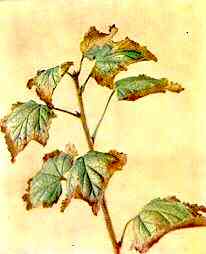
Again, symptoms produced by pests and diseases, mechanical injury or
weather conditions may be indistinguishable from certain mineral
deficiency symptoms. Thus leaf symptoms on young cereals and young
Brassica plants may be identical for wireworm, cutworm, root injury,
cold weather and phosphorus deficiency, whilst symptoms indistinguishable
from those of magnesium deficiency may be produced by canker infections
or mechanical damage to the bark of apple trees. Symptoms of chloride
injury are often almost identical with those of potassium deficiency.
( See
plate 68 and
plate 114 ).
Finally, for certain plants the symptoms of certain deficiencies are very similar and difficult to distinguish. Thus, chlorosis may be the symptom produced by deficiencies of both iron and manganese, as for example on apples, plums, raspberries and Brassica crops, and at certain stages during the season the particular deficiency could not be diagnosed with certainty from symptoms alone, although the presence of suitable indicator plants would usually make diagnosis possible.
The most successful diagnosis of deficiencies is obtained by a combination of the methods. It will often be necessary to use only two of the methods in a complementary way, as, for example, visual diagnosis in conjunction with injection or spraying, or the visual method with a partial examination of the soil conditions. Thus, when there is any doubt about a supposed instance of manganese deficiency, it can usually be confirmed by spraying or by an examination of the soil.
The method (or methods) of diagnosis used in any given case must depend on the circumstances in the field, on the facilities available and on the technical qualifications and experience of the individual making the diagnosis. When simple procedures can be followed they should be used, but in difficult cases the expert, with his specialized equipment and technique, will be needed.
In conclusion, it can be stated that, by the skilful use of the methods described, it should be possible to solve most problems of mineral deficiencies in crops that are likely to occur in Great Britain in either agricultural or horticultural practice.
(1) Askew, H. 0. (1935). The Boron Status of Fruit and Leaves in Relation to "Internal Cork" of Apples in the Nelson District. N. Zealand jour. Sc. and Tech., 17, 388.
(2) Bennett, J. P. (1931). The Treatment of Lime induced Chlorosis with Iron Salts. Univ. of California Agric. Expt. Sta., Circ. 321.
(3) Chapman, G. W. (1941). Leaf Analysis and Plant Nutrition. Soil Sc., 52, 63.
(4) Dyer, B. (1894). On the Analytical Determination of probably available "Mineral" Plant Food in Soils. Trans. Chem. Soc., 45, 115.
(5) Garner, W. W., McMurtrey, J. E., jr., Bowling, J. B., and Moss, E. G. (1930). Magnesium and Calcium Requirements of Tobacco Crop. jour. Agric. Res. 40, 145.
(6) Haas, A. R. C. and Quale, H. J. (1935). Copper Content of Citrus Leaves and Fruit in Relation to Exanthema and Fumigation Injury. Hilgardia, 9, 143.
(7) Harmer, P. M., and Berne, E.Ld (1941). Effects of applying Salt to a Muck Soil on the Yield, Composition Quality of Certain Vegetable Crops and on the Composition of the Soil producing them. J. Amer. Soc. Agron., 33, 952.
(8) Hartt, C. F. (1934). Some Effects of Potassium upon the Growth of Sugar Cane and upon the Absorption and Migration of Ash Constituents. Plant Physiol., 9, 399.
(9) Hartt, C. E. (1934). Some Effects of Potassium upon the amounts of Protein and Amino Acid Forms of Nitrogen, Sugars and Enzyme Activity of Sugar Cane. Plant Physiol., 9, 453.
(10) Heater, J. B., Blume, J. M., and Shelton, F. A. (1937). Rapid Chemical Tests for Coastal Plain Soils. Virginia Truck Expt. Sta., Bull., 95..
(11) Karmarkar, D. V. (1934). The Seasonal Cycles of Nitrogenous and Carbohydrate Materials in Fruit Trees. I . The Seasonal Cycles of Total Nitrogen and of Soluble Nitrogen Compounds in Wood, Bark and Leaves portions of Terminal Shoots of Apple Trees under two Cultural Systems - Grass plus Annual Spring Nitrate and Arable without Nitrogenous Fertilizer. J. Pomol and H 12, 177.
(12) Knowles, F., Watkin, J. E., and Cowie, G. A. (1940). Some Effects of Fertilizer Interactions on Growth and Composition of the Potato Plant. 30, 159.
(13) Lagatu, H., and Maume, L. (1924-1933). Investigations on Leaf Diagnosis. Collected Notes from Comptes rendus de I'Acadèmie des Sciences. Annales de l'ècole nationale d'agriculture de Montpelier. N.S. 22, 4, 257-306. (Notes translated and circulated by Imp. Bur. Fruit Prod., East Mallinf
(14) Lehr., J. J. (1941, 1942). The Importance of Sodium for Plant Nutrition, Soil Sc., 52, 237, 373; 53, 399.
(15) Liebig, J. (1840). Chemistry in its Application to Agriculture and Physiology Report to British Assoc.
(16) Litleland, O., and Brown, J. C. (1939, 1941). The Potassium Nutrition of Fruit Trees, II. Leaf Analyses. III. A Survey of the K Content of Peach Leaves from one hundred and thirty Orchards in California. Pr. Amer. Soc. Hort. Sci., 36, 91; 38, 37.
(17) McDonald, J. A. (1933). A Study of the Relationship between Nutrient Supply and the Chemical Composition of the Cacao Tree. Third Annual Re Cacao Res. 50.
(18) McDonald, J. A., and Rodriguez) G. (1934). The Effect of Manurial Treatments on the Chemical Composition of Cacao Leaves: The Diagnosis of Soil and Crop Nutrient Requirements by means of Leaf Analysis. Fourth Ann. Report on Cacao Res. 75.
(19) Morgan, M. F. (1939). The Universal Soil Testing System. Conn. Agr. Expt. Sta. Bull. 392 (1937). Revised as Circ. 127.
(20) Oserkowsky, J. (1933). Quantitative Relation between Chlorophyll and Iron in Green and Chlorotic Pear Trees. Plant Physiol., 8, 449.
(21) Roach, W..A. (1938). Plant Injection for Diagnostic and Curative Purpose. Imp. Bur. of Hort. and Plantation Crops, East Malling, Tech. Coinm. 10.
(22) Stewart, R. (1932). The Mitscherlich, Wiessmann and Neubauer Methods of Determining the Nutrient Content of Soils. Imp. Bur. Soil Sc., Tech. Com. 25
(23) Thomas, W. (1937). Foliar Diagnosis: Principles and Practice. Plant Physiol., 12: 571.
(24) Thomas, W. (1937). Foliar Diagnosis- Application of the Concepts of Quantity and Quality in Determining Response to Fertilizers. P. Amer. Soc. H( 35, 269.
(25) Thornton, S. F., Conner, S. D., and Fraser, R. (1939). The Use of Rapid Chemical Tests on Soils and Plants as Aids in Determining Fertilizer Needs. Univ. Agr. Expt. Stn. Circ. 204 (revised).
(26) Vaidya, V. G. (1938). The Seasonal Cycles of Ash, Carbohydrate and Nitrogenous Constituents in the Terminal Shoots of Apple Trees and the Effects of Five Vegetatively Propagated Rootstocks on Them. I. Total Ash and Ash constituents. J. Pomol. and Hort. Sci., 16, 101.
(27) Wallace, T. (1928). The Effects of Manurial Treatments on the Chemical Composition of Gooseberry Bushes. I. Effects on Dry Matter, Ash and Ash Constituents of Leaves and Stems of Terminal Shoots and of Fruits: and on Total Nitrogen of Fruits. J. Pomol. and Hort. Sci., 7, 131.
(28) Wallace, T. (1928). Investigations on Chlorosis of Fruit Trees. III. A Chlorosis of Plums due to Potassium Deficiency. J. Pomol. and Hort. Sc., 7, 184.
(29) Wallace, T. (1929). Investigations on Chlorosis of Fruit Trees. IV. The Control of of Lime-induced Chlorosis in the Field. J. Pomol. and Hort Sc., 7, 21
(30) Wallace, T. (1930). Experiments on the Manuring of Fruit Trees. III. The Effects of Deficiencies of Potassium, Calcium and Magnesium respectively on the Contents of these Elements and of Phosphorus in the Shoot and Trunk Regions of Apple Trees. J. Pomol. and Hort. Sc., 8, 23.
(31) Wallace, T.' (1931). Chemical Investigations relating to Potassium Deficiency of Fruit Trees. J. Pomol. and Hort. Sc., 9, 111.
(32) Wallace, T. (1935). Investigations on Chlorosis of Fruit Trees. V. The Control of Lime-induced Chlorosis by Injection of Iron Salts. J. Pomol. and Hort 13, 54.
(33) Wallace, T. (1940). Chemical Investigations relating to Magnesium Deficiency of Fruit Trees. J. Pomol. and Hort. Sc., 18, 145.
(34) Wallace, T. (1940). Magnesium Deficiency of Fruit Trees. The Comparative Base Status of the Leaves of Apple Trees and of Gooseberry and Black Currant Bushes receiving various Manurial Treatment under Conditions of Magnesium Deficiency. J. Pomol. and Hort. Sc., 18, 261.
(35) Wallace, T., and Ogilvie, L. (1941). Manganese Deficiency of Agricultural and Horticultural Crops. Summary of Investigations, Season 1941. Ann. Rep. Long. Ashton Res. Stn., 45.
(36) Wallace, T., and Proebsting, E. L. (1933). The Potassium Status of Soils and Fruit Plants in some cases of Potassium Deficiency. J. Pomol. and Hort. Sc., 11, 120.
Color Pictures of Mineral Defeciencies in Plants - 1943
Using Hydroponics to Understand the Earth's Life Processes
on the Atomic Level
The Tortoise Shell Hydroponic Reference Center
Understanding Colloidal Suspensions
Plants need to absorb what you feed them.
" The Art of Healing Ourselves "
Only You can bring Good Health and Healing into Your Body.