Among fruits, visual symptoms of calcium deficiency have only been noted
in apple trees, and these in sand culture experiments.
The symptoms shown were: Death of the growing points of terminal shoots
followed by die-back of the affected shoots; scorching and forward rolling
of the leaf margins, the tip leaves being first affected.
MAGNESIUM DEFICIENCY
Symptoms of this deficiency are most marked on the foliage, and the effects
always develop initially on the oldest leaves and proceed systematically
towards the younger ones. Chlorotic effects are common, which is not
surprising in view of the fact that magnesium is a constituent of
chlorophyll, the green coloring matter of the leaf. But chlorosis is
by no means the only color effect produced, and brilliant tints are
often developed. The deficiency is most prevalent towards the end of the
growth seasons of plants, but it may appear in seedlings, especially in
rainy periods. ( See Plate 26 ).
The usual sequence of
events is that the oldest leaves are the first to develop the characteristic
symptoms, which intensify either gradually or quickly, whilst
simultaneously they spread progressively towards the younger leaves.
Severely affected leaves may wither and be shed, or may absciss without
the withering stage. Defoliation may be extremely severe, as for
instance, with apple trees, where by August or September a heavy-cropping
tree may be left bearing no leaves other than those on the tips of
shoots and be unable to ripen the crop.
The remarkable variety of effects produced by magnesium deficiency on the
leaves of different kinds of plants makes it necessary to learn the
symptoms for individual plants, but when they are known, their great
variety has the advantage that it enables abundant cross checking of
symptoms in field diagnosis.
Where magnesium deficiency symptoms develop in annual plants at a late
stage in their growth period, yields may not be appreciably reduced, but
in perennials such as fruit, a prolonged deficiency results in stunted
growth and eventually in a useless tree.
The deficiency has been of very rare occurrence in cereals in this country.
The leaf symptoms take the form of an intervenal chlorotic striping and
growth may be considerably dwarfed.
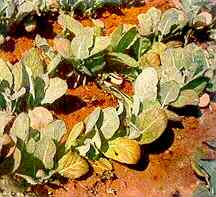
Brassicae, as a group, appear very susceptible to the deficiency, and of
these cauliflower, broccoli and kale are most severely affected. In these
crops the symptoms begin in a similar fashion, as an intervenal chlorotic
mottling or "marbling" of the older leaves. The affected leaves later
develop tints which may be very brilliant (especially in cauliflower
and broccoli) yellow, orange, red and purple colors predominating.
In swedes, the whole of the chlorotic areas may become reddish purple
and the deficiency may be confused with phosphorus starvation.
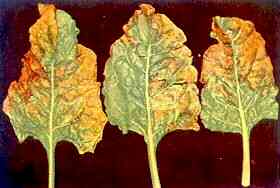
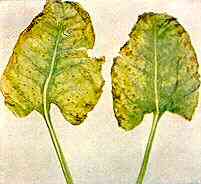
In sugar beet, the symptoms begin as a faint intervenal chlorosis
(resembling a water-soaked condition) near the leaf margins and extend
between the lateral veins towards the midrib. The chlorosis subsequently
increases in intensity and yellowish tints are developed. Finally,
areas near the leaf margins and between the veins become necrotic,
and produce a scorching effect, and the older leaves may wither.
These symptoms may be confused with those of virus "yellows" but can be
distinguished from them by the patchy distribution of symptoms over the
leaf and the orange tinting produced by the virus. ( See Plate 30 and
Plate 110 )
Potatoes may show severe effects of the deficiency, and in this crop some
variation in symptoms is shown by different varieties. The leaves may or
may not show considerable chlorosis, beginning as usual at the base of
the plant. Necrosis may develop either marginally and extend in a patchy
fashion between the veins towards the midrib (e.g., Sharpes Express)
or may occur intervenally over a well-defined central area around the
midrib, leaving a clear, green, marginal band (Dunbar Standard).
Affected leaves may wither quickly and hang vertically down the stem
or be shed. Defoliation may be serious. One example was noted where
severity in a "blight" attack (phytophthora infestans) was clearly
related to areas of magnesium deficiency.
In tomatoes, the lower leaves first show intervenal chlorosis and
yellow patches may occur in the chlorotic areas. The leaf margins
may or may not remain green, and the leaves may show some marginal
roll towards the upper surfaces. Intervenal necrotic patches develop
later, and finally the leaves wither and are either shed or remain
hanging vertically on the stems.
The most severe effects of the deficiency in this country have occurred
on apples, the leaves of which show a variety of symptoms. In their
simplest form the symptoms consist merely of an intervenal necrosis,
either in areas around the midrib or beginning near the margins and
developing progressively towards the midrib, The brown necrotic
condition is preceded by a slight fading of the normal green color
in the areas to be later affected and these light green areas also
feel limp and thin to the touch. The necrosis may be preceded by purple
tinting which fades as the necrosis develops, or the necrosis may be
accompanied by an intervenal chlorosis. In some examples of marginal
necrosis it is difficult to distinguish the symptoms from those which
result from potassium deficiency.
Under acute magnesium deficiency, the fruits of apples fail to ripen
normally on the trees, and are small, poorly colored and lack flavor.
The leaf symptoms shown by other fruit plants are as follows:
Pears, very dark brown intervenal patches, developing first near the
midrib and spreading outwards, the margin remaining green; plums and
cherries, brown intervenal and marginal necrosis, with varying degrees
of chlorosis; gooseberries, a broad red marginal band which eventually
fades to pale yellow or cream; black currants, the leaf surface becomes
a vivid purple color with the exception of a marginal band, which
remains green, and the leaf tends to curl back towards the under
surface; raspberries, the central portion and the margin of the leaf
become yellow, with a green band separating the tinted areas;
strawberries, the tinted pattern is similar to that of raspberries,
but bright orange, red and purple tints are developed.
POTASSIUM DEFICIENCY
Symptoms of potassium deficiency may vary according to the extent of the
shortage of the element. Thus in a mild deficiency in cereals, plants
with rather thin shoots may be developed and, where the deficiency is
acute, shoots may die back and stunted plants with numerous tillers but
few or no flowering stems, result. In trees, a slight deficiency leads
to somewhat restricted shoot growth, and the shoots are thin, whilst
when severe no terminal shoot growth occurs and shoots or entire branches
die back, and eventually the tree may die. Leaf symptoms are striking,
and though somewhat varied are generally very characteristic for the
different kinds of plants. The color of the leaves may be dull
bluish-green, and there may be some chlorosis, especially in intervenal
areas. One of the following symptoms will invariably occur, beginning
on the older leaves; browning of the tips (tip burn), marginal scorching
(leaf scorch), the development of brown spots, usually most numerous near
the margins; this last symptom may occur along with marginal scorching.
The laminae of the leaves of many broad leafed plants show a tendency
either to curl backward toward the under surfaces or roll forward towards
the upper surface parallel with the midrib. Scorched margins often turn
sharply forward.
Considerable stunting usually follows from potassium deficiency,
internodes of stems are short, the production of grain and fruit is
greatly curtailed and root systems may be very poor, trees often being
loose in the soil.
Broad-leaved crops which show scorched leaf margins should always be
suspected of potassium deficiency, but it must be pointed out that this
symptom may result from other causes, such as calcium or phosphorus
deficiencies, chloride injury, damage from salt spray, drought, drying
winds, burning from fertilizers, etc.
Important symptoms for some of the more important plants are as follows:
In cereals, the plants are either thin and grain formation is poor, both
heads and individual grains being small, or they may tiller excessively
and have few flowering stems, whilst growth is soft and the leaves
somewhat bluish-green or slightly chlorotic, and leaf tips and margins
may show browning. Barley appears to be the most susceptible cereal.
The leaves of Brassica crops are bluish-green and may show slight
intervenal chlorosis. Leaf margins show scorching and leaves may tend
to curl backward, with the scorched edges curling sharply forward.
Scorching may progress intervenally from the margins towards the
midribs in cauliflowers. Growth is slow, and in consequence the leaves
are tough and unpalatable.
In sugar beet and mangolds, the leaves may appear somewhat upright in
habit. The older leaves develop marginal browning which extends
intervenally towards the midrib. Finally, the scorched leaves wither
and fall round the plant.
Potassium deficiency is of outstanding importance in potatoes. When
severe the plants are very squat in habit. The leaves lack luster, are
dull, bluish-green and may show intervenal chlorosis. The margins and
tips develop browning and innumerable small, dark brown spots, which
eventually coalesce, are apparent on the undersides. The upper surfaces
of the leaves have a characteristic bronzed appearance. The leaves show
crinkling and curling towards the under surfaces. They eventually turn
brown and wither and may be shed, or the stems may collapse and the haulms
lie as a brown mass on the soil. Tuber size is much reduced and crops may
be negligible.
Tomato plants have a high requirement for potassium. When the element is
deficient the plants are woody and growth is slow. The leaves are
bluish-green in color. In the lower leaves, the green around the margins
and between the veins fades to a pale grayish color, and the leaf margins
eventually become scorched and curl forward towards the surface. Scorching
may progress towards the upper leaves. The leaves may also show bronzing,
and small, yellow and orange patches may develop on some of the leaflets.
The fruits often fail to ripen evenly, and may show sharply defined,
green patches near the stalks (greenback), or greenish-yellow patches,
which merge into the general red color of the surface (blotchy ripening).
Clover is one of the crops in which spotting of the foliage occurs in
addition to marginal browning, With this plant the leaves first show
some chlorotic spotting and marginal chlorosis, and these are followed
by browning of spots and margins.
Onions and leeks show as the chief leaf symptom browning of the tips,
which progresses down the leaves in the manner of a "die-back". Parsnips,
carrots and beans, and to a less extent peas, are often affected by
potassium deficiency. Chlorosis and scorch occur on these plants, and
with peas the leaves may show spotting as for clover.
The deficiency is of outstanding importance for fruit, especially apples,
gooseberries, red currants and raspberries. With all, growth is stunted
and dieback of shoots and branches common; the leaves are bluish-green
and may show some intervenal chlorosis, and all show typical marginal
scorch, either brown or gray in color; blossom buds may be plentiful in
the early stages of the deficiency but fruit yields are very low and
quality is of the cull grade.
On apple leaves, marginal scorching is the outstanding symptom, and there
may be some intervenal chlorosis. Apple fruits may be fairly highly flushed
or remain green and of immature appearance; they are sub-acid and woody to
taste. In pears, the scorched margins of the leaves are almost black. In
plums, peaches and cherries, there may be considerable chlorosis in
addition to scorch, and some varieties show considerable forward rolling
of the leaf margins, In gooseberries and black currants, marginal
scorching is generally preceded by purple tinting of the leaves which
disappears as scorch develops. Red currants show some intervenal chlorosis
in addition to marginal scorch. Raspberries and other rubi, in addition
to marginal scorching, exhibit intervenal browning.
SODIUM DEFICIENCY
The only crops on which sodium deficiency effects may be said to be shown
are the sodium-loving crops, such as sugar beet, mangolds and turnips.
Where sodium is in short supply for these plants, the leaves are dark
green, rather dull, wilt rapidly in drought and many tend to grow out
horizontally from the crown of the plant.
SULFUR DEFICIENCY
Drastic deficiency of sulfur in the field has been reported for tea, in
which shoot growth becomes restricted, leaves decrease in size, become
rolled towards the upper surfaces, are stiff and brittle, and show marked
chlorosis and yellowing; defoliation is severe and eventually terminal
buds die and branches die back. The condition is known as it "tea yellows".
Sand cultures with tomatoes and fruit plants have shown that the effects
of sulfur deficiency in many ways resemble those due to nitrogen
deficiency. Shoot growth becomes restricted, though less so than with
nitrogen deficiency; stems are stiff, woody and thin; growth is erect
and yellowing and tinting of the leaves occur. In the author's
experiments brilliant orange and red tints were developed on apple,
gooseberry and strawberry foliage.
IRON DEFICIENCY
Iron deficiency is much more common in fruit plants than in vegetable or
agricultural crops. The main symptom is always severe chlorosis of the
leaves, and young growths are always most severely affected. In some
instances the leaves may be almost wholly bleached and in others the
chlorosis may produce a mottled pattern. Scorching of leaf margins and
tips may occur in extreme conditions.
Since chlorosis due to iron deficiency has almost invariably been
associated with soils of high lime content, it is often termed
"lime-induced chlorosis".
Cereals, other farm crops and vegetables are evidently very resistant
to iron deficiency in the field, since they are grown even on chalk
soils without showing appreciable deficiency effects.
A soil derived from the Dolomitic Conglomerate is the only one known to
the author to produce iron deficiency in cereals, and here the condition
is complicated by the presence of high amounts of zinc in the soil. The
young plants become markedly chlorotic, especially the tops of the plants,
and leaf tips die. The plants eventually become very weak, remain
stunted and may die.
Brassica crops suffering from iron deficiency all show chlorotic
"marbling" effects on the leaves, and occasional leaves are completely
bleached. The symptoms are very similar to those of manganese deficiency,
and frequently it would be impossible to distinguish between the two
deficiencies on these crops from visual symptoms alone.
On tomatoes, the leaves near the tips of the plants show a chlorotic
mottling, the chlorosis being most pronounced near the midrib and towards
the bases of the leaflets.
In apples, pears, plums and cherries, the chlorotic symptoms are similar
and definitely more severe on the young leaves at the tips of the shoots,
In severe examples the shoot tips die and the die-back may extend
downwards into the large branches.
Raspberries, and other rubi, are very severely affected, and chlorotic
leaves may occur for considerable distances down the shoots from the tips.
Gooseberries and currants are not as susceptible as raspberries or the
tree fruits, and often the only leaf symptom is a slight intervenal
chlorosis of tip leaves.
Strawberries may be severely affected, when the leaves show severely
chlorotic intervenal areas whilst the veins remain green.
MANGANESE DEFICIENCY
Chlorosis of the leaves is one of the most common symptoms of manganese
deficiency, but the detailed symptoms are very varied.
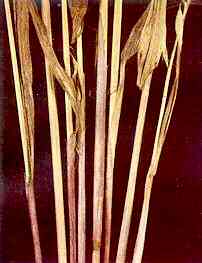
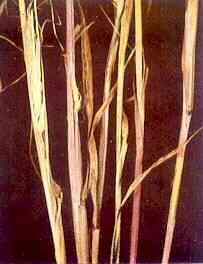
Among cereals, oats is the most susceptible crop, and total failures from
manganese deficiency are common. The deficiency in oats is known as "Gray
Speck" disease. The leaf symptoms usually appear on the older leaves in
the early spring, when the plants are four to six inches high. The basal
portions become somewhat yellowish; gray or buff-colored specks or
streaks appear, chiefly in the basal halves and often most severely
near the margins. The streaks tend to elongate and coalesce, and
severely affected tissue turns brown. The leaves eventually break
over near the distal ends of the seriously affected basal parts. The
tissue above the break may remain green and hang down limply. The
brown areas may also twist into the form of spirals. In the final stage,
severely affected leaves turn brown and wither. The root system is often
very poorly developed and badly affected plants may die out completely.
Substantial recovery may occur naturally after mid-summer, when growth
may show much improvement and heads may be formed, but usually there
is relatively little grain and many of the heads are "blind".
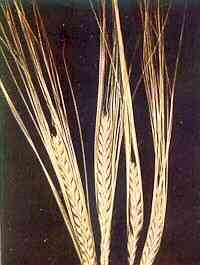
In wheat and barley the leaves are somewhat pale green and may show only
faint chlorotic streaking and yellowing. On severely affected wheat plants
intervenal white lesions are developed and on barley numerous small brown
spots and lesions occur along intervenal areas. Affected leaves on the
lower parts of the plants turn brown and die off.
In Brassica crops the symptoms first appear as an intervenal, chlorotic
marbling. With severe deficiencies the whole of the leaves may be
practically bleached, only the veins remaining green, as in kale, or
some necrosis may develop in the mottled tissue, when it takes on a
dull, brownish gray appearance, as in savoys.
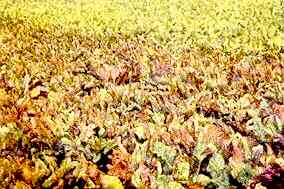
The symptoms shown by sugar beet, mangolds and garden beet are very
characteristic, the condition in sugar beet being known as "Speckled
Yellows". The leaves tend to be more upright than usual and somewhat
triangular in outline, due to curling of the margins towards the upper
surfaces. In sugar beet and mangolds, the intervenal tissue becomes
chlorotic, but in garden beet the chlorosis is masked by the red pigment
of the leaves, although the green color disappears from the leaves and
they appear a rather faded red color. The red tinting is very striking
when seen in a bed of plants.
( See Plate 85 ).
Brownish spots may
appear in the intervenal areas and the brown tissue may die and fall out
leaving small holes.
In potatoes, the tip leaves lose their luster and turn pale, and tend to
be small and rolled towards the upper surfaces. Small blackish-brown
spots may be developed on the leaves along the veins, and although these
are more numerous on the pale leaves near the tips of the shoots, they
may also be present on older leaves which are still green.
In severe conditions the plants in the mass show much browning and
yellowing, especially in the young foliage.
Of vegetable crops, parsnips show a very characteristic intervenal
chlorosis; in spinach and spinach beet the symptoms are similar to
those of sugar beet; dwarf beans become strongly chlorotic and the
chlorotic tissue develops necrotic areas; runner beans show a mild
intervenal chlorosis in Cos Lettuce the older leaves become chlorotic;
parsley leaves show browning of the leaf margins; in marrows there is
a striking intervene chlorotic mottling; onions develop chlorotic
streaking of the leaves.
In peas, the deficiency produces a very characteristic condition of the
seed known as Marsh Spot. The plants themselves may appear quite healthy
or, with a severe deficiency, may show a somewhat chlorotic condition
in the foliage. When the seed coat is removed and the two cotyledons
separated, either a small brown speck or a larger, circular brown area
seen on the flat surfaces. The areas may become hollowed out in very
severe conditions.
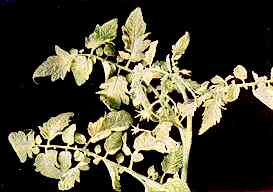
Although acute manganese deficiency occurs in tomatoes in the U.S.A
where the plants become markedly chlorotic, only very mild instance
have been observed by the author. In these only the tip foliage was
affected, the symptoms taking the form of an intervenal, chlorotic
mottling on the young leaves, similar to that caused by a mild iron
deficiency. ( See Plate 74 ).
The following symptoms have been noted on fruit plants:
Apples:
The leaves develop an intervenal chlorosis which begins
near the margins and extends towards the midrib, and finally only the
veins remain green. Strongly growing young shoots may be only little
affected, which is a point of difference from iron deficiency, where
the chlorotic condition is always most severe in the young tip foliage.
Pears:
The normal green of the leaves may appear slightly faded
and a somewhat faint intervenal chlorosis develops, beginning near the
margins and progressing towards the midrib. The chlorosis is very
distinct from that due to iron deficiency.
Plums and Peaches:
The type of symptom is similar to the apple;
peaches especially may become severely chlorotic.
Cherries:
The leaves show a marked intervenal chlorosis with a
very definite pattern, beginning near the. margins and progressing
towards the midrib.
Black Currants:
The tip leaves become slightly chlorotic. Severe
effects have not been observed.
Raspberries:
The leaves, especially on the upper parts of the
shoots, become severely chlorotic; the appearance is very similar to
that due to iron deficiency.
BORON DEFICIENCY
Boron deficiency is responsible for a large number of so called "diseases".
The best known of these are "Heart Rot" of sugar beet and mangolds,
"Canker" of table beet, "Brown Heart" of swedes (also known as "Raan")
and turnips, "Browning" or "Hollow Stem" of cauliflower, "Cracked Stem"
of celery, alfalfa "Yellows", "Drought Spot" (or "Cork", "Corky Core"
or "Corky Pit") of apples, "Hard Fruit" of citrus and Top Sickness of
tobacco.
The list leaves no doubt as to the importance of the deficiency in crops,
and also indicates the wide variety of symptoms which have given rise to
the numerous descriptive names applied to the "diseases".
With many plants growing points are severely affected and may die, and
stems and leaves may show considerable distortion. Both the pith and
epidermis of stems may be affected, giving rise to hollow and roughened
stems. Leaves are often scorched and curled, and may show slight mottling
or some pigment formation. Fruits when affected are severely deformed
and useless.
The deficiency is not known in cereals in the field, and they may have
a very low requirement for boron.
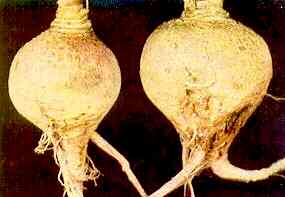
The Brassicae, as a family, may suffer severely. Cauliflowers are
particularly susceptible, the symptoms consisting of a browning of
the curd (the curd may actually fail to develop), distortion of the
young leaves and a hollow condition of the stem. Marrow stem kale
shows some distortion and growth restriction near the growing point,
a slight mottling of the younger leaf margins and a hollow condition
of the stem. A crack develops in the stem at the hollow portion and
infection with bacillus caratovorus may occur. Cabbages are fairly
resistant; young plants may show distortion of the leaves and old
plants water-soaked or breakdown areas in the pith of the stems in
the region of the heads. Swedes and turnips may show no external
symptoms in tops or roots, but when the roots are cut across transversely,
patches of water-soaked and slightly brownish-colored tissue, surrounded
by tissue of more normal appearance, may be seen occupying the central
portions. With an acute deficiency the center of the root may be hollow.
The roots are fibrous and somewhat bitter to taste. In one severe instance
in swedes examined by the author, roughening of the skin on the upper
portions of the roots occurred. ( See Plate 99 )
Very characteristic external symptoms are shown by sugar beet and mangolds.
In young plants the youngest leaves show weak development and may die
and become brown, when rotting of the crown follows. It older plants
the outside leaves show a wilted condition, tend to lie on the ground,
become severely scorched and develop yellow pigment. The upper surfaces
of the petioles may show cracking of the epidermis. The growing point
dies and the crown becomes covered with numerous small and often deformed
leaves. The crown tissue rots and a large hollow surrounded by black
tissue may be formed. The symptoms are fairly similar for mangolds,
but rotting often begins on the side of the root rather than in the
crown. In table beet, rotting occurs on the sides of the root and may
not penetrate into the more central tissues.
Boron application has been stated to have cured an internal rust spot
of potatoes but, in the author's experience, potatoes grown in the field
under conditions producing total failures of sugar beet and other boron
susceptible crops have not shown any symptom which could be attributed
to deficiency of boron.
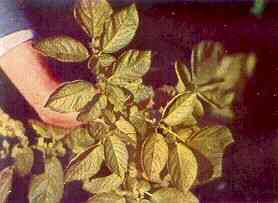
On the other hand, boron toxicity has been induced in potatoes by
dressing of 20-lbs. per acre of borax to a soil in which the deficiency
is readily induced in sugar beet by liming. The injury was shown as a
brow marginal scorching ( See Plate 108 ),
the brown area being very narrow.
In "cracked stem" of celery, the leaves show a brown mottling, the stems
become brittle, and brown stripes appear in the epidermis above the
vascular bundles of the stalks. The affected tissues later disrupt and
become dark brown in color.
Boron deficiency has not been observed in tomatoes other than in sand
cultures.
Although boron deficiency has not been recorded in commercial plantations
of apples in this country, its effects are serious in important
fruit-growing areas, such as Canada, U.S.A., New Zealand and Australia
and it also occurs in some European countries. The fruits produced are
malformed and misshapen. On the exteriors, they may show cracking and
roughening of the skin and pitting, and internally, corky areas in the
cortex and browning in the core region may occur. The trees may lose
some their leaves and develop a condition of the foliage known as
rosetting; defoliation and rosette symptoms are accompanied by splitting
at roughening of the bark, and by die-back of the twigs and branches.
ZINC, COPPER AND MOLYBDENUM DEFICIENCIES
Though deficiencies of zinc and copper are of importance for several crops
in various countries, these deficiencies have not been observed for any
crop in this country, (England) and are thus merely of academic interest
at present. A deficiency of molybdenum has not yet been recorded in a
field crop any part of the world. (Since this was written, fields in
China have been found to be deficient.) Zinc deficiency is considered
to be the cause of several serious "diseases" of fruit trees in the
U.S.A. and other countries "Little Leaf" or "Rosette" of apples, pecans,
vines and stone fruits, "Mottle Leaf" of Citrus and walnut "Yellows".
It also causes "Bronzing" of tung, and "White Tip" of maize, and is
responsible for poor yields cereals in Australia.
Copper deficiency is also associated with certain pathological condition
of fruit trees in U.S.A., South Africa and Australia, notably "Exanthema"
or die-back of Citrus, pears, prunes, plums and apples, in which shoots
die-back, the foliage may show "burning" of the margins or chlorosis,
and resetting and multiple bud formation may occur; gumming may also
take place.
The deficiency occurs in farm crops in Holland and Denmark, where it is
known as "Reclamation Disease", "Yellow Tip" and '"Wither Tip", and in
Australia.
Characteristic symptoms in cereals are withering and marginal chlorosis
(yellowish gray) of the tips of the younger leaves, which may fail to
unroll, and a tendency for the foliage to wilt; the bases of the plants
remain green and bushy in appearance; grain formation is more severely
restricted than vegetative growth.
In the U.S.A., on certain peat soils, copper is also essential for the
proper growth of lettuce.
========================
Bibliography
(1) Anderssen, F. G. (1932). Chlorosis of Deciduous Fruit Trees due to a
Copper Deficiency. J. Pomol. and Hort. Sc., 10, 130.
(2) Arnon, D. I., and Stout, P. R. (1939). Molybdenum as an Essential
Element for Higher Plants-Plant Physiol, 14, 599.
(3) Barnette, R. M., Camp, L. P., Warner, J. D., Gall, 0. E. (1936). The
Use of Zinc Sulfphte under Corn and other Field Crops. Univ. Florida Agr.
Expt. Stn., Bull. 292.
(4) Beaumont, A. B., and Snell, M. E. (1935). The Effect of Magnesium
Deficiency on Crop Plants. J. Agr. Res. 50, 553.
(5) Brenchley, W. E. (1936). The Essential Nature of Certain Minor Elements
for Plant Nutrition. Bot. Rev. 2, 173.
(6) Carolus, R. L., and Brown, B. E. (1935). Magnesium Deficiency. I. The
Value of Magnesium Compounds in Vegetable Production in Virginia. Va. Truck
Expt. Sta., Bull. 89, 1250.
(7) Chandler, W. H. (1937). Zinc as a Nutrient for Plants. Bot. Gaz., 98,
625.
(8) Chandler, W. H., Hoagland, D. R., and Hibbard, P. L. (1931-1937). Little
Leaf or Rosette in Fruit Trees-P. Amer. Soc. Hort. Sc., 28, 556; 29, 225;
30, 70; 32, 11; 33, 131; 34, 210.
(9) Chapman, H. D., and Brown, S. M. (1941). The Effects of Sulfur
Deficiency on Citrus. Hilgardia 14, 185
(10) Chapman, H. D., and Brown, S. M. (1941). The Effects of Phosphorus
Deficiency on Citrus. Hilgardia 14, 161.
(11) Chapman,H.D.,Vanselow,A.P.,andLiebig,G.F.,jun.(1937). The Production
of Citrus Mottle Leaf in controlled Nutrient Cultures. J. Agr. Res. 55, 365.
(12) Chucka, J. A. (1934). Magnesium Deficiency in Aroostook Potato Soils.
Amer. Potato Jour., 11, 29.
(13) Cowie, G. A. (1938). The Relations of Phosphatic Manuring to Potash
Deficiency Symptoms on the Potato Crop. Emp. jour. Expt. Agric. 6, 315.
(14) Davidson, 0. W. (1938). Symptoms of Malnutrition in the Peach resulting
from Various Combinations of Nutrient Deficiencies. Proc. Amer. Soc. Hort.
Sc., 36, 87.
(15) Davis, M. B., and Hill, H. (1941). Apple Nutrition. Dom. of Canada.
Div. of Hort., Tech. Bull., 32.
(16) Davies, W. M. (1939). Manganese Deficiency in Relation to Soils and
Crops. Agric. Prog. 16, Part 1, 45.
(17) Dennis, A. C., and Dennis, R. W. G. (1939). Boron and Plant Life. Part
III. Developments in Agric. and Hort. 1937-38. Fert. Feed Stuffs and Farm
Supplies jour. Feb. 8, 22; Mar. 8, 22; Apr. 5, 9.
(18) Dennis, A. C., and Dennis, R. W. G. (1940, 1941). Boron and Plant Life,
Part IV. Developments in Agr. and Hort. 1939-40. Rep Inted from Fert. Feed.
Stuffs and Farm Supplies jour. Nov. 13, 27; Dec. 11, 2 ; Jan. 8, 22; Feb. 5,
19.
(19) Dennis, R. W. G. (1937). A Review of Developments in the Applications
of Boron in Acric. and Hort. 1935-37. Fert. Feed. Stuffs and Farm Supplies
jour. Sept. 8, 22; Oct. 6, 20.
(20) Dennis, R. W. G. (1941). Plants and Manganese. Fert., Feed. Stuffs and
Farm Supplies, jour. 26, Nos. 13-16.
(21) Dennis, R. W. G., and O'Brien, D. G. (1937). Boron in Agriculture. Res.
Bull. No. 5. The West of Scotland Agric. Coll. Plant Husbandry Dept.
(22) De Vries, 0. (1939). De Magnesium@verzorgin-, der Cultuurplanten.
Chemisch. Weekblad. 36, No. 35.
(23) Furneaux, B. S., and Glasscock, H. H. (1936). Soils in Relation to
Marsh Spot of Pea Seed. J. Agr. Sc., 26, 59.
(24) Gallagher, P. H., and Walsh, T. (1941). Investigations on Grey Speck
Disease of Oats on some Irish Soils. Proc. Royal Irish Acad. 46. B. 143.
(25) Garner, W. W., McMurtrey, J. E., and Bacon, C. W. (1923). Sand Drown a
Chlorosis of Tobacco due to Magnesium Deficiency and the Relation of
Sulfates and Chlorides of Potassium to the Disease. J. Agr. Res., 23, 27.
(26) Haas, A. R. C. (19,32). Injurious Effects of Manganese and Iron
Deficiencies on the Growth of Citrus. Hilgardia, 7, 181.
(27) Harding, D., and Schmidt, C. M. (1938). Bibliography on Boron as a
Plant Nutrient (Mimeo). Amer. Potash Instit. Inc., Washington, D.C.
(28) Hoagland, D. R., and Chandler, W. H. (1932). Some Effects of
Deficiencies of Phosphate and Potassium on the Growth and Composition of
Fruit Trees under Controlled Conditions. @ P. Amer. Soc. Hort. Sc., 29, 267.
(29) Imperial Bureau of Fruit Production (1937). Bibliography on Chlorosis
of Plants. File No. 507. (Mimeo).
(30) Jacks, G. V., and Scherbatoff, H. (1934). Soil Deficiencies and Plant
Diseases. Imp. Bur. Soil Sc., Tech. Corn. 3 1.
(31) Jameson, D. H., and-Schmidt, C. M. (1939, 1940, 1941). Bibliography on
Boron as a Plant Nutrient-Supplements I, II, III. (Mimeo). American Potash
Institute Inc., Washington, D.C.
(32) Jameson, D. H., and Schmidt, C. M. (1940). Bibliography of Literature
on Potash as a Plant Nutrient-Amer. Potash Instit. Inc., Washington, D.C.
(Mimeo).
(33) Jones, J. P. (1929). Deficiency of Magnesium the Cause of a Chlorosis
in Corn. J. Agr. Res., 39, 873.
(34) Lilleland, 0. (1932). Experiments in K. and. P. Deficiencies with Fruit
Trees in the Field. P. Amer. Soc. Hort. Sc., 29, 272.
(35) MacDonald,J.A.(1934). Some Effects of Deficiendes of Essential
Nutrient Elements on the Growth of Young Cacao Plants. Fourth Ann. Rep. on
Cacao Res. 83.
(36) McMurtrey, J. E., Jun. (1938). Distinctive Plant Symptoms caused by
Deficiency of any one of the Chemical Elements essential for Normal
Development. Bot. Rev., 4, 183.
(37) Nightingale, G. T., Schermerhorn, L. G., and Robbins, W. R. (1932).
Effects of Sulfur Deficiency on Metabolism of Tomato. Plant Physiol., 7,
565.
(38) Pettinger, N. A., Henderson, R. G and Wingard, S. A. (1932). Some
Nutritional Disorders of Corn Grown in Sand Cultures. Phytopath. 22, 33.
(39) Piper, C. S - (1940). The Symptoms and Diagnosis of Minor Element
Deficiencies in Agricultural and Horticultural Crops. I. Boron, Manganese.
II. Copper, Zinc, Molybdenum. Emp. jour. Expt. Agric., 8, 85, 199.
(40) Piper, C. S. (1942). Investigations on Copper Deficiency in Plants. J.
Agric. Sc., 32, 143.
(41) Samuel, G., and Piper, C. S. (1929). Manganese as an Essential Element
for Plant Growth. Ann. Appl. Biol., 16, 494.
(42) Schreiner, O., and Dawson, P. R. (1927). Manganese Deficiency in Soils
and Fertilizers. Indus. and Engin. Chem., 19, 400.
(43) Steenbjerg, F. (1940). -Copper in the Soil with Special Reference to
Reclamation Disease. Tidsskr. Planteavl., 45, 259 (also Imp. Bur. Soil Sc.
Soils and Fertilizers, 4, No. 6, 224 (1941).
(44) Storey, H. H., and Leach, R. (1933). A Sulfur Deficiency Disease of
the Tea Bush. Ann. Appl. Biol. 20, 23.
(45) Tiedjens, V. A., and Schermerhorno L. G. (1@37). Notes on Nutrient
Deficiencies of some Vegetable Crops. Proc. Amer. Soc. Hort. Sc., 35, 704.
(46) Tiedjens, V. A., and Wall, M. E. (1938). The Importance of Potassium
in the Growth of Vegetable Plants. P. Amer. Soc. Hort. Sc., 36, 740.
(47) Wall, M. E. (1939, 1940). R61e of Potassium in Plants. I, II, Ill. Soil
Sc., 47, 143; 49, 315, 393.
(48) Wallace, T. (1925). Experiments on the Manuring of Fruit Trees. I, II.
J. Pomol. and Hort. Sc., 4, 117; 5, 1.
(49) Wallace, T. (1928). Leaf Scorch on Fruit Trees. J. Pomol. and Hort.
Sc., 6, 243; 7, 1.
(50) Wallace, T. (1930). Some Effects of Deficiencies of Essential Elements
on Fruit Trees. Ann. Appl. Biol., 17, 649.
(51) Wallace, T. (1939). Magnesium Deficiency of Fruit Trees. J. Pomol. and
Hort. Sc., 17, 150.
(52) Wallace, T. (1940). Magnesium Deficiency of Fruit and Vegetable Crops.
Ann. Rep. Long Ashton Res. Stn., 24.
(53) Wallace, T. (1941). Manurial Experiments on Vegetable Crops. II.
Effects of Farmyard Manure and other Manurial Treatments on Savoys and
Early Potatoes. Ann. Rep. Lon,, Ashton Res. Stn., 33.
(54) Willis, L. G. (1936). Bibliography of References to the Literature on
the Minor Elements and their Relation to the Science of Plant Nutrition.
N.Y. Chilean Nitrate Educ. Bureau.
(55) Woodman, R. M. (1939). The Effects of a Deficiency of certain Essential
Elements on the Development and Yield of Carrots, Onions and Radishes grown
in Sand Cultures under Glass. J. Pomol. and Hort. Sc., 17, 297.
(56) Woodman, R. M. (1941). The Nutrition of Turnips. Ann. Appl. Biol., 28,
1.
Introduction & Chapter I – Essential
Points in the Nutrition of Plants
Color Pictures of Mineral Defeciencies in Plants - 1943
Using Hydroponics to Understand the Earth's Life Processes
on the Atomic Level
The Tortoise Shell Hydroponic Reference Center
Understanding Colloidal Suspensions
Plants need to absorb what you feed them.
" The Art of Healing Ourselves "
Only You can bring Good Health and Healing into Your Body.
Tortoise Shell Life Science Puzzle Box Front Page
View this page Full Frame