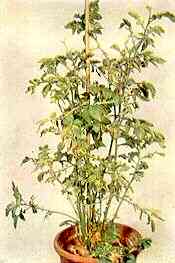
The Diagnosis of Mineral Deficiencies in Plants by Visual Symptoms
London — Published by His Majesty's Stationary Office — 1943
— Crown Copyright Reserved —
by Thomas Wallace, M.C., D.Sc., A.I.C
University of Bristol Agricultural and Horticulture Research Station,
Long Ashton, Bristol
CHAPTER II
Soils in Relation to the Supply of Mineral Nutrients
Since plants obtain their supplies of mineral nutrients from the soil, it is necessary to have some knowledge of soil conditions in order to understand the main problems of the supply of nutrient elements.
Soils are very complex bodies but, although showing such great variation,
they all consist of five main components, mineral matter, organic matter,
soil water, the soil atmosphere and a population of microorganisms. The
last, however, need not concern us in detail here.
Mineral Matter:
| FRACTION | DIAMETER LIMITS |
| Stones | > 2.0 m.m. |
| Coarse Sand | 2.0—0.2 m.m. |
| Fine Sand | 0.2—0.02 m.m. |
| Silt | 0.02—0.0002 m.m. |
| Clay | < 0.002 m.m. |
A preponderance of the coarser fractions tends to make soils light, free working, freely drained and hungry, whilst where the finer fractions predominate (especially clay) the soils are heavy, sticky, difficult to work and retentive of water and manures.
The clay fraction is of special importance as it possesses colloidal properties, which give to soils many of their characteristic properties, such as swelling and shrinkage, holding up of water and absorption of mineral nutrients from manures. The clay colloid, together with the organic colloid (humus), acts as the soil storehouse for available plant nutrients.
The mineral matter of soils provides the main natural source of mineral
nutrients, which become available to plants through the weathering of rock
minerals and the complex processes of soil formation.
Organic Matter:
Plant residues, either naturally or artificially added, provide the source of organic matter in soils. These residues vary greatly in character and composition, depending on the plants from which they are derived, whether from trees, grasses, clovers, cereals, root and vegetable crops, etc., and on the nutrient supplying powers of the soils on which they are grown. In addition to plant residues, soil organisms and animal remains contribute to the organic matter.
In the soil the fresh material undergoes chemical change, especially by the action of soil organisms, and when this has proceeded to the stage where the original cellular structure is no longer recognizable we speak of the brownish product as humus. The organic matter in the soil at any time thus consists of fresh and partly decomposed residues and humus.
The main points in the formation of humus are as follows:
The raw residues contain a variety of compounds, such as proteins and other nitrogenous materials, and sugars, starch, cellulose, tannins, lignin and nutrient salts. The soil organisms use compounds like sugars (carbohydrates) as sources of energy, ultimately oxidizing them to carbon dioxide. To do this they require a supply of nitrogen which they way take either from the nitrogenous compounds in the residues, or if this supply is insufficient they may use other nitrogen present in the soil. The most resistant to their attack of the compounds contained in the residues appears to be lignin, and it seems probable that the end-point of the more rapid decomposition processes humus is a complex mixture in which lignin derivatives preponderate.
During these processes the ratio of carbon to nitrogen (C/N) in the residues alters from about 40/1 to 10/1 so that the process entails a large reduction in carbon.
It will thus be seen that the organic matter of the soil supports the population of soil organisms, and of this population the bacteria alone may be of the order of 20 to 40 millions per gram of soil.
These organisms play a very great part in determining the availability of mineral nutrients in soils, by breaking down plant residues and also by providing carbon dioxide which, in combination with water, is of great importance for the weathering of the soil minerals. Certain of the soil organisms, especially bacteria, are also able to fix free nitrogen from the air and thus enrich the soil with this element. Other bacteria are present which cause the soil to lose nitrogen, and there are multitudes of protozoa which feed on the bacteria, and if too abundant render the soil unhealthy. A properly balanced soil population is requisite for good crops and disturbances of this balance either in a beneficial or deleterious direction may be brought about by soil treatment.
It is important to realize, however, that bacteria and other soil organisms do not work for the special benefit of crops, and that the changes they bring about are to meet their own particular needs, which are not always in harmony with the requirements of the crops. This point can be illustrated by digging into soil fresh straw or sugar and growing a crop on it immediately, when the crop will most probably show symptoms of acute nitrogen deficiency due to the fact that, in order to consume the large amount of carbohydrate contained in the straw or sugar, the organisms deplete the soil of its readily available nitrogen.
Organic matter produces both chemical and physical effects on soils. Like
clay, the humified material possesses colloidal properties, depending on
the minute size of the constituent particles and the enormous surface they
collectively present. It can swell and shrink and absorb nutrient salts.
Together with clay, humus coats the mineral particles and can bind these
together forming "crumbs", thus giving "structure" to soils. Humus acts as a binding agent for the particles of coarse sandy soils and exerts an "opening" effect on close-textured clay soils. The binding properties are not associated with stickiness to the same extent as those of clay. Humus is superior to clay colloid as a storehouse of nutrient bases.
Soil Water:
The manner in which water is held in soils and the way in which it moves through the soil mass provide difficult scientific problems. There is general agreement that in a wet soil a certain proportion of the water can be readily removed, and that some is held very strongly by forces in the soil. Moreover, it can be shown that only a proportion of the water in soils is available to plants. The movement of water through soils is also limited, and water tables at considerable depths below the surface cannot be relied upon to supply water to the surface layers of the soil by the well known capillary action which occurs in narrow tubes. Similarly, if a dry soil is wetted from the surface, the whole of the soil to a considerable depth does not become wetted through uniformly, but the top layers only are wetted, practically to full capacity, and the layers below remain dry.
This strictly limited movement of water through soils is of great practical importance, since it means that for practical purposes water does not move appreciably to the plant roots but the roots must go after the water.
The soil water contains the soluble products of the soil, and is the main nutrient medium for the plant roots. As such it is commonly called the soil solution. There is evidence that plants may also feed directly on nutrients contained in the soil colloids.
The soil solution is very dilute. Measurements made on displaced solutions show concentrations of soluble materials between 0.1 and 1.0%, whilst if drainage waters are analyzed the corresponding values are of the order of 0.02 to 0.5%. In both, the proportions of calcium, nitrate, sulfate, carbon dioxide, silica and organic matter are relatively high, and there may be large proportions of chloride, sodium and magnesium, but potassium is always low and phosphate and ammonia, are present only in traces.
The soil organisms play an important part in providing soluble products for the soil solution. They liberate into the solution nitrate, sulfate and carbon dioxide and these, acting as acids, dissolve corresponding or equivalent amounts of base-forming elements, particularly calcium. Further changes then occur, the calcium in particular bringing into solution other "bases" such as magnesium and potassium by "base" exchange reactions with the colloidal clay and humus materials.
Under normal conditions, the whole of the nitrate and chloride is present in the soil solution, and they pass into the drainage water if not quickly absorbed by plants. Sodium is also mainly present in soluble form. Calcium, magnesium and potassium are held in considerable amounts in the soil colloids as "exchangeable bases", and in this form are less easily washed out of the soil.
Phosphorus is mostly present as insoluble compounds, as calcium phosphates in neutral and alkaline soils, and as iron phosphate in acid soils. Both potassium and phosphorus are only present in the soil solution in very small amounts, but apparently supplies of these elements in the solution are quickly replenished when removed by plants.
The amounts of iron, aluminum and manganese dissolved are largely dependent on the soil reaction (pH) and in strongly acid soils (i.e., low pH values) they may assume toxic concentrations to plants.
The conditions governing boron solubility are not known though, under drought conditions and at high pH values, availability to plants is reduced.
Copper and zinc (perhaps also manganese) appear to present complicated problems in which organic matter and the soil organisms are concerned.
Molybdenum may be more readily soluble in soils under alkaline than acid
conditions, as it has been shown to be more readily available to pasture
plants under the former conditions.
The Soil Atmosphere:
The carbon dioxide content may fluctuate considerably, being increased by organic matter, by cropping, by high temperatures, which speed up the activities of soil organisms, and by the respiration of plant roots.
In poorly drained soils the concentration of carbon dioxide may be very high, with a correspondingly low oxygen content, and in extreme condition this may actually lead to inefficient absorption and even to root injury due to lack of oxygen. The fact that carbon dioxide accumulates and oxygen supply is depleted under conditions of poor drainage is important in considering deficiency problems in wet soils where practical results often appear contrary to expectation.
The mineral elements available to plants in soils may be present as the
result of natural soil processes or may come from additions of natural
manures and fertilizers.
Nitrogen:
Protein —> intermediate organic products, such as amino acids —> ammonia —> nitrite —> nitrate.
The effect of excess carbohydrate on these reactions has been mentioned.
Ammonia may be held in the colloid complex as an "exchangeable base" in
the same way as calcium, magnesium and potassium (see below).
Phosphorus:
The movement of phosphates in soils is very limited, and soils are said to have high "fixing powers" for phosphates. Heavy soils, as a rule, show higher fixing powers than light ones, and soils with high iron contents possess specially strong fixing properties. The two elements mainly responsible for the fixation of phosphates are calcium, in neutral and alkaline soils, and iron in acid soils.
The Relative Fixing Powers of some Light and Heavy Soils for Phosphates
| TABLE 1 | Percent Phosphoric Acid ( P2O5 ) soluble in 1% Citric Acid Solution. | |||||||
|---|---|---|---|---|---|---|---|---|
| Light Sands | Clays | |||||||
| Surface Soil | 0.0600 | 0.0865 | 0.1472 | 0.1730 | 0.0485 | 0.0601 | 0.0810 | 0.1158 |
| Subsoil | 0.0230 | 0.0616 | 0.0932 | 0.0734 | 0.0011 | 0.0085 | 0.0038 | 0.0120 |
Important practical points in connection with the fixation of phosphates
are that a large proportion of the phosphates added to many soils never
become available to the crops, and that phosphates should always be placed
as near as possible to the roots of the plants for which they are intended.
In some soils where fruit trees suffer from phosphate deficiency, the
method of injecting the phosphatic materials into the soils through
high-pressure lances has been suggested to obtain local concentrations
of fertilizer near portions of the roots. For cereal crops the difficulty
has been met by the introduction of combined seed and fertilizer drills,
which deliver the seed and phosphate into the soil in close proximity,
and by the use of granular fertilizers, of which only a small proportion
aof the material comes into contact with the soil.
Calcium:
Carbonate of lime is readily brought into solution in soils by means of
carbon dioxide dissolved in the soil water and thus, if the soil contains
lime, a supply of calcium in soluble form is readily assured. Calcium also
comprises the major proportion of the elements held as exchangeable bases
where soils are not strongly acid and it is readily brought into the soil
solution from this state.
Magnesium:
Potassium:
Sodium:
Soluble sodium compounds are readily available to plants.
Sulfur:
Under water-logging conditions, calcium sulfate may form crystalline deposits in the subsoil, and this substance may also be seen as a white deposit on the surface of soils when manuring is high, as in market gardens.
Sulfur compounds are changed from one form to another in the soil by special bacteria, the end product of whose reactions is the sulfate form where conditions favor oxidation. Thus, if the element sulfur is added as a dressing to soil, it may be quickly oxidized to sulfuric acid, which reaction is used in treating alkaline soils to lower the pH value. (See under Iron and Manganese, pages 17, 18.)
Sulfate:
The widespread occurrence of sulfur in rocks and organic matter and its
mobility in the soil doubtless account for the rarity of a deficiency of
the element in crops.
Chlorine:
Common salt or sodium chloride is. also present in considerable quantity
in the atmosphere near the sea, and a proportion of this reaches the soil,
adding both chloride and sodium.
Iron:
Manganese:
Boron:
Zinc and Copper:
Little is known of the factors affecting their availability to plants, but organic matter and soil organisms may be important factors.
Nitrogen:
Nitrogen deficiency occurs on all classes of soil, although, of course, some soils are less prone to the deficiency than others. Light sands lacking organic matter are perhaps the poorest of all as regards nitrogen. The nitrogen supplies of soils are greatly affected by cropping and management. Soils under grass and leguminous covers become enriched with nitrogen, and when these are ploughed under they generally yield a flush of nitrogen to the subsequent crops. The continuous cropping of arable soils with non-leguminous crops greatly depletes the nitrogen supply, and even the continuous clean cultivation of a soil without cropping impoverishes the soil of nitrogen by stimulating nitrification processes and destroying the organic matter. Under these latter conditions the nitrate which is formed is lost from the soil by leaching. Instances are known where fruit trees, after growing under clean-cultivated conditions for a number of years, have eventually suffered severely from nitrogen starvation due to destruction of the organic matter.The manner in which a temporary nitrogen deficiency may arise from the ploughing-in of organic matter of low nitrogen content has previously been described.
Nitrogen deficiency may also occur on soils with ample supplies of nitrogen,
such as peats, where drainage is defective or the reaction too acid for
nitrification to proceed.
Phosphorus:
Calcium:
It is, of course, more likely to occur on soils derived from rocks of low calcium content, such as siliceous sandstones, and light sandy soils are frequently acid and deficient in calcium due to an initial low content of calcium and ease of leaching. Since clays are not readily leached, they are not usually strongly acid, though certain clays, such as the Coal Measures Clay and London Clay, are often acid. Peats, other than Fen peats, are also poorly supplied with calcium.
Under field conditions it is generally difficult to ascribe a crop failure
on an acid soil entirely to a deficiency of calcium, since under such
conditions toxic effects may arise from other causes and confuse the issue.
It will be shown later, however, how in sand cultures symptoms of calcium
deficiency in plants can be separated from the effects produced by the
other factors concerned in acid soils, which enables calcium deficiency
effects to be distinguished in the field.
( See Plate 4 )
Magnesium:
Magnesium deficiency can be readily induced on many soils by excessive dressings of potassic fertilizers, especially sulfate of potash. Many examples of this have arisen in fruit plantations, especially with apples on poorer soils, and there is evidence to show that magnesium deficiency is also being produced in commercial glasshouse crops of tomatoes by high potash manuring, where the heavy waterings which must be given may also be of importance.
In the past, magnesium has been neglected as a fertilizer element in this
country, and doubtless the need for it did not arise when supplies of
farm-yard manure were more plentiful, but, under modern conditions, where
artificial manures (which contain no magnesium compounds) are so largely
used, and the tendency is towards the use of highly concentrated materials,
magnesium deficiency may soon become a serious problem unless the element
is added to the soil. The remedy is simple. The need for magnesium can be
met fully by the occasional use of magnesium limestone as a liming material.
Potassium:
Although potassium deficient soils may be found in all parts of Great Britain, the deficiency is most prevalent in the South, south east and east of England, in the area approximating to the Chalk belt, stretching from Dorset to Yorkshire.
One of the most certain methods of bringing about a condition of potash
deficiency in agricultural soils is to take hay crops from fields year
after year without returning any dung to the fields. This practice was,
unfortunately, very prevalent during the period of agricultural depression
prior to 1939, and has resulted in many crop failures on ploughed-out
meadows during the war. It is well to remember that the removal of any
leafy crop from land means the removal of considerable quantities of
potassium.
Sodium:
Sulfur:
Chlorine:
Iron:
Iron deficiency does not appear to result from a total deficiency of the element in the soil but from its unavailability due to other soil factors, mainly high pH. For this reason, the application of iron salts to the soil to correct the deficiency is usually ineffective, and the most economical method of correcting it is generally by means of foliage sprays (using from 0.2 to 1% ferrous sulfate), or by injection of solid compounds (such as ferric citrate or tartrate) into stems, a method used for fruit trees.
Sometimes the pH may be lowered sufficiently by dressings of sulfur to
ensure adequate supplies of iron to plants suffering from iron deficiency.
The deficiency may often be cured in trees by growing a grass cover over
the roots.
Manganese:
The main soil conditions under which the deficiency occurs in Great Britain may be grouped as follows:
1. Thin peaty Fen soils overlying calcareous subsoils, e.g., the so-called "skirt" soils of the Fens.2. Alluvial soils and marsh soils derived from calcareous materials such as calcareous silts and clays or shelly marine sands and muds.
3. Poorly drained, calcareous soils with high contents of organic matter, e.g., in wet areas overlying the Chalk or Carboniferous Limestone formations.
4. Calcareous black sands and reclaimed heath soils subsequently limed too generously.
5. Calcareous soils freshly broken up from old grassland.
6. Old black garden soils where stable manure and lime have been applied regularly for many years.
Manganese deficiency, like iron deficiency, is often difficult to cure by
the application of manganese salts to the soil, though in some soils this
method is satisfactory. Spraying methods are much more economical of
material and are very effective, more so than for iron, as the risk of
spray damage is negligible. Sulfur treatment of the soil is also efficacious
as with iron deficiency.
Boron:
Zinc and Copper:
Molybdenum:
(1) Heinicke, A. J., and Boynton, D. (1941). The response of McIntosh Apple Trees to Improved Subsoil Aeration. P. Amer. Soc. Hort. Sc. 38, 27.
(2) Hendrickson, A. H., and Veihmeyer, F. J. (1936). The Maintenance of predetermined Soil Moisture Conditions in Irrigation Experiments. P. Amer. Soc. Hort. Sc., 30, p. 421.
(3) jenny, H., and Overstreet, R. (1939). Cation Exchange between Plant Roots and Soil Colloid. Soil Sc., 47, 257.
(4) Keen, B. A. (1927). The Limited Role of Capillary in Supplying Water to Plant Roots. Proc. 1st Internat. Congress. Soil Sc., Comiss, I, 504.
(5) Kramer, P. J., and Coile, T. S. (1940). An Estimation of the Volume of Water made Available by Root Extension. Plant Physiol., 15, 743.
(6) Robinson, G. W. (1936). Soils, Their Origin, Constitution and Classification (2nd Edition). Thomas Murby & Co., London.
(7) Russell, E. J. (1937). Soil Conditions and Plant Growth (7th Edition). Longmans, Green & Co., London.
(8) Veihmeyer, F. J., and Hendrickson, A. H. (1927). Soil Moisture Conditions in Relation to Plant Growth. Plant Physiol., 2, 71,
(9) Waksman, S. A. (1936). Humus. Origin, Chemical Composition and Importance in Nature. Williams & Wilkins Co., Baltimore.
Color Pictures of Mineral Defeciencies in Plants - 1943
Using Hydroponics to Understand the Earth's Life Processes
on the Atomic Level
The Tortoise Shell Hydroponic Reference Center
Understanding Colloidal Suspensions
Plants need to absorb what you feed them.
" The Art of Healing Ourselves "
Only You can bring Good Health and Healing into Your Body.