The Transistor Era (1948 — 1959)
Approaching the Age of Space Exploration
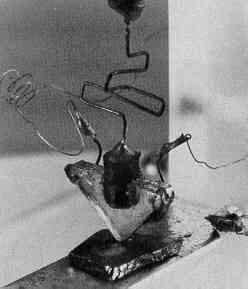
This crude version of the germanium point–contact transistor was developed by the research team of John Bardeen, Walter Brattain and William Shockley at Bell Laboratories in 1948.
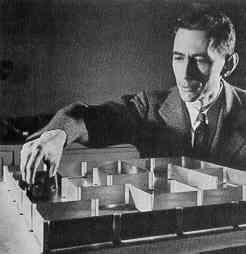
Claude, Shannon, founder of information theory, uses an electrical mouse and maze to demonstrate at Bell Laboratories the capability of telephone relays to act as memory elements in communications systems.
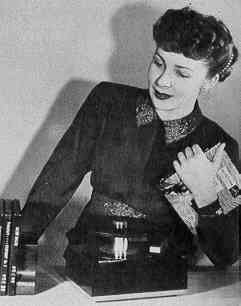
In 1949 the 45–rpm phonograph record was developed by RCA, which also developed a fast record changer that connected to TV sets and played the records through the TV amplifier. Today, the 45–rpm disc is still the "pop" recording medium.
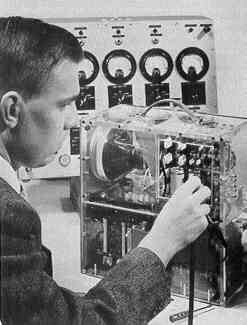
Researcher Gerald Herzog at RCA is shown making some laboratory tests in 1952 on the first all transistorized television set. It contained 37 semiconductors, could receive only a single channel and weighed 27 pounds. Herzog is now a staff vice president at the RCA solid–state Technology Center.
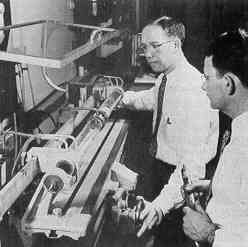
Extremely pure germanium, the key to semiconductors, was developed by this team of William Pfann (left) and Jack Scaff (right) at Bell Laboratories in 1954. The purity of the refined germanium can be likened to one pinch of salt in 35 boxcars filled with sugar.
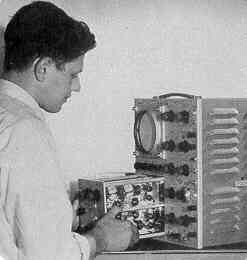
Putting the plug–in amplifier into the Model 535 oscilloscope is Bill Polits, a design engineer for Tektronix in 1954. The concept of the plug–in was first introduced in the Model 531 oscilloscope that was released several months earlier than the 535. Polits is presently a group vice president at Tektronix.
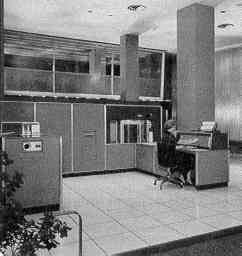
The RAMAC disc operating system, introduced by IBM in 1957, was the first data processing system to use record–like discs to store digital data. Each disc had a storage capacity of about 100,000 characters and could be randomly accessed.
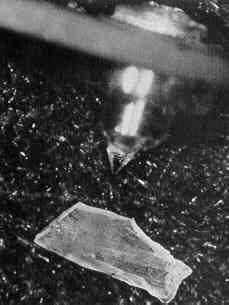
The first man–made diamonds, produced by General Electric's Dr. Herbert Strong in 1955, were only about 1/16 of an inch long. This photo shows a diamond just below a "standard" high–fidelity phonograph needle.
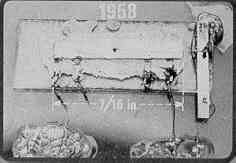
The first integrated circuit, developed by Jack Kilby at Texas Instruments, paved the way for today's pocketsized computers and for men, traveling to the moon.
Vol 24, number 4 Feb. 16, 1976
© 1976 Hayden Publishing Company Inc.
50 Essex St. Rochelle Park, NJ 07662
Historical Time Line — Introduction
The Foundation Years The Era of Giants The Communications Era
The Vacuum Tube Era The Transistor Era The Integrated Circuit Era
AM Broadcast Basics
The Original Theory for Radio was Presented by James Clerk Maxwell in 1873.
Nikola Tesla was the first to patent a workable system.
Gravity Site Link List Crossed-Field AM Antenna
Magnetism Maxwell's Equations in Magnetic Media
The Tortoise Shell Life Science Puzzle Box Front Page