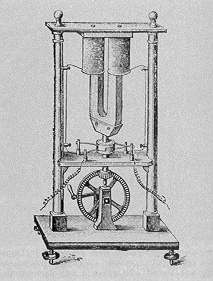
The development of electricity as a motive power was taken up by a host of inventors as early as 1832, when a rotary electromagnetic engine was constructed in England by William Sturgeon. It was exhibited in London the following spring.
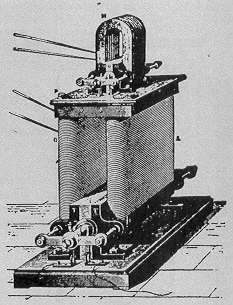
Henry Wilde's generator of 1866, considered to be "a machine of enormous and unprecedented power," employed a small, shaft–driven Siemens machine to energize the field coils of the larger dynamo.
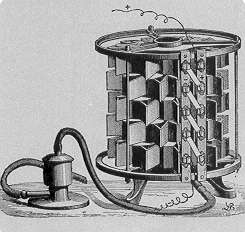
Thermo–electric generators were developed in Europe to replace costly battery power. Clamond's thermo–electric battery was heated with gas and was demonstrated in France in April, 1874.
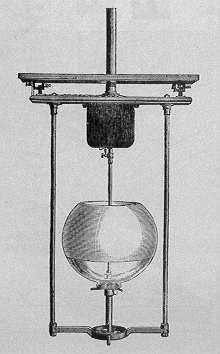
The first electric light was produced by "candles" and arc lights. Charles F. Brush invented an arc–lamp system that could light a greater number of lamps in a single circuit than could any competition,
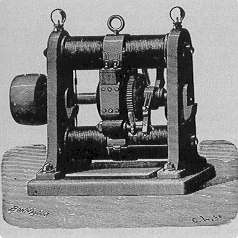
When two of Gramme's dynamos were accidentally connected together in 1873, with the first machine driven by a steam engine, the second began rotating backwards as a motor. It was the first demonstration of the transmission of mechanical power through electrical means.
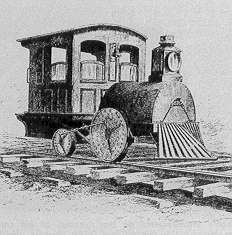
The vast improvements in dynamos of the late 1870s, and Gramme's discovery that they could be run as motors, led inventors to renewed interest in an electric railway. Edison's locomotive was demonstrated at Menlo Park, NJ, in 1880.
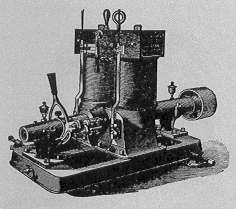
Edison's improvements on the dynamos of his contemporaries led to his efficient 1888 machine, which initiated the practical application of electricity throughout America.
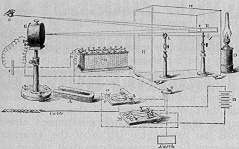
The mirror galvanometer, invented by Sir William Thomson, was the only instrument sensitive enough to receive messages over the early transatlantic cables. A typical setup is shown. In 1867 he invented a new receiver that recorded signals by spurting ink from a fine glass siphon, upon a moving paper ribbon.
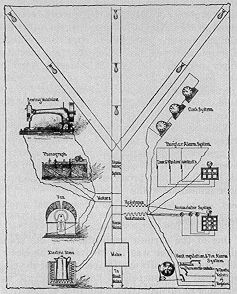
By the 1890s electricity was powering many of the same basic household lighting, cooking and appliances we have today. A wiring plan of that period shows the many items serviced by electricity.
Vol 24, number 4 Feb. 16, 1976
© 1976 Hayden Publishing Company Inc.
50 Essex St. Rochelle Park, NJ 07662
Historical Time Line — Introduction
The Foundation Years The Era of Giants The Communications Era
The Vacuum Tube Era The Transistor Era The Integrated Circuit Era
AM Broadcast Basics
The Original Theory for Radio was Presented by James Clerk Maxwell in 1873.
Nikola Tesla was the first to patent a workable system.
Gravity Site Link List Crossed-Field AM Antenna
Magnetism Maxwell's Equations in Magnetic Media
The Tortoise Shell Life Science Puzzle Box Front Page