Toxicity: Resembles that of arsenic and tellurium; occurs by inhalation, ingestion and absorption through skin of the metal or its compounds.
Acute: nervousness, vomiting, cough, dyspnea, convulsions, abdominal pain, diarrhea, somnolence, fall in blood pressure, respiratory failure and death. Garlic-like odor may be present on breath. Selenium oxychloride is a severe vesicant and may cause fatal poisoning.
Chronic: marked pallor, garlic odor of breath, sweat and urine; red staining of fingers, teeth and hair, marked debility, depression, epistaxis, G.I. disturbances, dermatitis, irritation of nose and throat. Hydrogen selenide can cause pneumonitis and damage to liver and spleen.
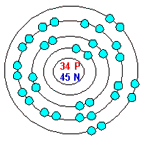
Research
Factors such as heavy alcohol consumption and / or excessive exposure to elements like cadmium, copper and lead can lower needed selenium levels in our bodies. Because of the problem with possible toxixity, the general public hasn't been informed of the importance of maintaining adequate levels of selenium in our bodies.
The rare amino acid selenocysteine is formed in the body using dietary selenium. High amounts of selenium are present in such foods as beef, bread, poultry and seafood.
Primarily a Selenium Deficiency Disease; plus essential fatty acids and copper.
Let's Play Doctor
J. D. Wallach, DVM, ND and Ma Lan, MD, MS
Copyright 1989 - Double Happiness Publishing Co., Bonita, Ca.
Cystic Fibrosis is the "crime" of the century second only to diabetes ( and that is only because diabetes affects millions and CF "only affects thousands each year" ) in that it is preventable, 100% curable in the early stages and can be far better managed in chronic cases than it is currently managed by "orthodox" medicine. Cystic fibrosis is an important fatal disease of humans. CF was originally thought to be limited to white populations of central European origin: today, CF has been diagnosed in all the peoples of the earth.
CF is thought to be genetically transmitted by the "orthodox" pediatricians, yet "they" have failed to prove their theory despite multimillions of dollars spent in research. Classically, the diagnosis is made when any two of four criteria are present, yet most "orthodox" pediatricians will not diagnose CF without a positive "sweat test" ( elevated level of sodium, chloride and potassium in the sweat – greater than 65 mEq.L.)
The "sweat test" has been elevated by dogma to "the diagnostic test" for CF yet there are at least 17 known diseases and syndromes that can give a positive sweat test leading at least one group of investigators to refer to CF as a syndrome rather than a disease.
Initially described in 1933, CF was first thought to be the result of a vitamin A deficiency in children dying with celiac disease. In 1938 the term "cystic fibrosis" was coined because the pathologist mistakenly thought the changes in the pancreas were true cysts ( fluid filled spaces lined with normal tissue ). It is well known today that the "cysts" of CF are, in fact, a dilation of the pancreatic functional unit ( acini ) with atrophy ( shrinking ) of the lining tissue. In 1952, the fact that congenital CF occurred in a significant in a significant number of CF patients was established. The foundation of the genetic theory of CF transmission is based on the frequent congenital appearance and two very poor papers, one published in 1913, which claimed that two children with diarrhea had an "inborn error in fat metabolism" and one in 1965 that did an epidemiological study of a group of 232 Australian families with CF – despite six sets of twins, the study failed to shed clear light on the proposed genetic theory. These papers were so poor they would not get past the letter opener at any "orthodox" medical journal today. We have spent an inordinate amount of time on CF because this syndrome again demonstrates very clearly that if any medical specialty will be eliminated by discovery, that discovery will never be given to the public by the "orthodox" doctors !!!
In 1978, the first universally accepted diagnosis of CF in a laboratory animal was made by one of us ( Dr. Joel Wallach ). The diagnosis was based on characteristic CF changes in the pancreas and liver in baby monkeys and were confirmed by CF experts from Johns Hopkins School of Medicine, Emory University and the University of Chicago !! Experts from NIH and the CF Foundation were overjoyed – that is until they learned that one of us ( Wallach ) could reproduce the CF changes with acongenital selenium deficiency in almost any animal species. With this revelation, Wallach was fired with 24 hours notice and "black-balled" from research ( to show you how ruthless they are, Wallach was fired ten days after his wife died of cancer ).
It has been learned recently that the positive "sweat test" is the result of an essential fatty acid deficiency that causes a secondary deficiency of "prostaglandin" ( very short lived hormones ) that control the sodium, chlorides and potassium levels of the sweat !!! Remember the talk by the distinguished anthropologist, Dr. Johnathon Leaky, SR. who said, the more facts you have, the better the truth you have.
The prevention of CF has been accomplished in pet, farm and laboratory animals by the veterinary profession by assuring adequate levels of selenium and essential fatty acid nutrients to the preconception, pregnant and nursing mother. This is not as easy as it sounds because of malabsorption problems ( i.e. celiac diseases and Crohn's Disease ) in a percentage of women !!! All things being normal a supplementation of 200 mcg selenium per day and 5 grams of flaxseed oil twice a day would be adequate to prevent CF.
Treatment of CF is very basic – treat the infant as early as possible with selenium IM at 10 - 25 mcg per day. Plant derived colloidal minerals may be used orally thereafter (Selenium Picolinate). Provide 5 grams of flaxseed oil orally twice daily. Most importantly YOU MUST DETERMINE IF THE INFANT IS ALLERGIC TO WHEAT, COW'S MILK OR SOY!!! If you do not correct the malabsorption problem, treatment will only be minimally effective. In the case of older CF patients, IV essential fatty acids and IM selenium provide excellent management leading to a normal life expectancy of 75 years !!!
Compare this approach to the heart and lung transplant offered by the "orthodox" pediatricians !!! If the proper treatment is carried out, the "typical CF lung disease" will not develop. The lungs of CF patients are normal at birth and only develop bronchiectasis after chronic essential fatty acid and copper deficiencies have taken their toll ( Copper Picolinate ). Don't forget the base nutritional supplementation here!
We went to China in 1988 to study Keshan Disease, a known selenium deficiency disease of Chinese children. We studied 1,700 autopsies and found 595 cases or 35% had pancreatic CF ( Remember CF is supposed to be a "genetic disease of children of middle European extract" – to justify this finding the proponents of the genetic theory will no doubt claim that a very virile English missionary impregnated 125,00 Chinese girls and unfortunately, he was "carrying the gene for CF".)
Study Suggests
Selenium Reduces Diabetic Nephropathy
from Diabetes Wellness Letter
© Diabetes Research and Wellness Foundation Inc.
P.O. Box 3837, Merrifield, VA 22116-3837 - 202-298-9211
Membership Subscription Center: DRWF, P.O. Box 231, Shrub Oak, NY 10588
We strongly urge you to use our TOLL FREE HELPLINE, 800-941-4635 for assistance with questions or concerns about your diabetes management, as it allows us to serve you more personally and efficiently than does written correspondence.
Diabetic nephropathy, in itself a debilitating condition, is also a milepost on the road to endstage renal disease and kidney failure. It represents the beginning of the process of the deterioration of the kidneys that occurs as a result of the blood imbalances inherent in diabetes, and is associated with constant or intermittent hyperglycemia.
The higher glucose levels go, and the longer they stay high, the more strain is put on the blood vessels of the kidneys, as well as on those of the eye, heart, limbs, and the entire circulatory system. This is the reason that hyperglycemia causes not only nephropathy, but also diabetic retinopathy, neuropathy, lower-extremity arterial disease, and eventually heart disease and kidney failure.
Now, a study on rats suggests that a selenium supplement reduces the overall plasma glucose level and also greatly reduces the effect of hyperglycemia in the kidneys. More testing remains to confirm that it offers the same benefits to humans with diabetes.
Christelle Douillet other researchers who conducted the study report that selenium has an antioxidant effect that helps to a certain extent in preventing kidney disease. But it also appears to have an insulin-like effect in lowering blood glucose.
Antioxidants alone generally help to delay diabetic complications, but since renal complications are caused by microaneurysms in small vessels that appear to be caused partly by high glucose, the insulin-like effect of selenium adds an extra protection, the researchers state.
SOURCE: Proceedings of the Society Experimental Biology and Medicine
Anti-cancer Diet Found ?
Tests in China link beta-carotene, vitamin E, seleniumThe Denver Post — September 15, 1993
by Jeff Nesmith — Cox News Service
WASHINGTON — Daily doses of beta-carotene, vitamin E and selenium dramatically reduced the risk of dying from cancer among thousands of residents in a rural area of China.
The experiment sponsored by the National Cancer Institute is the first hard evidence that some antioxidant substances can provide a "protective" effect against cancer, scientists said yesterday.
Other dietary supplements — vitamin C, retinol, zinc, riboflavin, molybdenum and niacin - had no statistically significant effect on cancer after five years, the study said.
However, in a group of middle-aged adults who took the combination of beta-carotene, vitamin E and selenium for five years, the results were striking: 13 percent fewer deaths from all cancers, 21 percent reduction in deaths from stomach cancer and a 9 percent decrease in deaths from all causes.
In presenting their results at a press conference, the government scientists cautioned that participants in the experiment have some of the worse cancer rates — and worse diets — in the world.
That could mean that the results may not apply to people whose basic diets provide more of the critical nutrients.
"This is a hopeful sign that vitamins and minerals may help prevent the onset of cancer in healthy individuals," said Dr. William J. Blot of the institutes biostatistics branch, "but the results don't automatically translate into Western populations.
The experiment was conducted among residents of Linxian, a rural county in Henan Province of north-central China. The rates of esophageal cancer and cancer of the gastric cardia - the point where the esophagus attaches to the stomach — among the people of Linxian are among the highest in the world, said Dr. Blot.
Epidemiologists have investigated pickled vegetables, mycotoxins in food and a tendency to gulp down scalding hot tea as possible causes. The diet of residents of the area is low in fruits and meats and other animal products and persistently deficient in a number of vitamins and minerals.
After selecting about 29,000 people between 40 and 69 years old, the scientists arranged daily pill-taking schemes in which various participants received different combinations of supplements: retinol and zinc, riboflavin and niacin, vitamin C and molybdenum, beta-carotene, selenium and vitamin E, and a placebo pill that contained none of the nutrients.
Participants received from one to two times the U.S. recommended daily allowances. Daily doses of beta-carotene, for which no RDA has been established, was 15,000 micrograms, or about the amount found in a carrot.
Beta-carotene is common in carrots, leafy vegetables and some fruits. Vitamin E is plentiful in margarine, vegetable oil, meats, nuts and leafy greens.
This study has recently been repeated in France with even better results. I will post the study soon.
Hydroponic Reference Center Project Page
Color Pictures of Mineral Defeciencies in Plants
Site Link List - Element List - Hydroponic Salts
The Tortoise Shell "Science of Health" Newsletter
— Putting an End to Disease on Our Planet —