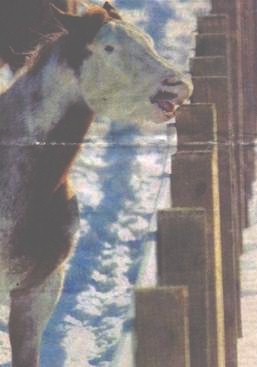
In your January 28, 2004 edition you have a picture of a horse gnawing on a fence post.
Some people might find this cute, but actually it a portrait of an abused horse.
This behavior is called Pica and Crib Biting (or pica and cribbing). You can look it up in a dictionary. It occurs when an animal isn’t receiving important nutrients that it needs in its food. Mineral blocks are often put out to help correct this.
If the horse’s owner fails to recognize this call for help by the horse, the horse will soon develop a serious illness, just as people who have an inadequate diet do.
You can hear more about this subject in a talk given by Joel D. Wallach, BS, DVM, ND at – http://www.hbci.com/~wenonah/news.htm
I don’t do much horse back riding myself, but last summer I went riding with Robert Waters, MD.
What impressed me most during the ride was the choice of plants that my horse stopped to nibble on.
This is "True Horse Sense". The horse new that these "weeds" contained something special that she needed for her nutrition.
We discussed this at length after the ride. Those who watch animals carefully will tell you that often when animals are put into a "new pasture", they will eat many varieties of "weeds" first before they will graze on the grasses.
The cravings that we humans have are meant to help guide us in selecting our foods also.
Tommy Cichanowski
cichanow@hbci.com
In Tijuana, capital of Mexico's Baja California state, Mildred Nelson, a registered nurse and director of the Bio-Med Center on Avenida General Ferreira, had read the Canadian edition of this book given her by Kim Lalancette, a young Québecer who, like Bernard Baril and other young AIDS victims, had recovered from his affliction after treatment by Naessens's remedies. Leafing through its pages, Nelson, a veteran battler for alternative cancer cures, grew increasingly excited.
As far back as the 1930s, the Tijuana clinic director had become chief assistant to Harry Hoxsey, a Texan oil millionaire who had developed a formula made up of seven herbs, plus potassium iodide, the earliest version of which his great-grandfather had first concocted in the mid-nineteenth century after watching a cancerous horse seek out special meadow plants, the ingestion of which led to recovery.
Used on hundreds of cancer victims, the Hoxsey formula's results were so promising that the American Medical Association (AMA) made its inventor a stingy offer to buy all rights to it. The offer, made in 1924, was flatly turned down by Hoxsey, who, as a result, became the object of a relentless AMA persecution, which, lasting for thirty-five years, was to lead to his repeatedly being charged with practicing medicine without a license and to his being sentenced to several jail terms.
Only Hoxsey's personal fortune, gained through his oil and gas ventures, allowed him to meet the legal costs of his extensive court battles and to continue to treat suffering cancer victims. In 1949, he carried his fight into enemy territory by suing the AMA.
The cake of his victory against America's most powerful medical authority was frosted when both the judge presiding at the trial and the AMA's own lawyer declared that there was no doubt that Hoxsey's formula really did cure many cases of cancer. Yet, in spite of all this, and as incredible as it may seem, the AMA, with unbounded viciousness, kept hounding Hoxsey as a quack. Exhausted by his struggles, Hoxsey finally closed his clinics and moved his operation to Tijuana, where, since his death, Mildred Nelson has presided over it.
A prize-winning film, "Hoxsey," available on videocassette, was made by Ken Ausabel and can be obtained by writing to him at Box 1644, Santa Fe, New Mexico 87504.
For another enthralling historical account of a Native American herbal remedy successfully used on cancer victims, and its suppression by the U.S. and Canadian medical authorities, see ESSIAC: An Herbal Treatment of Cancer (A Special Report), by Tom Valentine, Associated Partners West, P.O. Box 3048, Iowa City, Iowa 52244. Unpublished is the testing of still one more herbal concoction obtained from the head-shrinking Jivaro Indians by the late Pino Turolla, an Italian explorer, and author of Beyond the Andes (New York: Harper & Row, 1980). Tested on cancer-infested mice in a Seattle, Washington, laboratory for over two years, it proved ninety-eight percent effective in stopping their cancers.
Low Blood Sugar — Hypoglycemia
Mental Health – It's Not Just In Our Heads
Allergy And Alcoholic Addiction
Health and Light
The Effects of Natural and Artificial Light on Man and Other Living Things.
When winter falls, many find themselves in need of more light.
Using Hydroponics to Understand the Earth's Life Processes
On the Atomic Level
Tommy's History of Western Technology
The Tortoise Shell "Science of Health" Newsletter
— Putting an End to Disease on Our Planet —