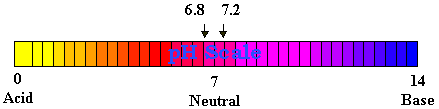
The pH notation is an index of Hydrogen's chemical activity in a solution.
pH is a Log Scale Unit of Measure, and is used to express the degree of acidity of a substance.
Values will range from pH 1 to pH 2 for strong acids, through pH 7 for neutral solutions such as ultra pure water, on up to values of pH 11 and higher for very strong bases like lye.
The centimeter is a unit measure of length. The gram is a unit measure of weight. Similarly, pH is the unit measure we use to say how much free or active acid is in a substance. The pH scale goes from 0 to 14. A pH of 0 means a very high acid activity; a pH of 14 means a very low acid activity. In between these two extremes is a pH of 7. This is the pH of pure water.
Addition of a strong acid, such as sulfuric acid ( H2SO4 ) to water makes the resulting solution very high in active acid concentration. This is called an acidic solution. The addition of a strong base or alkali material, such as sodium hydroxide ( NaOH ), to water makes the resulting solution very low in active acid concentration. This is called a very basic or alkali solution. Water, which is neither very acidic nor very alkali, is said to be neutral. The pH scale is a quantitative way of expressing the active acid or alkali concentration of a solution.
In the Chemical Industry ...
In Biochemistry ...
In Agronomy ...
In Food Science ...
In the Pulp and Paper Industry ...
In Chemical Research and Engineering ...
In Environmental Research and Pollution Control ...
Protecting our waterways requires constant monitoring of industrial effluent. Plating and metal finishing plants tend to produce acidic wastewater, as do mining operations, Chemical plants often have very alkaline wastewater. pH measurements are used as a guide to the proper neutralization of these plant wastes, as well as to monitor the final effluent quality. Occasionally, an acidic stream can be combined with an alkaline stream to produce a final stream, which is close to neutral. pH measurements assure the proper management of this cost saving technique.
To understand more about pH, we need to know more about the chemistry of water. A molecule of water is composed of one oxygen atom and two hydrogen atoms and looks something like this.
H = Hydrogen: O = Oxygen:
Water Molecule ( H2O ):
In pure water, most of the water molecules remain intact. However, a very small amount of them react with each other in the following manner.
H2O + H2O ===> H3O+ + OH–
Water + Water ===> Hydronium Ion+ ( an Acid ) + Hydroxyl Ion– ( a Base )
The Hydronium ion ( H3O+) is the chemical unit which accounts. for the acidic properties of a solution. The hydroxyl ion ( OH– ) is the chemical which accounts for the basic or alkaline properties of a solution.
As you can see, when pure water reacts as described in Figure 2, it produces an equal amount of H3O+ and OH–. Thus, it does not have an excess of either ion. It is therefore called a neutral solution.
If a strong acid, such as hydrochloric acid ( HCl ) is added to water, it reacts with some of the water molecules as follows:
Thus, the addition of HCl to water increases the H3O+ or acid concentration of the resulting solution.
If a strong base, such as sodium hydroxide, is added to water, it ionizes as follows:
Thus, the addition of NaOH to water increases the OH– or alkali concentration of the resulting solutions.
Another interesting aspect of water is that the concentration of H3O+ and OH– remain in balance with each other. An increase in the concentration of H3O+ causes a proportional decrease in the concentration of OH–.
Accordingly, a table can be constructed which shows the relationship of the pH's H3O+ concentration, and OH– concentration.
         pH     H3O+ (Acid)               OH- (Base)

         0      1.0                       0.00000000000001
         1      0.1                       0.0000000000001

         |      |                         |
         |      |                         |
         |      |                         |

        13      0.0000000000001           0.1
        14      0.00000000000001          1.0
1. As the acid ( H3O+) concentration decreases, the pH increases.
2. As the acid ( H3O+) concentration decreases, the base ( OH– ) concentration increases proportionately.
3. At pH 7 the acid ( H3O+) and base ( OH– ) concentrations are equal. This is called the neutral point.
4. The pH scale represents the number of places the decimal point is moved to the left of one in expressing the acid ( H3O+) concentration.
5. Each pH unit represents a tenfold change in H3O+ or OH– concentration. For example, solution at pH 6 is 10 times more concentrated in H3O+ ions than a solution at pH 7.
Thus, you can see from this chart that the pH scale is a far more concise way of quantitively expressing the acidity of a solution.
Certain organic dye solutions change color over a relatively small pH range. These are called indicator solutions. They can be used to indicate the approximate pH of a solution. By adding a few drops of a phenolphthalein indicator to a solution one can tell if the pH of the solution has a pH greater than 9 by the red color present, or a pH less than 9 by the lack of color. Other dye materials can be chosen whose color changes indicate other pH ranges. For example, phenol red changes at pH 8, bromthymol blue at pH 7, and bromphenol blue at pH 4.
For convenience, these dyes are often deposited on a strip of paper. When a drop of solution to be tested is placed on the paper, the resulting color change is indicative of the approximate pH of the test solution. Dye indicator solutions or paper have the advantage of being quite inexpensive, very portable, and often suitable where only an approximate pH measurement is needed. On the other hand, where precise measurements are needed and / or the solution to be measured is colored, a pH meter is required. Accordingly, pH meter and electrode systems have been developed which respond in a precise manner to the pH of a solution.
To measure pH one can use any number of readily available ($25 – $100 ) pH probes. A pH probe acts like a battery that proportionately generates positive DC voltage for low pH, nothing for pH 7, and negative voltages for high pH values. So, all we have to do is measure this voltage and convert it to pH units.
But there are two problems involved. One problem is that pH is temperature sensitive, with the output voltage ranging from 54 millivolts per pH unit at zero degrees centigrade up to 74 millivolts per pH unit at 100° C. This means that we have to manually vary the gain or conversion constant of our pH measurement to be able to correct for temperature of the solution being measured.
The second problem is a bit more complex and explains the previously high cost of pH instruments. The source impedance of our pH probe is 15 megohms for the "low–impedance" probes and ranges upwards into hundreds of megohms for special units. In order to measure pH, our voltage amplifier must have an input impedance that is very high compared with 15 megohms. Here is where CMOS electronics has come to the rescue, producing accurate and inexpensive pH meters.
The essential features of a pH sensing electrode are shown in this figure.
The important requirements of this electrode are that ...
1.) the voltage at the internal reference / filling solution surface ( E ) remain constant,
2.) the voltage at the internal solution / glass membrane surface ( E² ) remain constant, and ...
3.) the voltage at the glass membrane / test solution surface ( E³ )changes proportional to the pH of the test solution.
It should be noted that the electrical resistance of the glass membrane is extremely high. Thus, a specialized voltmeter is required to measure the, voltage from a pH sensing electrode.
Electrode Lead
Electrode Cap
Reference Metal Wire
E¹
Reference Metal Ion Solution
E²
Salt Bridge Solution
Liquid Junction
E³
TEST SOLUTION
The important requirements of this electrode are that the voltages E¹, E², and E³, remain constant with time and test sample composition.
The advantages of this form of the electrode system include handling convenience and rugged construction. The single body construction also allows one, to measure the pH of small sample volumes, as well as the pH of surfaces, such as soil and skin.
Most modern pH meters use all solid-state electronics with very high input resistance or impedance characteristics. These meters measure the voltage of the pH electrode system while drawing extremely little current. Fortunately, the voltage change of a pH electrode varies linearly with pH units. At room temperature, a change of 1 pH unit causes a voltage change of about 60 millivolts (mV) or 0.060 volts. At O° centigrade (temperature at which water freezes) 1 pH unit change causes a 54 mV change. At 100° C. a 1 pH unit change causes a 70 mV change. Thus, a properly designed pH meter will have a temperature dial which varies the sensitivity of the meter to match the voltage from the electrodes.
Occasionally, specialized sensing electrodes fall short of delivering the full voltage which theory would predict. Accordingly, very versatile pH meters will also have an additional sensitivity control, called a slope control. This control, like the temperature dial, allows the analyst to vary the sensitivity of the meter to match the voltage from the electrodes.
pH Value 25° C. Composition
1.68 – Potassium Tetroxalate ( 0.05M )
3.56 – Potassium Hydrogen Tartrate ( Saturated )
4.01 – Potassium Hydrogen Phthaiate ( 0.05M )
6.86 – Potassium Dihydrogen Phosphate ( 0.025M )
9.18 – Borax ( 0.01M )
12.45 – Calcium Hydroxide ( Saturated )
Once the pH meter is standardized, the measurement procedure is as simple as this:
1. Rinse electrodes with distilled (or deionized) water and blot dry.
2. Place electrodes in test solution.
3. Adjust pH meter temperature dial to the temperature of the test solution.
4. Turn pH meter to "operate."
5. Read the pH of the test solution on the pH meter directly.
6. Turn pH meter to "standby."
7. Remove electrodes from test solution and rinse with water.
Markson Science Inc. 1-800-854-2822; (714) 755-6655
As we see, pH is a way of talking about the electrical state of the chemical solution. Very pure water will not conduct electricity and the measure of the resistivity of water is often used as a indicator of water's purity. The higher the resistance the purer the water. It is the ionic charge of the atoms and minerals dissolved in the water that is responsible for electron flow.
"Both Ph and Specific Conductance can be significantly affected by the presence of minute amounts of "Impurities" such as carbonates and oxides. The solubility of many of these is in the range of only 5 to 25 ppm. However, upon conversion to bicarbonates by atmospheric carbon dioxide, solubility may be greatly increased. Example: the conversion of calcium oxide — to calcium carbonate — to calcium bicarbonate." --- Thomas M. Riddick
pH and Body Temperature
M J Bookallil
How Our Bodies Regulate pH
BIOlogical TRANSmutations
by Professor C. Louis Kervan
Member of the New York Academy of Science
Translation and Adaptation by Michel Abehsera
The movement of life stems from the constant change of one element into another.
Director of Conferences of Paris University
Member of Conseil d'Hygiene de la Seine
Copyright 1989
If there is abundant literature showing that the presence of K is dependent on the availability of oxygen, there are also several experiments showing its relation to hydrogen, for according to our reaction, K + H = Ca. In other words, if K is too abundant in the presence of H, it will give Ca.
The presence of H is linked to acidity ( low pH ). An excess of H ions signifies an acidity that might become dangerous for the cell. However, in that case K can join an H nucleus to produce Ca, thereby establishing alkalinity and an optimum Ca/K ratio. The agent of equilibrium is thus K. The effects between K and Ca are opposite in appearance only; they are in fact complementary.
Hoagland writes that there is a clear tendency toward acidification of the of the cellular medium, freezing H+ ions; the addition of K+ ions leads to the alkalinization of the cellular liquids.
Reinberg notices that "the alkalinization of the cellular liquids with K is well known by arboriculturists, who use potassium nitrate to speed up fruit maturation."
It is of interest to point out that the proportions of K and Ca are of the same order in animal life — in the plasma as well as in seawater, where life began.
...
Darrow pointed out that a K increase in the cell decreases the cell's acidity because it causes a decrease in H. Thus the alkalinization takes place when K takes H to give Ca. Ca is taken back by the outside liquid and excreted, producing a negative Ca balance sheet. More Ca is excreted than ingested, but the main source of Ca is Mg.
The internal equilibrium of the animal cell postulates a large K content and a small Ca content. The reactions with H help to reduce acidification, since H is taken away.
It has been found that micro-organisms in the soil excrete H ions which acidify the soil; however, K neutralizes this acidity when it comes in contact with the roots.
If the calcium concentration in the nutritive medium is increased, there is a smaller absorption of K. This can be explained by the fact of reversibility:
...
This specific reaction allows a biological equilibrium to be maintained.
( I left out the tables and some equations for now. I think this is another book I will have to scan. )
 Hydroponic Reference Center
–
Rules of Hydroculture
Hydroponic Reference Center
–
Rules of Hydroculture
"Control of Colloid Stability through Zeta Potential"
by Thomas M. Riddick