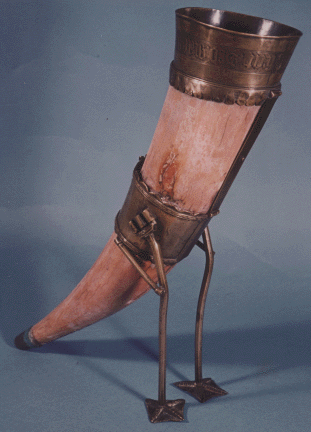
The Kavanagh Charter Horn
One of very few surviving objects known to have been the personal property of an Irish king, the Kavanagh Charter Horn is a ceremonial drinking horn of elephant ivory dating from the early 12th century, with brass mountings added in the 15th century. Owned by the MacMorrough Kavanagh Kings of Leinster for centuries, it remained in the possession of the Chiefs of the Borris line until its later donation to the National Museum of Ireland.
Photograph © The National Museum of Ireland. Used by permission.
|


The earliest references to Laigin (Leinster) relate to a people or confederation of dynasties which claimed common ancestry from Labraid Loingsech and his grandfather, Lóegaire Lorc. Some sources suggest that the name Laigin derives from 'láigen' ('a spear'). The dynasties descended from Labraid Loingsech were the Uí Garrchon, the Uí Máil, the Uí Failge, the Uí Bairrche, the Uí Dúnlainge, and the Uí Chennselaig (preserved in the modern name Kinsella), all of whom held the Kingship of Leinster at one time or another from the 5th century onward. The Uí Chennselaig eventually were to enjoy a preferential right to the succession by the end of the pre-Norman period, and their descendants, the Clan Kavanagh, continued to struggle against English rule into the early 16th century. As late as the 6th century, the territory occupied by the Laigin (the cóiced Laigen, or "fifth" of Leinster), included all of southeastern Ireland, extending to the Shannon and the Boyne, but later pressure from the Uí Néill in the north and the Eóghanachta in the west caused the area of their effective rule to contract. The Uí Chennselaig are descended from Énna Cennselach, and the earliest written records of the dynasty date from the early 6th century. Different septs within the extended dynasty alternated in the Kingship of Uí Chennselaig, and contended with other groups for the kingship of all of Leinster. The most important early Chief of the Uí Chennselaig was Brandub mac Echach (+605), whose center of power was Ráith Bile (Rathvilly, Co. Carlow). Brandub is depicted as a successful warrior, defending Leinster against the attacks of the Northern Uí Néill, and is the king-hero of the Leinster saga Bóruma Laigen (The Cattle Tribute of the Leinstermen). Between the mid-8th to the 11th centuries, the Uí Chennselaig were excluded from the provincial kingship by the Uí Dúnlainge of northern Leinster. However, under Diarmait mac Máel na mBó, who ascended the throne of Leinster in 1042, the dynasty returned to the kingship and held it (even in the face of much internecine warfare) until the late 12th century, with the death of Diarmait Mac Murchada (+1171). It has often been suggested that Diarmait Mac Murchada (Dermot MacMurrough) earned the sobriquet "Diarmait na nGall" (Dermot of the Foreigners) from the fact that he entered a military alliance with, and gave his daughter Aífe in marriage to, Richard de Clare (Strongbow), but it is more probable that the cognomen refers to the fact that he asserted control over the Hiberno-Norse kingdom of Dublin. Despite his negative posthumous reputation as the catalyst for Norman rule in Ireland, Diarmait was roundly praised by contemporary accounts as a great patron of church reform, having endowed the Cistercian abbey of Baltinglass. This act moved St. Bernard of Clairvaux to write a letter of commendation to Diarmait. On the death of Diarmait Mac Murchada, Strongbow recognized his nephew Murtough as King of Uí Chennselaig, and the descendants of this sept (MacMurchadha, or MacMorrough) claimed the kingship of Leinster from the 13th century onward. Their most successful Chief, Art Caomhánach Mac Murchadha, or "Art Kavanagh MacMurrough" (+1416/7), succeeded in resisting Richard II of England, and in creating a relatively secure territory in Wexford and Carlow, from which he and his successors were able to menace the English Pale and extract regular "black rents," until late in the 16th century. The later descendants of the Chiefly line adopted the name Caomhánach (Kavanagh), after Art Caomhánach Mac Murchadha, who symbolized the Gaelic recovery of the late 14th century by reviving the title "King of Leinster." Until the mid-20th century, the Chiefship was held by the MacMorrough Kavanagh family of Borris, Co. Carlow. The male line of descent from this family ended in 1953 with the death of Art MacMorrough Kavanagh of Borris, Chief of the Name, at which time the Chiefship devolved upon the Ballyhale line of the family. The present Chief is William Butler Kavanagh, The MacMorrough Kavanagh, Prince of Leinster, who succeeded his father (also William Butler Kavanagh) in 1962. He resides in Wales, as does his duly appointed Tánaiste, Simon MacMorrough Kavanagh.
Sources The Oxford Companion to Irish History, S.J. Connolly, ed. Oxford: Oxford University Press, 1998 (s.v. "Laigin," "Uí Chennselaig," and "MacMurrough"). The MacMillan Atlas of Irish History, Seán Duffy, ed. New York: MacMillan / Arcadia Editions, 1997.  Return to the Royal House of Leinster. |