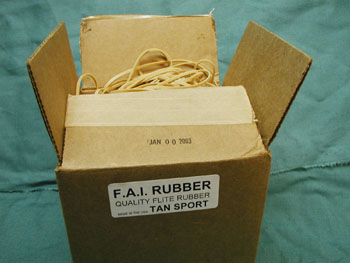
Rubber
| A large part of getting the best performance from your Delta Dart is understanding the rubber motor that powers the plane. The most popular rubber for model was known as "Tan II". But new rubber is either Tan Sport or Tan Super Sport. Rubber can be natural or synthetic or a combination of both, Tan II is a combination of both. Natural rubber is most commonly obtained from a certain tree found in South America or Asia. |
|
For more information on rubber, check out the following links: Rubber Links
Choosing the Correct Size for Replacement Rubber
The rubber that comes with the Delta Dart, is much too short for good duration. This rubber is good if you must wind your plane by hand as there is not so much slack in the rubber.
Rule of Thumb for Sizing the Rubber Motor
Length should be about 1 1/2 times the length from prop hook to rear hook. Measuring my Delta Dart showed a distance of 6 3/4 inches.
Calculation: 6.75" x 1.5" = 10.125"
As this is a loop of rubber, cut a loop at least 22 inches long to allow extra for tying a square knot.
How Does the Rubber Motor Work (in terms of energy transfer)?
When you crank the winder, mechanical energy is converted to potential energy stored in the rubber. To be more precise, this is elastic potential energy. Harcourts Dictionary defines elastic potential energy as "the energy made available for use by the return of an elastic body to its original configuration."
Potential energy of the wound rubber is converted to
kinetic energy of the spinning propeller.
Harcourts Dictionary defines kinetic energy as "the energy inherent in the motion of a
body"
Rubber has a property known as "elasticity", it will return to normal configuration. Winding the rubber motor stretches the rubber and because it has elasticity it will turn the propeller as it unwinds. With continued stretching the rubber does not contract as much, the rubber becomes thinner and longer over continued winding. If the rubber is wound to near maximum turns flight after flight, performance of the rubber will suffer. Not using the rubber for a period of time will allow it to recover some of the lost performance. Modern rubber is better in this respect than the rubber available 20 years ago.
When the rubber unwinds, there will be much more power available in the first few seconds than during the rest of the motor run. This is known as the "power burst" and can make trimming of a rubber powered model somewhat tricky.
Winders
|
|
|
|
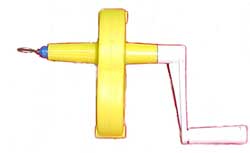
15:1 Winder |
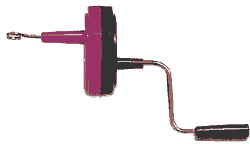
5:1 Winder |
Although it is possible to wind the rubber motor by turning the propeller with your index finger clockwise, it is much more efficient to use a device known as a "winder". The winder has a crank that turns gears, this turns the rubber motor faster than you turn the hand crank. Rubber is stretched so that it becomes thinner and more turns can be cranked into the rubber.
Winders are commercially available in ratios of 5:1 or 15:1, the 15:1 winder is quicker, but 5:1 winders are generally less expensive,
Stretch Winding
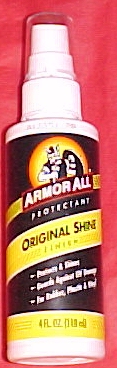
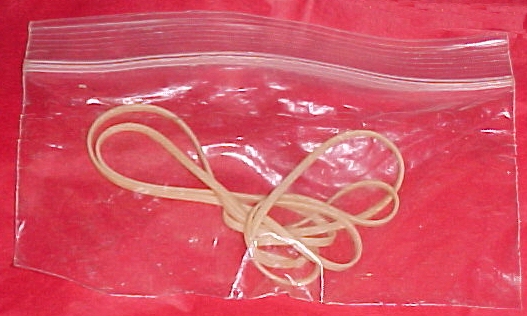
To get maximum turns in rubber, the rubber is stretched to a length of 3 to 4 times the un-stretched length. To extend the life of the rubber and for smoother unwinding, the rubber should be lubricated before winding. Many things have been tried but silicone based rubber protectant such as Armorall or Son of a Gun are easy to find and use. The rubber motor is placed in a plastic bag and then the rubber protectant is sprayed in the bag, the rubber is worked inside the bag.
|
|
|
| Armoral rubber protectant available in automotive stores. | Place rubber re-sealable bag and spray lubricant inside. Work the rubber around. |
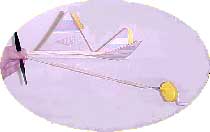
To wind rubber in plane, have
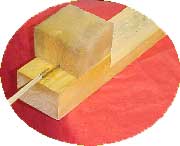
Rubber can be wound outside of plane
helper hold propeller firmly.
and transferred to plane without a helper.
The rubber can be wound in the plane by having a helper hold the prop and removing the rubber from the rear hook and attaching it to the winder. Or the rubber can be taken off the plane and wound, then transferred back to the plane fully wound.
Calculating How Many Turns Can be Wound in the Rubber Motor
The number of turns that can be wound in a rubber motor is proportional to the width of the rubber, Smaller rubber more turns, larger rubber, fewer turns. Charts have been created relating the width of rubber to the maximum number of turns per inch. Multiplying by the length of the rubber motor, the total turns that can be wound into the motor can be found. For sport flying it is better to wind to less than 100% of maximum turns, as the rubber will not loose power as quickly.
For example: maximum turns per inch for 3/32" rubber is 129, for our rubber motor 10" long, maximum turns would be 1290. For sport flying 80% would result in 1032 turns.
129 x 10 = 1290 1290 x .8 = 1032
Can you do the math for 1/8" rubber, Turns Per Inch is 97?
Calculating Winder Turns
Once we know the total turns, it is easy to calculate the total cranks of the winder needed. Simply divide the total turns by the ratio of the winder.
For example using the 5:1: 1032 / 5 = 206.4, truncating to a whole number would be 206 winder turns.
Can you do the math for a 15:1 winder?
Winding the Rubber
Stretch the rubber to 3 to 4 times the relaxed length with the winder. Begin winding, counting ever turn of the winder handle. When half the total turns have been wound in, slowly begin moving the winder closer to the other end of the rubber motor. With practice you will get a feel for when the rubber is close to maximum turns because the rubber will feel very tight.
Transferring the Rubber
Motor Wound in Plane
When you have finished winding, grab the rubber 1/4 inch from the end, let go of the winder so there is a very small amount of the rubber that is unwound at the very end. Now carefully place this small loop over the rear hook on the motor stick. With a lubbed rubber motor you will have to grip the rubber very tightly with thumb and fore finger.
Motor Wound Outside of Plane
If you have you have wound the rubber on a hook away from the plane; gently slide the rubber off the hook first and transfer it to the prop hook on the plane. It will be necessary to allow a small amount of rubber to unwind first to get a loop that will slide on to the prop hook.
Important!
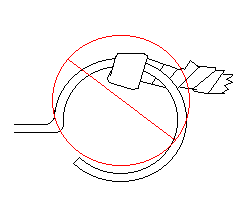
You want the rubber to unwind as smoothly as possible. The rubber needs to be centered in the middle of the prop hook. If not, there is a better chance that motor will bind when unwinding, causing the prop to stop. Check this out and push the rubber to the center of the prop hook if necessary. It is also a good idea to make sure the turns in the rubber motor have knotted evenly, if not work the rubber motor with your fingers until it is.
Braiding the Rubber Motor
 |
 |
|
Braided single loop rubber motor |
Un-braided motor hangs loose |
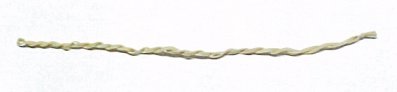
It is possible to braid a single loop rubber motor, this allows a longer rubber motor and less slack at the end of the motor run. With less slack, there is less of a problem with a changing Center of Gravity and the plane will glide better.
Fasten one end of the length of rubber and put in several twists in the rubber. Now tie the rubber and the two lengths of the rubber loop will twist together.