Introduction
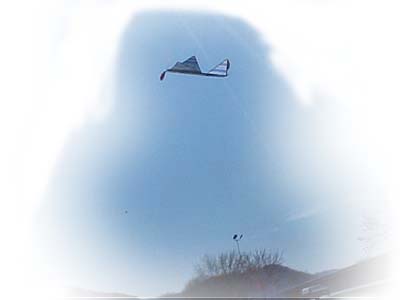
In the twenty-plus years as a model aviation enthusiast of almost every type of model airplane, the last couple of years I have realized how important simple rubber-powered airplanes such as the Delta Dart are in the hobby. Not only to promote the hobby of model aviation, but to facilitate other learning as well. Bill Kuhl
|
|
|
What purpose does this model serve?
Delta Dart or AMA Cub; (basically the same plane, see Delta Dart / AMA Cub History for an explanation of the name) has introduced more people to model aviation than any other model plane. Although criticized by some modelers, it has many desirable features for a first model plane:
Why I have created the web page?
Why building, flying, and adjusting a simple model such as the Delta Dart serves a purpose beyond trying to introduce kids to model aviation?
What can be done after building and flying model such as the Delta Dart?
Importance of Model Aviation - September 14, 1983
| An excerpt from the 124-page report of the National Science Board Commission on Pre-college Education in Mathematics, Science, and Technology includes 10 separate chapters and five exhibits. |
|
Informal Education A great deal of education takes place outside the classroom. The most fortunate students receive experiences in museums, clubs, and independent activities. All children are strongly conditioned and motivated by their early experiences and impressions. The child who has regularly visited zoos, plantaria, and science museums, hiked along nature trails, and built model airplanes and telescopes is infinitely better prepared for, and more receptive to, the mathematics and science of the classroom.
|
And here is what a couple of modelers commented to that:
I owe as much, if not more, to my uncle who introduced me to model airplanes when I was a kid 30+ years ago than I do to any of my university professors in helping me to become the knowledgeable structural engineer that I am today.
Thanks Uncle Tom.
Cliff
I know what you mean Cliff. I had an uncle who gave me a model airplane kit at Christmas time when I was maybe 9 years old. I thought it was a very big deal. This same uncle later gave me his old Boy Scout Manual. That uncle probably had a bigger influence on my life and the way I turned out than anyone else, even my parents.
Ed
Brief History of Model Aviation
The first rubber-powered model plane can be credited to the
French aviation enthusiast, Alphonse Penaud. Initially he experimented with
rubber-powered model helicopters but later turned to building model planes
powered by rubber. The Wright brothers were first exposed to flight by the toy
helicopter their father gave them based on the helicopter developed by Penaud.
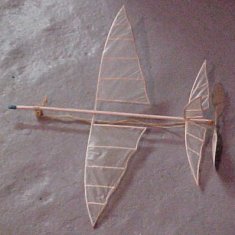
Penaud’s model plane the “Planophore”, made a public appearance in Paris in 1871, flying 131 feet. His model incorporated dihedral and a negative angle in the stabilizer for longitudinal stability. The Wright’s credited Alphonse Penaud as one of their most influential predecessors. It can be seen that model airplanes contributed to the success of full-size aircraft. Modern Copy of Planophore
The First Aeromodeling Clubs
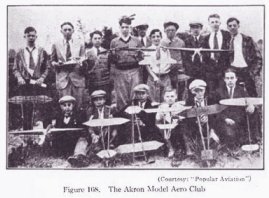
The first model airplane clubs started in the New York City
area as early as 1907. Balsa wood was
not used in model planes until around 1911, so models were constructed of
materials such as bamboo, pine, and spruce. 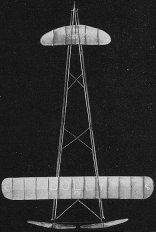
Most models were twin pushers, two motor sticks with a prop in the rear of each, coming together in front. Viewed from the top it looked like a capital letter “A”. The propellers turned in opposing directions to cancel the effects of torque.
Twin Pusher picture
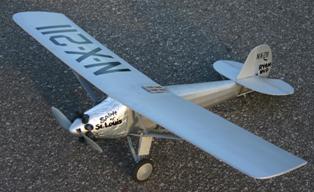
Video
Clip of my Electric RC Model Flying - 2.16 mb .mpg
The Influence of Charles Lindbergh on Aeromodeling
Charles Lindbergh’s historic flight from New York to Paris in 1927 was the driving force to skyrocket the popularity of aeromodeling. Before Lindbergh’s flight only around a dozen model airplane kit manufacturers existed and within a year of the flight there were over two thousand.
Model Airplanes Used for Advertising
Many large businesses (oil companies, automobile manufactures, and newspapers) took notice of the popularity of aeromodeling and decided to use this in their advertising campaigns. They sponsored contests, created model designs, and created fictitious characters to promote the model airplanes.
City Sponsored Model Airplane Clubs
In the 1930’s, even city government promoted model aviation by sponsoring contest and clubs. Detroit Department of Recreation sponsored twenty-two clubs, and even sold modeling supplies. School gyms were open one night a week for indoor flying.
Popularity of Model Airplanes Shows Sign of Decline
Even though there were extremely large model contests in the early 1950’s, there were also signs that model aviation was not as popular with the masses as it once was. The Mirror Meet in New York was one very large contest held in 1950. One thousand contestants and two hundred thousand spectators; prizes that were just as impressive, even a full-size airplane! Yet by 1953, the Plymouth Motor Corporation ended sponsorship of their once popular model airplane contests.
Science Olympiad
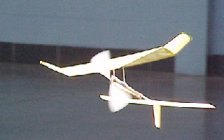 Sorcerer
SO Plane
Sorcerer
SO Plane
Today, the largest number of young people are exposed to free flight model airplanes by an event that is part of a competition held in many middle and high schools known as “Science Olympiad”. The model airplane event is now known as, “The Wright Stuff”. Planes must be built according to specifications that limit the size and minimum weight of the airplane. Competitions are held at regional and national levels, with the top times equaling what a very skillful indoor modeler might accomplish.
History of the Delta Dart and AMA Cub
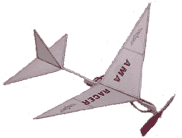
The Delta Dart appeared in the April 1967 issue of American Modeler. Designed by AMA's Technical Director, Frank Ehling but Dick and Ruth Meyer did much of the early promotion of the plane and received a Distinguished Service Award from the AMA. With materials donated by Sig, they made up 300 kits on their kitchen table, some of which were taken by Frank Ehling to the 1966 Nats. Although some people thought the plane too simple and heavy, kids found it easy to build and fly. It was thought with the pointy wing tips, warps would have less effect because most of the wing area was closer to the center of the wing.
Sig decided to sell the same basic plane as a kit called the "AMA Racer". The biggest change in the AMA Racer from the original Delta Dart, is that the wing is moveable, so Center of Gravity adjustments are easy. Another change is that the tail boom is made from spruce instead of balsa. Frank Ehling designed another plane known as the "AMA Cub", but is sold by Midwest as the Delta Dart. According to the Sig Catalog, this is the plane that has been used in beginner's promotions since 1968 and is the most produced model airplane of all time.
Not a rubber-powered free flight, but another Frank Ehling designed beginner's promotion plane, was the Delta Dart II AMAzer. Featured in the July 1981 Model Aviation magazine, the Delta Dart II AMAzer could be flown first as a whip-powered plane, and later converted to a .049 glow engine powered control line plane. Midwest Products Company produced the Delta Dart II AMAzer kits for a time.
Neil Dennis informed me that Model Builder magazine featured a "Baby Dart" by Fred Reese. Also there was a Russian version known as the "Delta Dartnik", no joke, I saw the plans!
Ending on a sad note, Frank Ehling died on August 21, 2001 at 86. He had been the technical director for the Academy of Model Aeronautics from 1960 to 1982. He was inducted into the AMA's Model Aviation Hall of Fame in 1977.
Although the original Delta Dart or present day AMA Racer might possibly be a slightly better flyer, the AMA Cub design has design features that make it a better beginner’s plane. The one-piece motor stick comes with the correct stabilizer incidence built in, contrasted to the two-piece motor stick with tail boom on the AMA Racer. Besides being fragile, it is easy to not have the proper incidence in the tail, resulting in a plane that either dives or stalls. The joints used at the tips of the wing, stab, and vertical fin can be less than perfect and still be adequately strong because the covering material reinforces the joint.
With the exception of the motor stick, the AMA Cub is made entirely out of 1/16 x 1/8” balsa strip. Some beginner’s models such as the Peck ROG utilize 1/16” square balsa, which although lighter, is difficult for the beginner to handle without breaking, and the structure will more easily warp.
Comments Received on the AMA Cub / Delta Dart Web Site
Way to go...Bill,
Although I haven't read it completely...Your AMA website looks fantastic. Looks like it might do the trick to help youth understand what we are doing in aeromodeling, if they take the time to read and follow their inspiration. Nothing seem to work effectively as hands-on programs. This website may introduce more young modelers that we can physically handle. A great resource for them.
Thanks for your efforts. Did you do the entire website yourself? We'll share your link with members of our modeling community. Great job.
Bill:
Just a note to let you know how impressed everyone I know who's seen your cub web page is with the work you have done. I've communicated to a number of people and who are AMA members and all who've seen it think you've done a great job.
I can't find my book mark to that great DD site. Could someone post it please. I have a cub scout leader interested in it as a project.
Thanks,
Charlie
Hey Bill,
The Delta Dart site is looking great. BTW, thanks for the billing (you know I blush easy).