Aerodynamics
The study of aerodynamics can be very complicated, but a basic understanding of a few aerodynamic principles are needed to adjust the Delta Dart for good flight performance. Descriptions given here have been simplified, as such might not be completely accurate.
Information Covered:
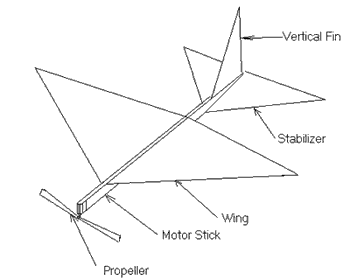
To understand a discussion of how to trim your Delta Dart for flight, an understanding of the components of the plane and their functions is needed.
Note: AMA Cub plan refers stabilizer as the tail and the vertical fin as the rudder.
Propeller - produces the thrust to pull the model forward.
Motor Stick - this could also called the "fuselage" on models with a full-width body. On simple models such as the Delta Dart it is a balsa stick that joins the propeller, wing, vertical fin, and stabilizer at the proper angles and distances apart.
Wing - the major lifting surface of an airplane
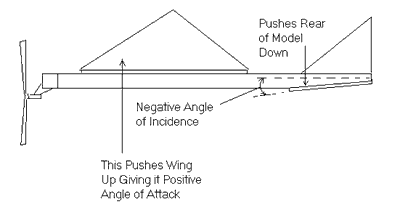
Stabilizer - keeps the model flying stable in the pitch axis (up and down). On the Delta Dart negative incidence pushes down on the rear the model causing the wing to fly through the air with a positive angle of attack.
The Function of the Stabilizer
Vertical Fin - the purpose of the vertical fin is partly to give directional control and keep the fuselage aligned with the airflow, and partly to counterbalance the side area that results from dihedral. If the fin is too small the model will show a coupled rolling, yawing flight path, known as 'Dutch Roll'. If its too big, it will overpower the dihedral and cause a spiral dive.
|
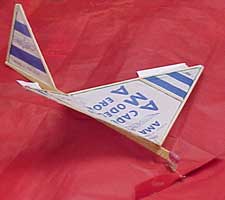
It is possible to create a plane without a stabilizer but other methods of keeping the plane stable in pitch must be used. Wing covering is underneath balsa structure. The idea was submitted to Model Aviation by Dick Baxter. |
 |
Forces on a Flying Model
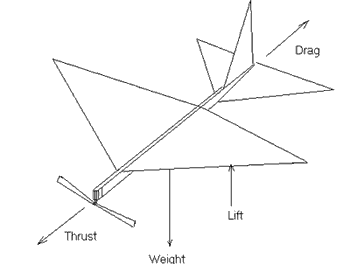
Drag - is the force that opposes thrust. There are different types of drag but it basically there is the drag caused by creating lift and the drag caused by pushing the other parts of the plane through the air. If your plane is trimmed to fly against warps, the extra drag will decrease performance.
Lift - opposes the gravitational pull of the weight of the plane. The Delta Dart has no real airfoil, but flies because the angle of attack of the wing pushes air downward. On small planes the lack of a curved airfoil does not reduce performance as much as it would on a larger aircraft.
Weight - the force that opposes lift, caused by gravitational attraction. Reducing weight as much as possible will improve performance greatly.
Thrust - is produced by the turning propeller which is really a wing that rotates pulling forward. The faster the propeller turns, the greater the thrust produced. With a rubber powered model, the faster the propeller turns, the quicker the limited turns in the rubber motor will be used up.
Planes like the Delta Dart are what is known as a "free flight" model, their flight path is determined by the adjustments made to the model. Such a model must have "stability". Webster's dictionary defines stability as the resistance to sudden change , dislodgment, or overthrow. In a free flight model such as the Delta Dart, the model should return to level flight should the model hit a beam near the ceiling or a gust of wind outside. This is done by using "dihedral" and the function of the stabilizer on the model.
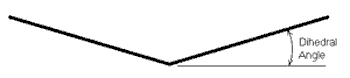
Dihedral - The wing halves are tilted upward to give the model stability. This helps prevent the wing from slipping or sliding into the turn.
Variations From Level Flight
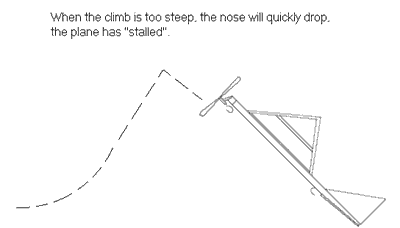
Stall – when the climb is too steep for the available power, the nose of the plane will quickly drop, this is known as a “stall”. As the plane dives and picks up speed, most likely it will pull up from the dive and climb again until the plane stalls again. If your plane is stalling, the total flight time will suffer. With enough power, your plane would do a loop instead of stalling, although it might be fun to watch, would also decrease the flight time.
Mpeg video 1.6 mb of AMA Cub stalling several times.

Dive - flight path is at a downward angle, with the center of gravity too far forward, the plane will not recover from dive.
Proper Launch Technique – hold the propeller with one hand and the motor stick. Release propeller first and launch the plane immediately afterwards. Do Not throw too hard, many beginners have this problem. Even with a perfectly trimmed airplane, launching the plane with too much speed, can put it into a stall right from the start. Flying outdoors with any amount of breeze, can make the situation worse.
As the incidence in the tail is set, the primary adjustment for climb is by changing the "Center of Gravity" or "CG". The CG is the point on the plane where it balances from front to rear. This means adding clay to the front of the plane for too much climb or to the rear for not enough climb. Adding clay means adding extra weight. For this reason, it is important to glue the wing on as close to balanced as possible to start with.
Should the model dive to the ground, weight will have to be added to the tail. If the climb is too steep, weight should be added to the nose.
Adjusting the Turning Radius – tightening the radius of the circle will reduce the steepness of the climb, when the circle is small enough, your plane will be doing a spiral dive to the ground. There will be situations indoors when you need to get the plane into a smaller circle to avoid walls. By tightening up the circle slightly, the plane might be cured of the climbing excessively without having to add weight to the plane.
Turning your Delta Dart can be accomplished by twisting the plastic prop hangar as shown in the directions or by adding a rudder trim tab. A rudder trim tab is glued to the rear of the vertical fin, construction paper will work. Looking at the plane from the rear, bend the tab to right for right turn and left for left turn.