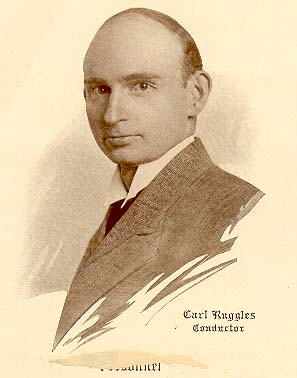
Carl Ruggles
Winona, MN, is a small community on the Mississippi River in the Southeast corner of Minnesota. It is located on the great river and sits between two sets of imposing bluffs which average 600 feet in height. It was (and is) a wealthy little community and it is easy to see how Ruggles was attracted to it.
Shortly after Ruggles began as a student at Harvard, he decided music was more important than education and in January, 1907, moved to Winona, Minnesota. He was hired to teach violin there at a music school which had only a catalog as its main asset. He is credited with having founded a Y.M.C.A. orchestra which evolved into the Winona Symphony which has functioned almost continuously since that time.
Just previous to his move to the Midwest, he met Charlotte Snell, a well-known singer, and was moved by her flawless performance at a recital in New York. She subsequently followed him to Winona and they were married on April 27, 1908. In that same year she appeared as a soloist with the Minneapolis Symphony Orchestra. Charlotte became a very important influence in Ruggles's life and it was she who suggested the poetic titles to many of his works.
It was also during these Winona years that Ruggles came under the influence of a violinist from Minneapolis-St. Paul named Christian Timner. He credits Timner with teaching him a great deal about orchestras and conducting.
While in Winona, Ruggles began work on an opera, "The Sunken Bell", which was based on Charles Henry Meltzer's translation of Hauptmann's Die versunkene Glocke. In 1917, Charlotte returned to Winona after their usual summer in the East where Ruggles himself remained, presumably to finish the opera. According to Briggs (1958) a portion of the work was submitted to the Metropolitan Opera, accepted, and then destroyed by Ruggles before it was completed. Ruggles's only explanation for destroying the opera was that one day he had come across Hauptmann's original work and found the translation so ugly he simply destroyed what he had done.
Carl Ruggles A Selected Bibliography
Atkin's Museum of Fine Art

     Kansas City, MO

     [Print of Benton's "The Sun Treader"]
Benton, Thomas Hart
"The Sun Treader" (portrait)
Musical Digest XXVII (July, 1946)Bohm, Jerome D.
New York Herald Tribune
Feb 13, 1951, 17.Briggs, John
"Crusty Composer"
New York Times, Oct. 12, 1958, sec. 2, p. 11.Chase, Gilbert
America's Music. Rev. 2nd ed.
New York: McGraw-Hill, 1966Chicago Art Institute Scrapbook
70:127-128
Mar. 1937 - Nov. 1937Cohn, Arthur
"Now, that other American giant - Carl Ruggles."
Am. Rec. G, XXXII (March, 1966), 588-90.Cowell, Henry
"American Composers on American Music"
Palo Alto, CA: Stanford University Press, 1933.Cowell, Henry
"Carl Ruggles". Carmelite, Carmel, CA. Aug. 1930Cowell, Henry
"Organum. First Performance."
Mus. Quarterly, XXXVI (April, 1950), 272-4.Cowell, Henry
"3 Native Composers: Ives, Ruggles, Harris.".
New Freeman, I (May 3, 1930), 184-86.Diether, J.
"Composers' Showcase"
Mus. Am. 81:52, May 1961.Edmunds, J. & Boelzner, G.
"Some Twentieth Century American Composers: a Selective
Bibliography." NY Public Library Bulletin, LXIII (April, 1959), 421-22.Edwards, Arthur C. & Marrocco, W. Thom.
Music in the United States.
Dubuque, IA: Wm. C. Brown, 1968.Ellsworth, R.
"Americans on Microgroove"
High Fidelity, VI (Aug., 1956), 63.Ewen, David
American Composers Today
Wilson, 1949, 208-9.Ewen, David
World of 20th C. Music.
Engelwood Cliffs: Prentice-Hall, 1968.Goldman, R. F.
"Current Chronicle: New York"
Musical Quarterly, XXXVII (Oct., 1951), 578-79.Harrison, Lou
"Carl Ruggles".
The Score, XII, (June, 1955), 15-26.Harrison, Lou
"Evocations".
The Score, XII, (June, 1955), 19-24.Harrison, Lou
"Ruggles, Ives, Varese".
View, V No. 4 (Nov. 1945), 11.Howard, John Tasker
Our American Music. 3rd Ed.
rev. Crowell 1946, 398-9.Kirkpatrick, John
"The Evolution of Carl Ruggles (A Chronicle Largely in His Own Words)".
Perspectives of New Music, VI (Nov. 2, 1968), 142-66.Lopatnikoff, Nikolai
"America in Berlin".
Modern Music, IX No. 2 (Jan-Feb 1932), 91.Perle, George
"Atonality and the Twelve-note System in the U.S.".
Score, XXVII (Jul 1960), 55-8.Peterson, Thomas Elliot
"The Music of Carl Ruggles".
Unpublished PhD Dissertation, U. of Washington, 1967.
Dissertation Abstracts 28:1839A-40ARepass, R.
"American Composers of Today".
London Mus. VIII:24, (Dec. 1953).Rudhyar, Dane
"Carl Ruggles and the Future of Dissonant Counterpoint".
Christian Science Monitor, Dec. 23, 1922, 22.Saecker, Janice
"Carl Ruggles in Winona."
Unpublished graduate paper, Winona State University, 1967.Salzman, Eric
"Carl Ruggles."
Hi Fi Stereo Review, XVII (Sept, 1966), 53-63.Seeger, Charles
"Carl Ruggles."
Musical Quarterly, XVIII (Oct, 1932), 578-92.Seeger, Charles
"Charles Ives and Carl Ruggles."
Mag. Art, XXXII (July, 1939), 396-99.Upton, Wm. Treat
"Aspects of the Modern Art-Song."
Musical Quarterly, XXIV (Jan, 1938), 20-22.Ziffrin, M.J.
"'Angels' - two views."
Mus. Review, XXIX, (Nov. 3, 1968), 184-96.

Works by Carl Ruggles
ANGELS (for muted brass)
EVOCATIONS - Four Chants for Piano
MEN AND MOUNTAINS (orchestra) 1924
1. Men - rhapsodic proclamation
2. Lilacs - 7-part string orchestra
3. Marching Mountains
ORGANUM (orchestra) 1944-47
PORTALS (string orchestra) 1926
THE SUNKEN BELL (opera) 1912-23
Libretto by C. H. Meltzer - incomplete - destroyed except for sketches
SUN TREADER (orchestra) 1931
TOYS (voice and piano) 1919
VOX CLAMANS IN DESERTO (voice and orchestra)